

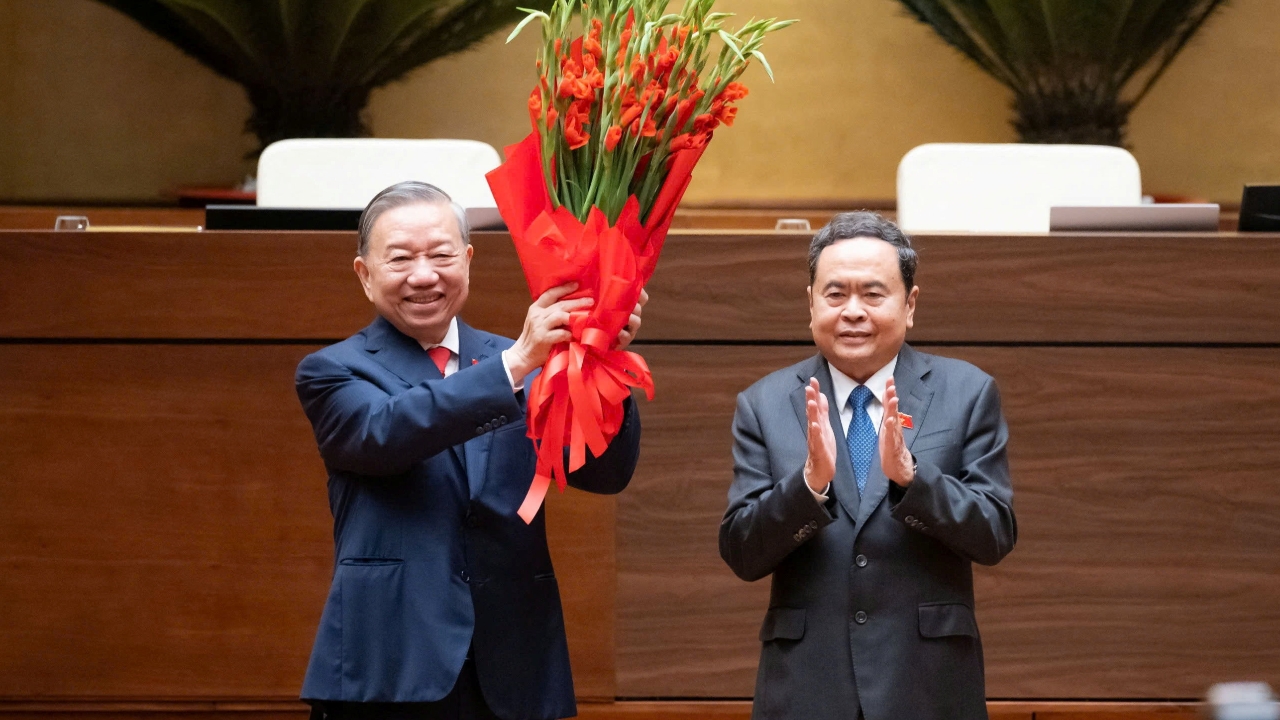
Vietnam's National Assembly unanimously voted to appoint "To Lam" as president while he also serves as General Secretary of the Communist Party. This marks the end of the "collective leadership" era and the full transition to a "supreme leader" model. He announced a major economic reform plan targeting 10% annual growth amid challenges from U.S. tariff barriers and the global energy crisis. Tags: [Vietnam National Assembly, To Lam, Communist Party, Economic Reform, Tariff Barriers, Energy Crisis, Political Leadership]
Vietnam's National Assembly approved with 100% support the appointment of 68-year-old To Lam as president of the Socialist Republic of Vietnam for the 2026–2031 term. This historic consolidation of power means To Lam will hold both the General Secretary of the Communist Party and the presidency, a leadership style similar to China's President Xi Jinping. Tags: [To Lam, Vietnam Presidency, Communist Party, Political Consolidation, Xi Jinping, China]
Le Hong Hiep, an expert from Singapore's ISEAS institute, commented that this represents a major shift in Vietnam—from a collective decision-making model toward a "strong leader" system, effectively establishing a true supreme leader of the country.Tags: [Le Hong Hiep, ISEAS, Vietnam Politics, Leadership Transition, Strong Leader, Supreme Leader]
To Lam rose to power following the death of former party leader Nguyen Phu Trong in 2024 and swiftly enacted changes. In under two years, he accelerated state restructuring by merging provinces, dissolving eight ministries and state agencies, and cutting nearly 150,000 civil service positions to eliminate bureaucratic delays and centralize decision-making authority.Tags: [To Lam, Nguyen Phu Trong, State Restructuring, Bureaucratic Reform, Vietnam Government, Civil Service Reduction]
To Lam aims to drive economic growth at 10% annually over the next five years through policies supporting the private sector and large infrastructure projects. In 2025, Vietnam's economy grew by 8% despite facing a 20% tariff imposed by the U.S. government.Tags: [Economic Growth, To Lam, Private Sector, Infrastructure, U.S. Tariffs, Vietnam Economy]
However, To Lam's government faces significant challenges, including pressure from the U.S. attempting to block the rerouting of Chinese exports through Vietnam, and the impact of Middle East conflicts driving oil prices up. This could cause regional energy shortages and complicate balancing relations between the U.S., Vietnam's main export market, and China, its largest raw material supplier.Tags: [U.S. Pressure, China Trade, Middle East Conflict, Energy Prices, Vietnam Foreign Relations, Trade Balance]
In a parliamentary statement, To Lam emphasized, "Nations that dare to undertake strategic reforms, timely institutional improvements, and harness their people's potential will rise as leaders and develop sustainably."Tags: [To Lam, Strategic Reform, Institutional Improvement, Sustainable Development, Vietnam Leadership]
To Lam is the first leader in modern Vietnamese history to hold the two highest offices through the party's normal selection process, rather than by succeeding a suddenly deceased predecessor. This reflects his current absolute and decisive authority.Tags: [To Lam, Vietnamese Leadership, Political Authority, Party Selection, Modern History]
Source: AFPTags: [AFP, News Source]