

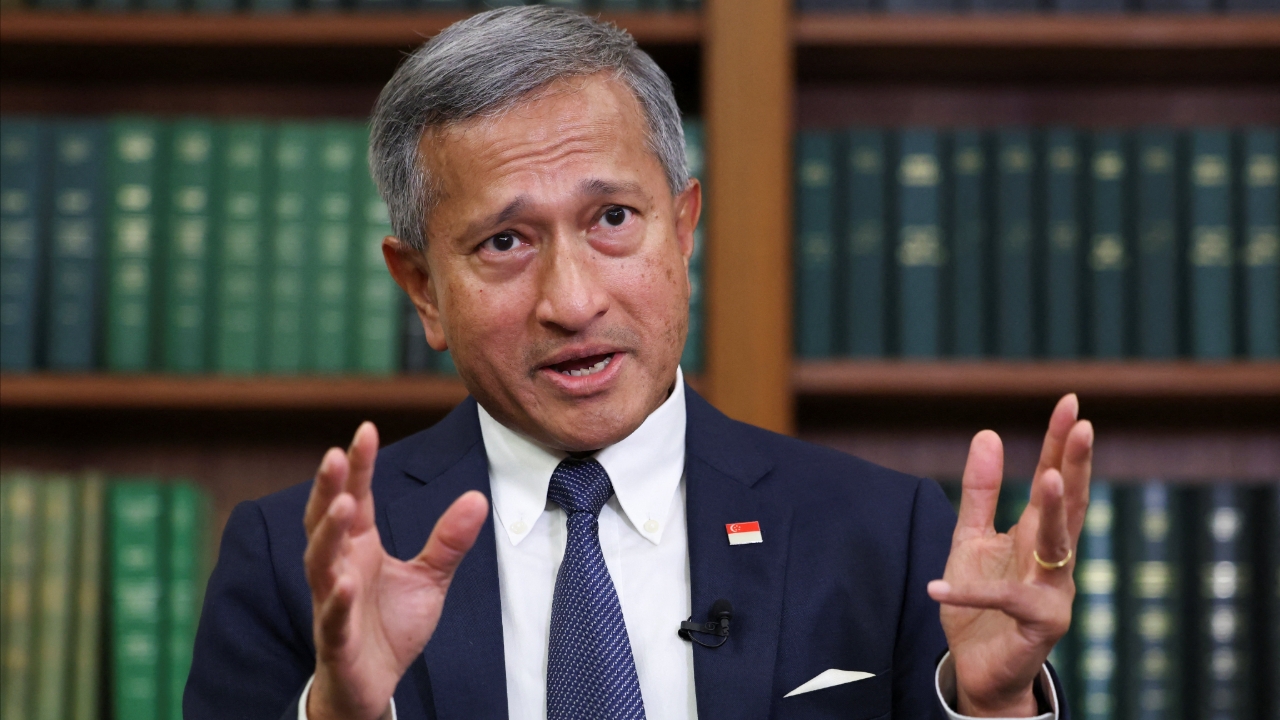
Singapore's foreign minister declared that the country will not negotiate with Iran about paying transit fees to allow cargo ships safe passage through the Strait of Hormuz, emphasizing that passage through this strait is a legal "right," not a "privilege" granted to any country.
On 7 Apr 2026 GMT+7, Dr. Vivian Balakrishnan, Singapore's Minister for Foreign Affairs, stated in Parliament that Singapore will not negotiate with Iran to seek rights for safe passage through the Strait of Hormuz, as such behavior would undermine fundamental principles of international law.
Dr. Balakrishnan responded to a question from Mr. Faadli Fawzi, a Member of Parliament (Workers' Party - Aljunied GRC), who asked whether Singapore should negotiate with Iran or consider paying transit fees for its vessels. Dr. Balakrishnan emphasized that passage through such waterways is a "right," not a "privilege."
"There is a right of transit passage," he said. "It is not a privilege requiring coastal states' approval, nor is it a permit to be begged for, and certainly not a toll to be paid."
He also stressed that the Strait of Hormuz, like the Malacca and Singapore Straits, is an international shipping route. This right is enshrined in the United Nations Convention on the Law of the Sea (UNCLOS), to which Singapore is a party.
Dr. Balakrishnan added that this principle applies even to states that have not ratified UNCLOS, noting that non-participation does not grant those countries a "free pass."
Previously, Iran stated it had permitted ships from several countries to transit the Strait of Hormuz after its forces had blocked passage, disrupting global oil supplies since the conflict began on 28 Feb 2026. Most of these countries are Asian states, including China, India, Pakistan, Japan, Thailand, and Malaysia.
Dr. Balakrishnan described Singapore's stance as principled rather than geopolitical.
"You might wonder why I use such a strict legal definition—not because I am obsessed with legalities, but because the Malacca and Singapore Straits are also strategically critical points," he said.
He pointed out that the volume of oil transported by sea—both crude and refined—through the Malacca and Singapore Straits exceeds that passing through the Strait of Hormuz. Additionally, in terms of global container trade, shipping through this region also surpasses that of the Strait of Hormuz.
He added that while the narrowest point of the Strait of Hormuz is 21 nautical miles wide, the narrowest section of the Singapore Strait is less than 2 nautical miles wide.
"Now you understand why we must clearly assert that international law and UNCLOS are the constitution of the oceans," Dr. Balakrishnan said. "Freedom of navigation is a right, not a privilege for ships and aircraft, and this is of utmost importance to Singapore."
He concluded that he had previously discussed with Iran's foreign minister before the current conflict and expected to speak again but drew a clear line that there would be no negotiations over transit fees.
"On principle, and not because we take sides, I cannot engage in negotiations for safe passage or toll fees for ships because doing so would implicitly erode this legal principle," he said. "This is another example of Singapore standing firm on principles without choosing sides."
Follow international news:https://www.thairath.co.th/news/foreign
Source:cna