

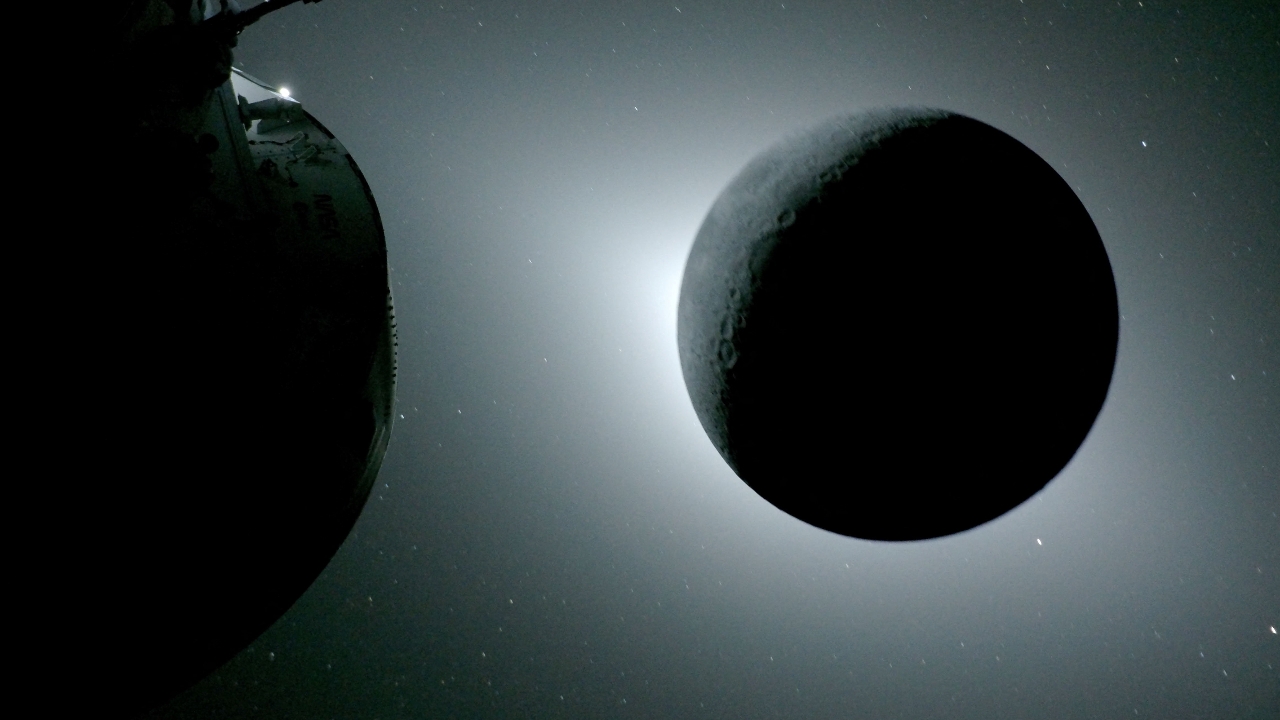
The Artemis 2 astronauts made history by sending back the first high-resolution images of the moon to Earth, revealing terrain never before seen by the human eye, along with valuable scientific data, ahead of their scheduled return and splashdown off California's coast this Friday.
The United States National Aeronautics and Space Administration (NASA) has released the first photos from the Artemis 2 mission, captured by astronauts during a historic flyby of the moon on 6 April. These images were transmitted back to Earth on 7 April, revealing stunning details of the lunar surface from angles never previously witnessed by humans.
The images were taken by four astronauts: Reid Wiseman, Victor Glover, Christina Koch from NASA, and Jeremy Hansen from the Canadian Space Agency (CSA), using high-quality cameras that captured thousands of shots over the seven-hour passage around the "far side of the moon."
What excited scientists most was the photograph of a "solar eclipse" phenomenon taken from space, clearly showing the sun’s corona. Additionally, there are images capturing "Earthset and Earthrise," as well as photographs of craters, ancient lava flows, and surface fissures that illustrate the moon's geological evolution.
Dr. Nikki Fox, NASA’s Assistant Director for Science Mission Directorate, stated, "These images are rich in scientific value and will inspire future generations." The crew also reported six sightings of flashes caused by small meteorite impacts on the moon’s dark side. This data will be analyzed alongside observations from amateur astronomers worldwide to accurately pinpoint impact locations.
Currently, the Orion spacecraft is more than halfway through its return journey, with a planned splashdown in the Pacific Ocean off San Diego, California, on Friday, 10 April at approximately 20:07 Eastern U.S. Time (which corresponds to 07:07 on Saturday, 11 April Thai time). NASA will broadcast the return and recovery operations live on NASA+ and YouTube starting at 05:30 Thai time Saturday, with NASA and Department of Defense personnel awaiting the astronauts’ transfer to the USS John P. Murtha recovery ship.
The Artemis 2 mission marks a pivotal moment in the golden era of space exploration, establishing a sustainable foundation for lunar settlement that will serve as a stepping stone toward sending humans to Mars in the future.
.sourceNASA