

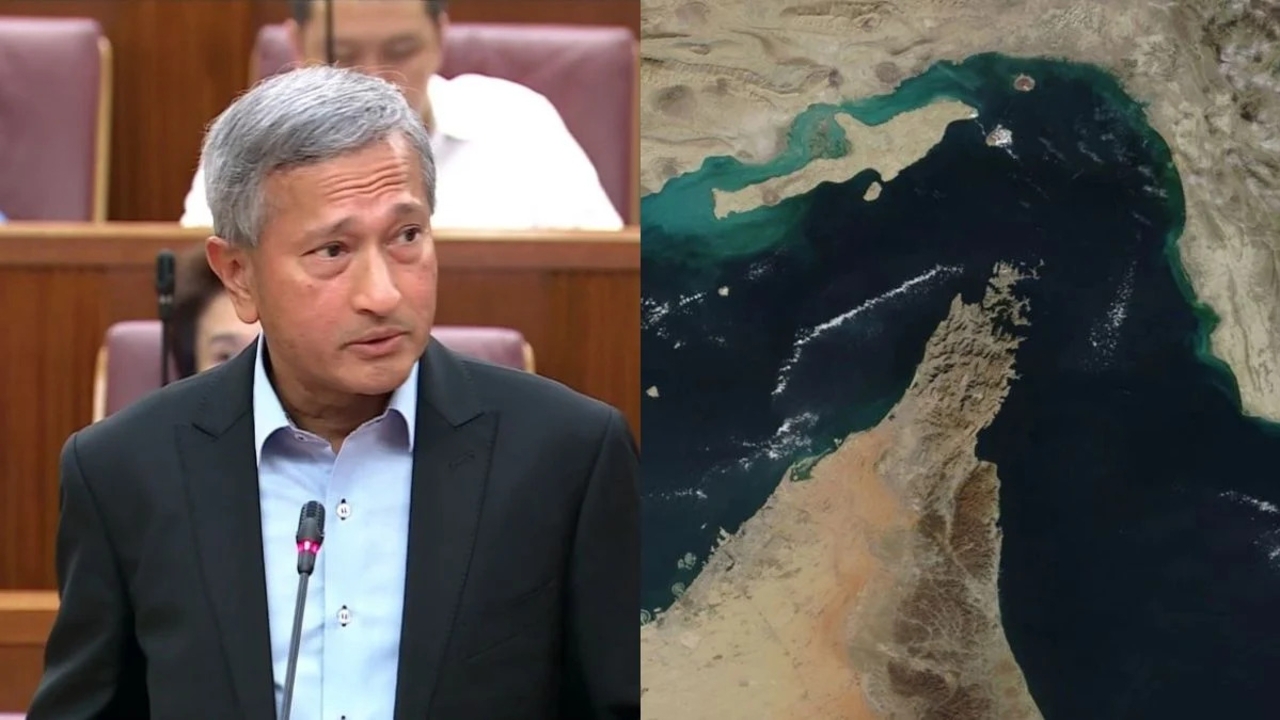
Dr. Vivian Balakrishnan, Singapore's Foreign Minister, declared the country's position rejecting any negotiations or payments to Iran in exchange for navigation through the Strait of Hormuz, emphasizing this as a "right" under the law, not a "privilege" that coastal states can grant or charge for at will. He stressed the need to uphold international legal norms to protect Singapore's future interests in the Malacca Strait and surrounding waters.
Dr. Vivian Balakrishnan made the statement to Parliament on Tuesday, 7 April 2024 GMT+7, affirming that Singapore will not engage in talks with Iran to seek "safe passage" or consider paying transit fees for Singapore-flagged vessels in the Strait of Hormuz amid rising tensions.
Dr. Vivian emphasized that navigation through international waterways is a "right" under law, not a "privilege" for coastal states to grant or charge for arbitrarily. He cited the United Nations Convention on the Law of the Sea (UNCLOS), known as the "Constitution of the Oceans," which all countries must abide by.
The Singapore Foreign Minister explained that agreeing to negotiate for passage rights in the Strait of Hormuz would set a dangerous precedent and undermine international law principles, potentially backfiring on Singapore itself. He noted that the volume and value of crude oil and container cargo passing through the Malacca Strait and Singapore far exceed those of the Strait of Hormuz, while the narrowest point of the Strait of Hormuz is 21 nautical miles wide compared to less than 2 nautical miles for the Singapore Strait.
He said that if Singapore accepts tolls or permits in other waters, it would lose the ability to claim freedom of navigation in its own adjacent waters in the future.
"This is not about taking political sides but strictly adhering to legal principles, because if any region is engulfed in conflict and missiles are fired, no matter how prosperous and secure we are as an oasis, we will inevitably be affected," he stated.
Previously, Iranian authorities said they had allowed vessels from certain countries, including China, India, Pakistan, Japan, Thailand, and Malaysia, to pass through the Strait of Hormuz after maritime traffic was heavily restricted due to war conditions since late February. However, Dr. Vivian confirmed that although he has discussed with Iran's Foreign Minister before, there will be no negotiation over passage rights.
Currently, the Maritime and Port Authority of Singapore (MPA) is closely monitoring the situation and coordinating with Singapore-flagged vessel operators in the area, while consulting with the International Maritime Organization (IMO) on establishing an internationally recognized "safe navigation corridor" to ensure crew safety and global trade stability.
Meanwhile, the Singapore government has warned citizens and businesses to prepare for increasingly volatile and severe global economic conditions, the price the world pays amid expanding warfare.
/SourceCNA