

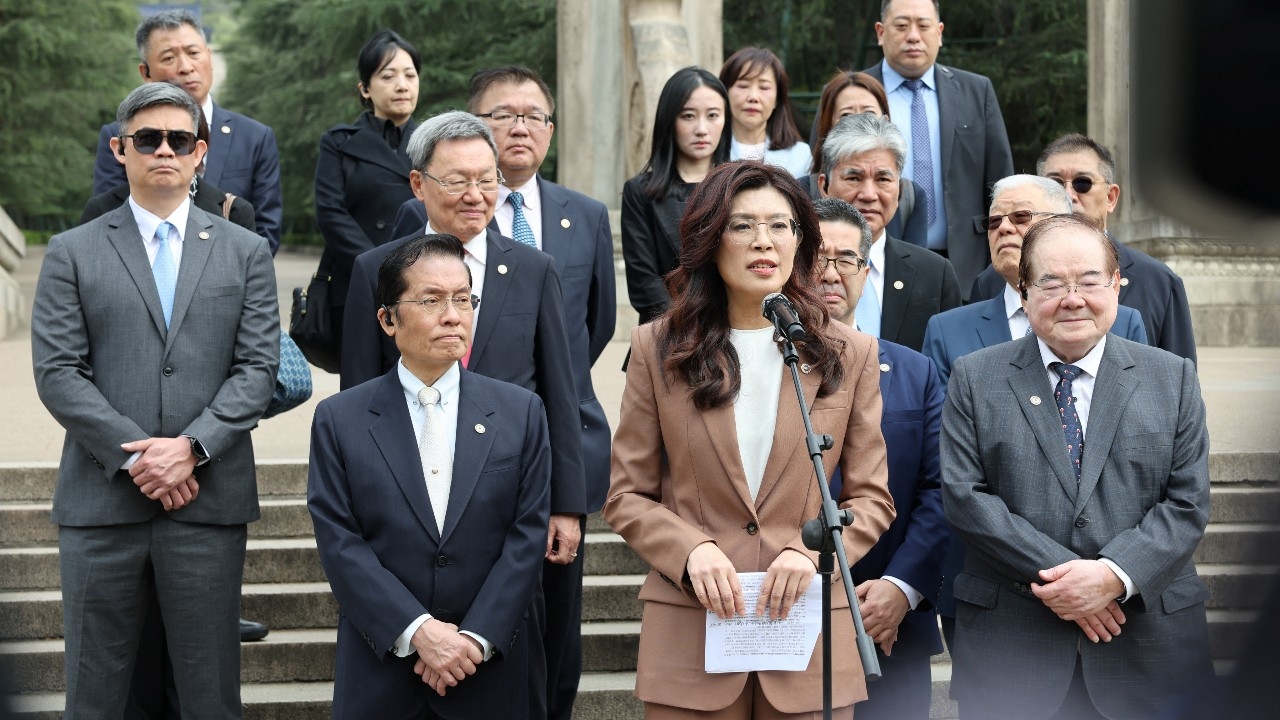
The chairman of Taiwan's Kuomintang (KMT) opposition party traveled to Shanghai, emphasizing a mission of peace aimed at reducing tensions in the Taiwan Strait. She invoked a warning to leaders on both sides: "The sky should have birds, not missiles," while the Chinese military continues to send warplanes and warships close to Taiwan.
Ms. Zheng Liwen, chairwoman of Taiwan's largest opposition party, the Kuomintang, issued a cautionary message during her visit to mainland China, stating that the sky should be a space of nature and peace, not a zone for warfare.
At a press conference at Yangshan Port in Shanghai, Ms. Zheng warned, "The sky should be for birds to fly, not for missiles, and the waters should be for fish to swim, not for warships." She also quoted the World War I English poem "In Flanders Fields" to emphasize that if peace cannot be maintained, the spirits of fallen ancestors cannot rest peacefully.
Ms. Zheng described this trip to China as a "mission of peace" intended to ease tensions amid China's continuing military pressure on Taiwan. She is scheduled to visit Beijing next and may have the opportunity to meet with Chinese President Xi Jinping.
However, Taiwan's government under President Lai Ching-te has urged Ms. Zheng to use this opportunity to tell China to stop its military intimidation, stressing that China should negotiate directly with a democratically elected government rather than through the opposition party.
Despite the opposition leader's presence on the mainland, China continues military operations near Taiwan. Taiwan's Ministry of National Defense reported that in the past 24 hours, six Chinese warplanes and eight warships were detected operating around Taiwan.
Meanwhile, Ms. Michelle Lin, a legislator from the ruling Democratic Progressive Party (DPP), criticized via Facebook, saying, "The facts prove that the threat from the Chinese military is escalating. Even two days after Ms. Zheng's arrival in China, the Chinese Communist Party still holds the 'knife to Taiwan's throat.'"
President Lai Ching-te remains firm in his stance, ready to negotiate with Chinese authorities under the principle that "Taiwan's future must be decided by the Taiwanese people alone," and he completely rejects China's sovereignty claims over Taiwan.
/sourceReuters