

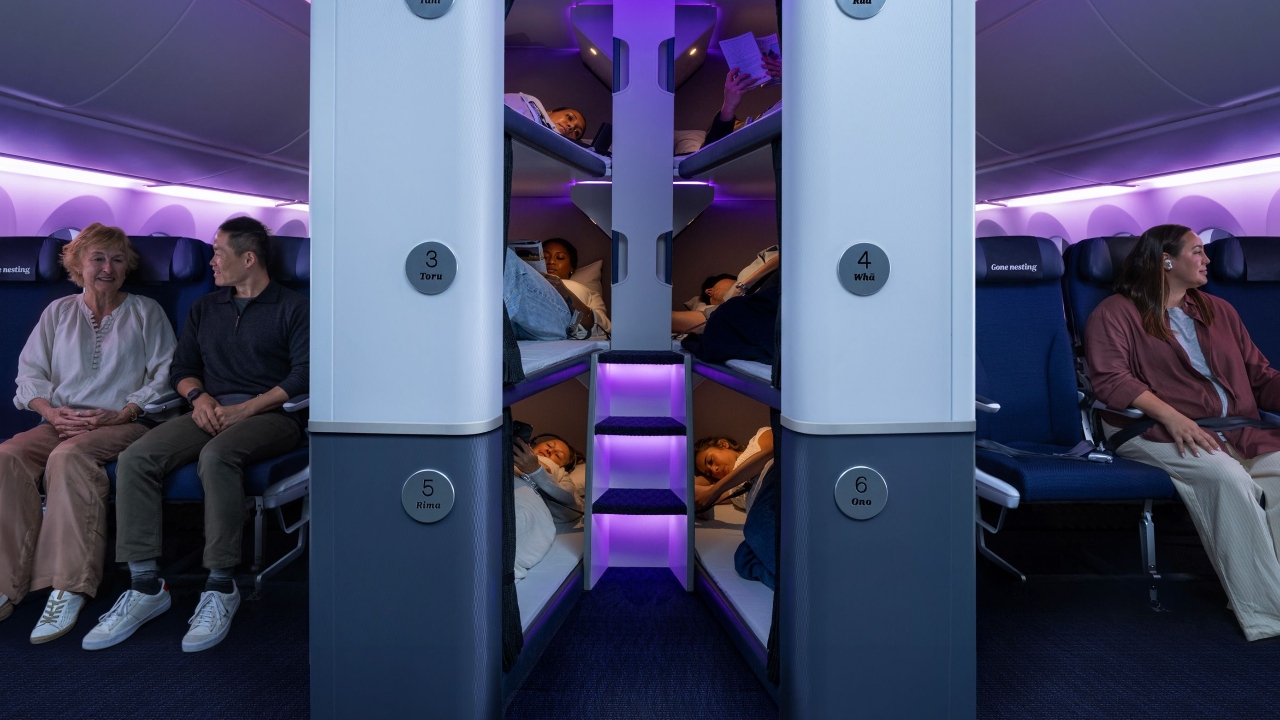
Air New Zealand has introduced "Skynest," a six-seat bunk bed sleeping pod for economy passengers on flights between Auckland and New York. Each passenger is limited to 4 hours per use and pays an additional fee of about 9,300 baht. Booking starts this May, with the selling point being true lie-flat rest even at an economy price, alongside strict rules banning children from sneaking in and prohibiting food inside the pod.
Air New Zealand announced a significant update regarding the "Skynest" service — a lie-flat sleeping pod, the world's first for economy and premium economy passengers. Booking opens on 18 May for special long-haul flights between Auckland and New York, with actual service scheduled to begin in late 2026.
Skynest will be installed on Boeing 787-9 Dreamliner aircraft, with six pods per plane. Passengers must still purchase a regular seat for the flight, which lasts over 17 hours, but can buy the additional service to access a pod for a 4-hour session at approximately 495 New Zealand dollars (about 9,354 baht) per session. Initially, booking is limited to one session per person per flight.
Each sleeping pod comes fully equipped, including fresh bedding replaced each time, privacy curtains, adjustable ambient lighting, and a relaxation kit containing an eye mask, skincare products, earplugs, and socks.
Each bed measures about 203 centimeters long, with a shoulder width of approximately 64 centimeters that tapers to about 41 centimeters at the foot end.
To ensure restful sleep, the airline has set rules such as no sharing a pod by two people, a strict ban on children sneaking into pods, no eating snacks inside, and a request to avoid strong perfumes. Because silence is statistically challenging, earplugs are provided to all passengers in case of snoring.
Nikheel Advani, Chief Executive Officer of Air New Zealand, stated that for a remote country like New Zealand, "travel is highly significant," and making passengers willing to endure long flights requires making onboard rest genuinely manageable and comfortable.
However, the aviation industry still faces many challenges, notably fluctuating fuel prices and impacts from conflicts in the Middle East. These have forced Air New Zealand to raise fares and reduce flights by about 4% recently to support the company's financial position.