

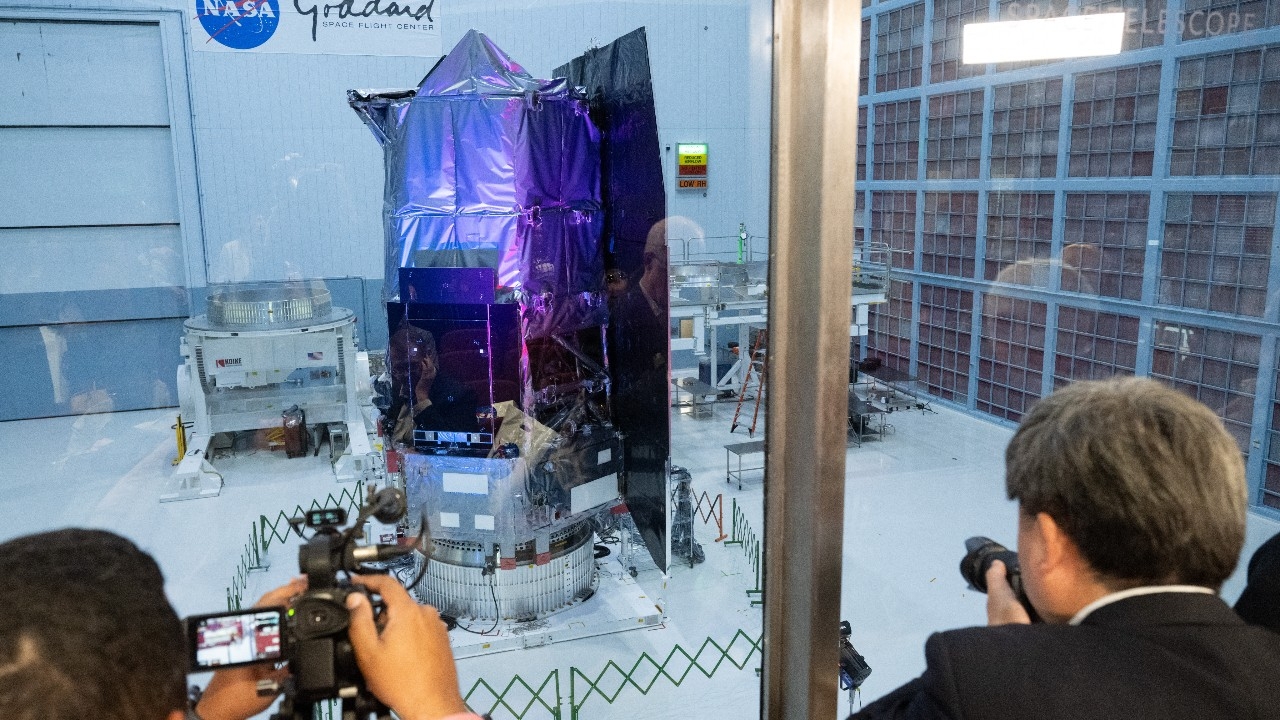
NASA has revealed its new "Nancy Grace Roman" space telescope, which is 100 times more powerful than the Hubble telescope. It is set to be launched into space to search for tens of thousands of exoplanets and explore the mysteries of dark matter, which makes up 95% of the universe.
The National Aeronautics and Space Administration (NASA) unveiled the "Nancy Grace Roman" space telescope at the Goddard Space Flight Center in Maryland. This telescope is designed to scan the sky with unprecedented wide and deep coverage to create what is called the "cosmic map book."
Jared Isaacman, a NASA executive, stated that this telescope will help answer some of the most fundamental questions in astronomy, such as how the universe evolves, the ultimate fate of the universe, and whether humanity is alone in the cosmos.
The Roman telescope is named after Nancy Grace Roman, a pioneering female astronomer known as the "Mother of the Hubble Space Telescope." Although this new telescope has the same 2.4-meter primary mirror size as Hubble, it incorporates far more advanced technology, offering a field of view at least 100 times wider than that of Hubble.
Additionally, it can transmit up to 11 terabytes of data back to Earth daily. In just one year, it will collect more data than Hubble has gathered over its entire 30-plus year lifetime. It can survey the sky 1,000 times faster than Hubble while maintaining comparable resolution and infrared sensitivity.

Nikki Fox, NASA's Assistant Director for Science Missions, revealed that "The Roman telescope will discover tens of thousands of new exoplanets, reveal billions of galaxies, thousands of supernovae, and tens of billions of stars."
Another key objective of the Roman telescope is to study "dark matter" and "dark energy," believed to constitute 95% of the unseen universe. Dark matter acts like glue holding galaxies together, while dark energy is the force driving the universe's accelerating expansion.
Equipped with a 300-megapixel infrared camera, the Roman telescope will detect light traveling from distant galaxies formed billions of years ago, enabling us to look back in time to study how cosmic structures formed.
The 12-meter-long telescope with large solar panels will be transported to Florida for launch aboard a SpaceX rocket, targeted for as early as September this year. It will be stationed at the L2 (Lagrange Point 2), approximately 1.5 million kilometers from Earth on the opposite side of the Sun, to keep instruments cool and shielded from sunlight, Earthlight, and moonlight interference.
Scientists believe data from the Roman telescope, working alongside the James Webb Space Telescope, will usher in a new era of astronomical discovery and may lead to Nobel Prize-worthy findings in the future.