

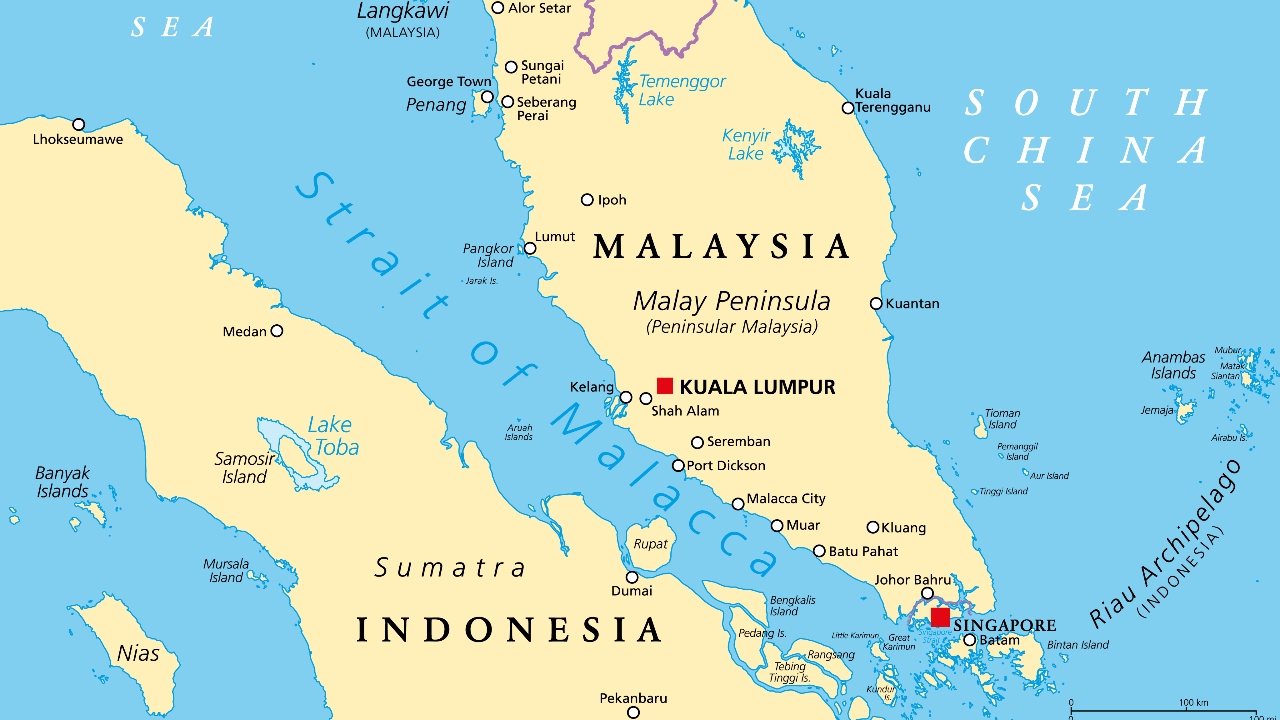
Indonesia's Finance Minister has proposed a concept to charge fees on cargo ships passing through the Malacca Strait, aiming to elevate the country from a "peripheral state" to a "key player" in the global economy. This follows Iran’s example with its plans in the Strait of Hormuz. Meanwhile, Singapore insists that navigation must remain a right of freedom, not a privilege subject to payment. .
Purbaya Yudhi Sadewa, Indonesia's Minister of Finance, has proposed charging fees on ships transiting the Malacca Strait, one of the world's most important shipping and energy transport routes, to maximize economic value from Indonesia’s strategic geographic position.
The proposal was raised during a seminar in Jakarta, where Purbaya stated that it aligns with President Prabowo Subianto’s policy to stop seeing Indonesia as merely a "peripheral state" and instead become a "key player" in the global economy. He noted, "Indonesia is located on a strategic route, yet ships pass through freely without charge, and I am not sure if that is appropriate."
The Finance Minister acknowledged that the idea was inspired by Iran’s plan to impose transit fees in the Strait of Hormuz amid the ongoing Middle East conflict lasting over eight weeks. He believes that if the three coastal countries—Indonesia, Malaysia, and Singapore—collaborate to collect fees, it could generate substantial revenue.
He said that although Indonesia controls most of the waters, it cannot unilaterally set policies because of cross-border interests. "Singapore is small, Malaysia is similar; maybe we could split it in two. If it were that simple, it would be easy, but it isn’t. So, with all the resources we have, we must not think defensively but begin to think more proactively, though carefully."
On the other hand, Vivian Balakrishnan, Singapore’s Minister for Foreign Affairs, continues to oppose the proposal, stating that the shipping routes in the Malacca Strait and Singapore "must remain open to everyone." He emphasized that Singapore will not support any efforts to restrict navigation or impose toll-like charges, saying, "The right of passage is guaranteed for all. We will not participate in any attempt to block, hinder, or charge fees in our waters."
Singapore stressed that the "right of transit passage" is protected under the United Nations Convention on the Law of the Sea (UNCLOS), recognized as a fundamental international right, not a privilege granted by coastal states or a license requiring payment.
Although the Indonesian government views this as merely an "initial concept," it acknowledges that actual implementation would be difficult since it requires joint approval from Malaysia and Singapore, who also share interests in the waters.
The proposal remains at a preliminary stage, with the Indonesian government needing to assess its impact on global trade and consult with involved countries before any future policy actions.
SourceCNA