

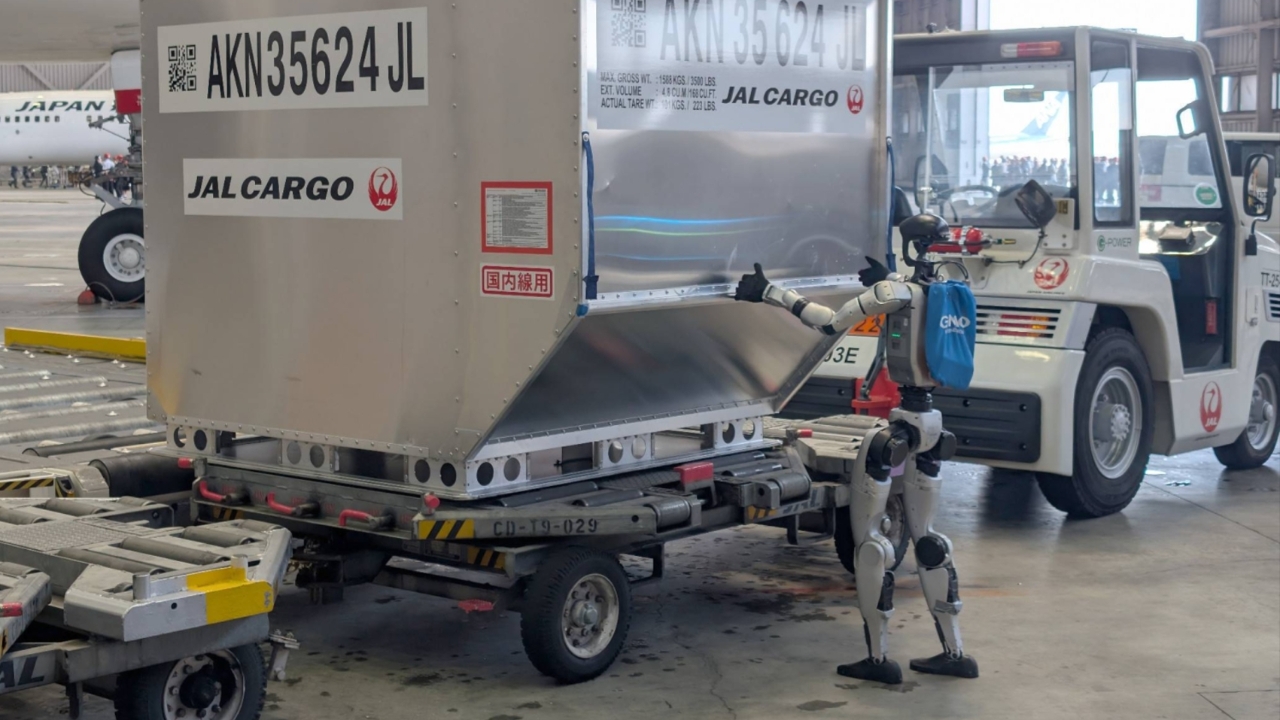
Japan Airlines plans to start testing humanoid robots to assist with transporting luggage and cargo at Haneda Airport in early May, aiming to reduce employee workload amid a tourism boom and an aging society.
Luggage handlers at Haneda Airport, known for their hard work but heavy burdens, are set to gain a new colleague: a "robot." Japan Airlines (JAL) announced plans to trial humanoid robots to address the country's chronic labor shortages.
This project is a collaboration between JAL and partners including GMO Internet Group. It will introduce humanoid robots made in China to assist with moving suitcases and cargo on the apron at Haneda Airport, which serves over 60 million passengers annually.
During a media demonstration last week, a 130-centimeter-tall robot produced by Unitree from Hangzhou showcased its ability to push cargo containers onto a conveyor belt next to a passenger plane and even waved to human workers. The trial is scheduled to run until 2028 before considering permanent installation.
Yoshiteru Suzuki, president of JAL Ground Service, told Kyodo News, "Using robots for physically demanding tasks will definitely reduce employee workload and bring great benefits to the organization." However, Suzuki emphasized that certain critical tasks, especially "safety management," will remain the responsibility of humans.
Tomohiro Uchida, president of GMO AI and Robotics, added, "Although airports appear highly automated, much of the behind-the-scenes work still relies heavily on human labor, which is currently facing a severe staffing shortage crisis."
Japan is currently facing two simultaneous challenges: a rapid increase in foreign tourists—over 7 million visitors in just the first two months of 2026—and a shrinking working-age population due to an aging society.
Projections indicate Japan may need over 6.5 million foreign workers by 2040 to achieve economic growth targets, yet the government faces political pressure to control immigration numbers.
These robots can operate continuously for about two to three hours per charge. Developers plan to expand their roles to other tasks in the future, aiming to build a sustainable airport management system despite human resource constraints.