

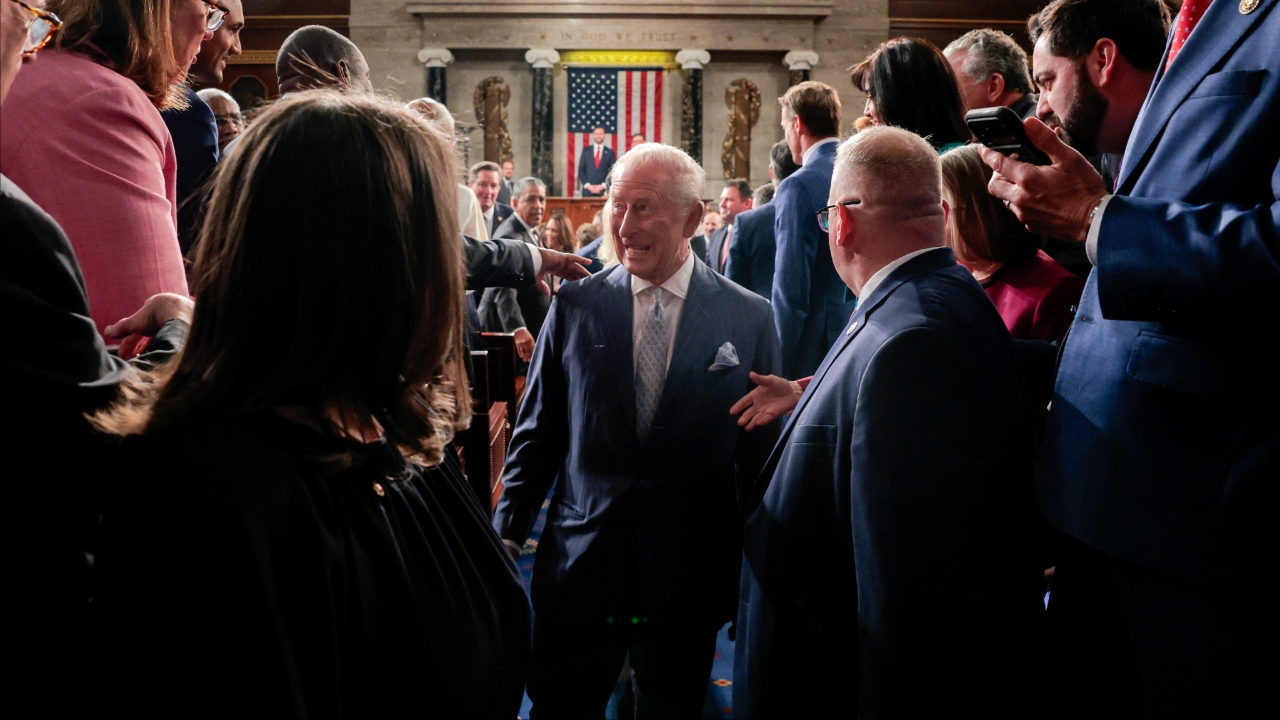
King Charles III of the United Kingdom delivered a speech to the U.S. Congress during his visit to Washington, D.C., emphasizing the relationship between the two countries but scarcely mentioning the Epstein case, which is heavily impacting the UK.
King Charles III's visit to the United States aimed to celebrate the 250th anniversary of the U.S., the longstanding bond between Britain and America, and their close relationship as "special allies." However, the visit was also viewed as a "mission to salvage the situation."
The current state of U.S.-UK relations is somewhat tense due to Britain's hesitation to fully support the joint U.S.-Israeli war against Iran. King Charles's goal was to ease these tensions, particularly through his joint address to Congress on Tuesday afternoon.
Nevertheless, there is some cause for hope since President Donald Trump is known for his unpredictable personality. Warm relations can quickly turn cold, but likewise, strained ties can be restored with presidential favor.
Despite the tension, the relationship has not broken down. Near the end of his speech, King Charles spoke of “reconciliation and new beginnings,” which he described as characteristic of the centuries-old interactions between the two countries. Trump responded positively, praising King Charles as “a wonderful person.”
However, parts of King Charles's speech may please Democrats while simultaneously surprising (and raising concerns within) the White House.
King Charles began his speech by referring to “a time of great uncertainty” that both the U.S. and the UK are currently experiencing.
He outlined conflicts in the Middle East and Europe that have recently caused friction between the two nations, also noting threats to democracy from political violence that disrupted the White House Correspondents' Dinner last Saturday night.
King Charles then shifted to the reality that the U.S. and UK do not always agree. “With the spirit of 1776 in our hearts... we might agree that we do not always see eye to eye.”
However, this was a prelude to his conclusion that when the two countries align, they can achieve great things “not only for the benefit of our own peoples but for all humanity.”
When King Charles mentioned the English legal tradition in the Magna Carta that “executive power must be subject to checks and balances,” he received thunderous applause and a standing ovation, but this applause carried an intriguing subtext.
The cheers began among Democratic members in the chamber and spread throughout. Critics of Donald Trump on the political left often condemn the president for what they see as abuse of power.
The belief that the president should be strictly checked and balanced is a driving force behind the nationwide "no kings" protests, which have drawn hundreds of thousands over the past year.
Later in the speech, a final statement from King Charles sparked murmurs—both agreement and concern—among Democrats.
“American words carry weight and meaning, as they have since the Declaration of Independence,” King Charles said. “But the actions of this great nation matter even more.”
Democrats frequently criticize Trump's words, communication style, and actions, often viewing the British monarch’s remarks as a subtle caution to the nation while offering liberals an opportunity to reaffirm their "no kings" stance.
King Charles cited former U.S. Secretary of State Henry Kissinger in discussing the Atlantic alliance, noting that the only time NATO has mobilized to defend a member state was after the Al-Qaeda attacks on the World Trade Center on 11 September 2001.
Previously, Trump had disparaged the British Navy, a long-standing source of UK pride, calling British warships "toys" and saying their aircraft carriers were "not really operational."
King Charles, who served in the British Navy for five years, specifically referenced his military service as a starting point to discuss the benefits of security and intelligence cooperation between the two countries, as well as between America and Europe.
He also took the opportunity to mention climate change, a topic he has long championed but which Trump has consistently rejected.
“From the depths of the Atlantic Ocean to the heartbreaking melting ice sheets in the Arctic, the commitment and expertise of the U.S. military and its allies are at the heart of NATO, pledging to defend each other, protect our citizens and interests, and secure North Americans and Europeans from common enemies.”
Beyond international politics, one major question about King Charles's visit was whether he would mention Jeffrey Epstein and the victims of the late sexual offender in his speech, which he did not.
The closest he came was an implied reference to the need to “support victims of certain social harms that sadly still exist in the societies of both countries today.”
From the American perspective, these words were considered “too mild.”
Last year, despite opposition from the Trump administration, Congress passed legislation requiring the release of U.S. government files related to the Epstein investigation.
These files have led to new revelations about Epstein's deep connections to wealthy and powerful figures, including Peter Mandelson, former British ambassador to the U.S., and Andrew Mountbatten-Windsor, or former Prince Andrew, King Charles’s brother.
So far, the Epstein saga has had a greater impact in the UK than in the U.S., where few current political figures have been negatively affected.
Although the topic was not raised in the speech, it has not disappeared from the news, and the full story from the U.S. side may not yet be fully revealed.
Considering King Charles's serious goals with high stakes for the U.S.-UK relationship, parts of his speech were surprisingly relaxed and lively.
He began with a quote from Oscar Wilde, often cited (and misquoted) about the U.S. and Britain being alike “except in their language.”
He also joked about the English tradition of Members of Parliament being held "hostage" (by custom) when the monarch delivers a speech at Westminster, wondering if anyone in the U.S. Congress would volunteer for that role today.
He further joked that the American Declaration of Independence was a “yesterday event” for a country with Britain’s long history and that he was not visiting to play the role of a “master planner” hoping to reclaim British rule.
Although tensions exist between the U.S. and UK, on Tuesday King Charles appeared to succeed in "melting the ice" and creating a more positive atmosphere.
Follow international news:https://www.thairath.co.th/news/foreign
Source:bbc