

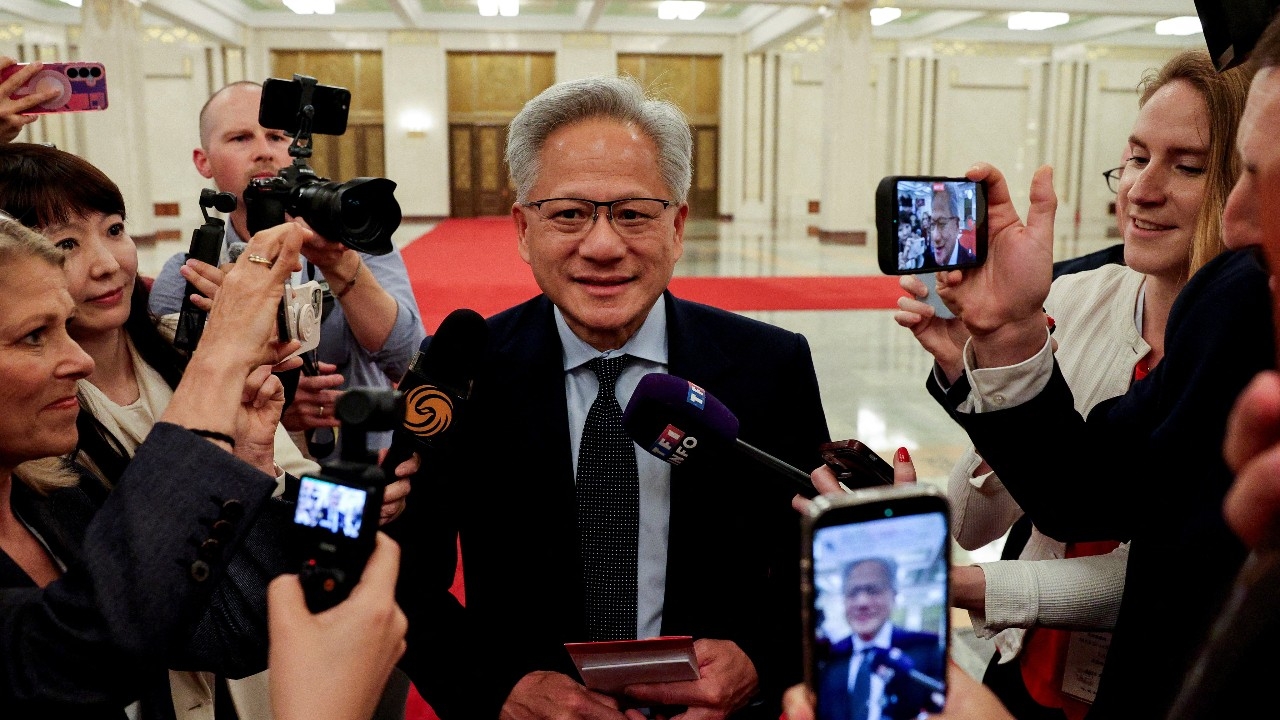
The U.S. Department of Commerce has approved 10 leading Chinese technology companies, including Alibaba and Tencent, to purchase NVIDIA's cutting-edge AI H200 chips. However, no shipments have been delivered yet. Meanwhile, NVIDIA CEO Jensen Huang traveled with President Donald Trump's delegation to China, hoping to unlock a long-stalled major deal.
Insiders revealed that the U.S. Department of Commerce has issued licenses allowing about 10 Chinese companies to order NVIDIA's H200 AI processing chips, which are the company's powerful second-tier AI chips below its top model.
However, despite official approval, no shipments have been made so far because the deals remain hindered by political issues and security restrictions imposed by both the U.S. and China.
The list of approved companies includes major Chinese tech giants such as Alibaba, Tencent, ByteDance, and JD.com, as well as distributors like Lenovo and Foxconn. Under U.S. conditions, each company can purchase up to 75,000 chips, either directly from NVIDIA or through authorized resellers.
This approval reflects the intensifying technology competition between the U.S. and China. Although the U.S. permits sales, security restrictions continue to severely limit actual trade progress.
Before the U.S. tightened export controls, NVIDIA held up to a 95% market share of advanced AI chips in China, which accounted for about 13% of the company’s total revenue. Jensen Huang previously estimated that China’s AI market alone would be worth around 50 billion U.S. dollars this year.
Sources indicated that although the U.S. approved the sales, Chinese companies have started to slow orders after receiving signals from their government to be cautious about dependence on foreign technology, especially in critical AI industries and digital infrastructure. At the same time, China is accelerating the development of domestic AI chips, with many Chinese firms increasingly using Huawei chips to reduce reliance on NVIDIA.
NVIDIA CEO Jensen Huang, who traveled with President Donald Trump during this visit to China, said he hopes the meeting between Trump and President Xi Jinping will improve bilateral relations and pave the way for further technology cooperation.
Reports noted that Trump invited Huang to join the flight from Alaska to Beijing for the U.S.-China leaders’ summit, raising expectations that it could help unlock the currently stalled AI chip deals.
However, U.S. export conditions remain strict. Chinese companies must prove that the chips will not be used for military purposes and must implement adequate security measures. Meanwhile, NVIDIA must confirm its U.S. inventory levels before exports.
Moreover, the Trump administration structured the deal so that the U.S. receives a 25% revenue share from chip sales, by requiring the chips to transit through U.S. territory before shipment to China. This has raised concerns in Beijing about security and the risk of technological backdoors.
Hardline groups in the U.S. criticized the Trump administration, arguing that allowing NVIDIA to sell chips to China could cause the U.S. to lose its AI advantage and help China catch up with American technology faster.
Chris McGwire, a researcher at the U.S. Council on Foreign Relations, said, "Every deal that allows NVIDIA to sell chips to China means fewer chips available for American companies and reduces the U.S.'s AI advantage over China."
. SourceReuters