

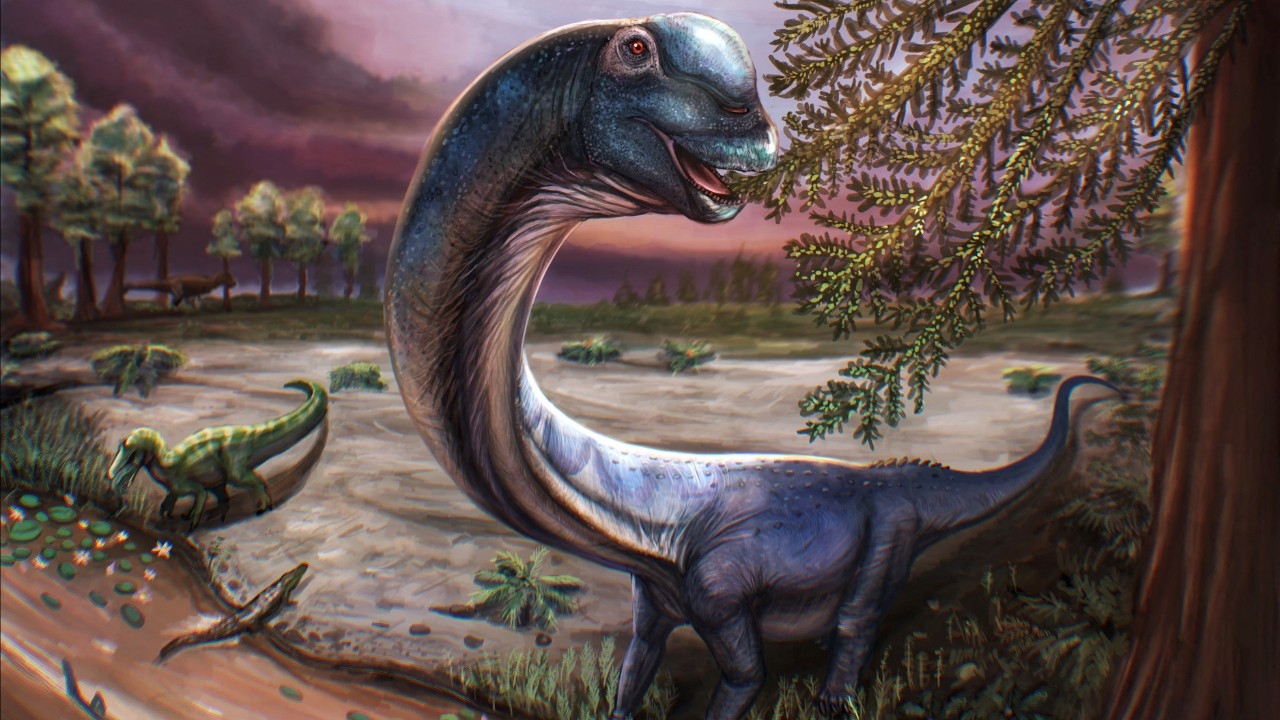
Scientists have confirmed that fossils found in Thailand about 10 years ago belong to a new species of giant long-necked dinosaur, named "Nagatitan chaiyaphumensis."
Foreign news agencies reported on 14 May 2026 that scientists have confirmed the discovery of a new giant dinosaur species from fossils found in Thailand, identifying it as twice the size of the Tyrannosaurus rex, or T. rex.
This dinosaur has been named "Nagatitan," the largest dinosaur ever found in Southeast Asia, weighing up to 27 tons—equivalent to nine fully grown Asian elephants—and measuring 27 meters in length. Nagatitan belongs to the Sauropod family, a group of long-necked herbivorous dinosaurs.
A research team from the United Kingdom and Thailand identified this dinosaur species from fossils discovered beside a pond in northeastern Thailand more than a decade ago. They stated that this finding helps explain how past climate changes enabled the development of enormous dinosaurs.

The full name of the dinosaur is Nagatitan chaiyaphumensis. "Naga" refers to the mythical serpent in Southeast Asian folklore, "Titan" references the powerful deities of Greek mythology, and "chaiyaphumensis" means "from Chaiyaphum," the province where the fossils were unearthed.
Analysis shows that Nagatitan lived approximately 100 to 120 million years ago, making it about 40 million years older and twice as large as the T. rex.
Thitiput Setthapanichsakul, a Thai doctoral student at University College London (UCL) and lead researcher of the study published in Scientific Reports, said researchers call Nagatitan Thailand's "last giant" because its fossils were found in rock layers containing the country's youngest known dinosaurs.
"The younger rock layers from the late dinosaur era likely contain no dinosaur remains because the region had become a shallow sea by then. Therefore, this could be the last or most recent large sauropod we will find in Southeast Asia," Thitiput explained.
Thitiput, who admits to being a lifelong "dinosaur enthusiast," said in a UCL press release that this study also helped "fulfill a childhood promise to name a dinosaur someday."
Nagatitan is the 14th dinosaur species to be named in Thailand. Dr. Sita Manitkul, a paleontologist from Mahasarakham University, said Thailand has a high diversity of dinosaur fossils and "may be the third most densely fossil-rich country in Asia."

Nagatitan roamed the Earth during a period when atmospheric carbon dioxide levels were rising, correlating with a global temperature increase at that time.
Professor Paul Upchurch from UCL, a co-researcher, told National Geographic that sauropods were extremely large during this period and "it is quite surprising that sauropods could cope with rising temperatures," since their large bodies retain heat and cool down less efficiently.
He also told Reuters that "it is possible that higher temperatures affected the vegetation that was the main food source for these giant herbivorous sauropods."
Follow international news:https://www.thairath.co.th/news/foreign
Source:bbc