

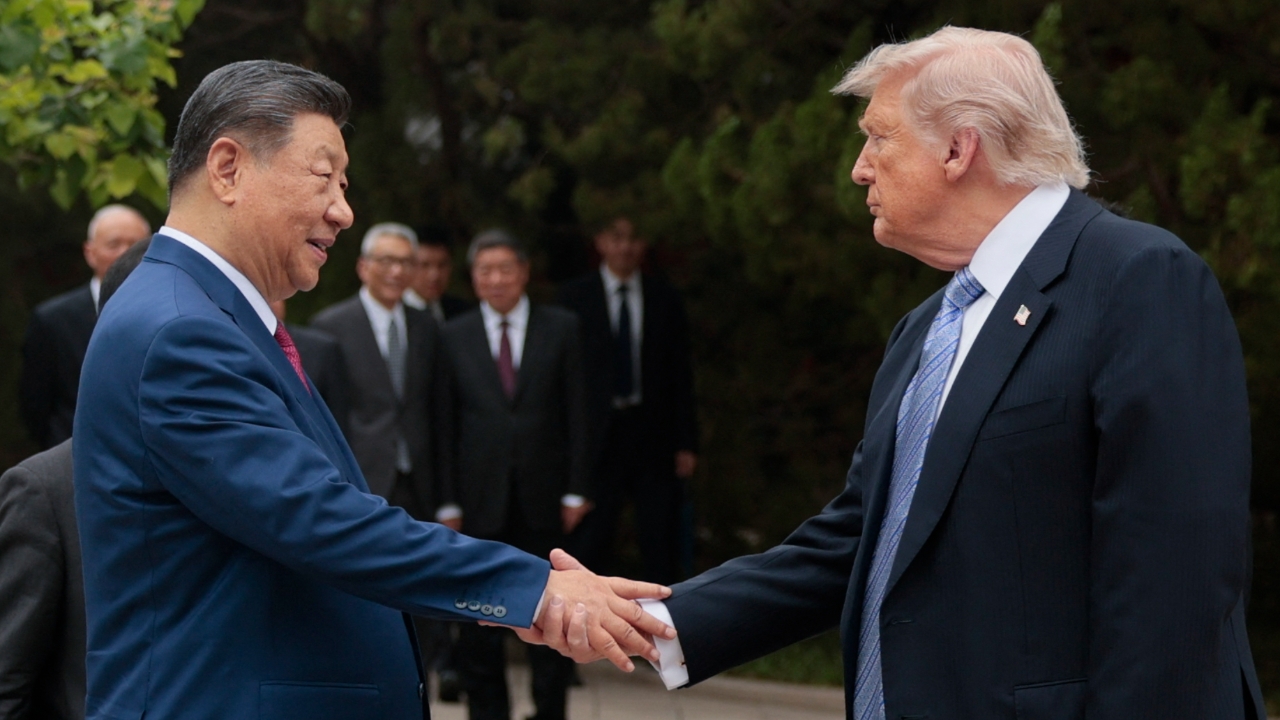
President Donald Trump completed his official visit to China amid an atmosphere full of praise and grand ceremonies, but disappointed the stock market as Boeing plane orders fell short of targets. Analysts and investors viewed the visit as having less tangible substance than anticipated.
President Donald Trump departed China aboard Air Force One after concluding a summit with President Xi Jinping. This marked his first visit to China, a major strategic and economic rival, since 2017. Although Trump praised the "excellent trade agreements," analysts and investors saw the visit as less substantive than expected.
One of the most closely watched issues was business deals. Trump told Fox News that China agreed to purchase 200 Boeing airplanes, marking the first commercial plane order from the U.S. in nearly a decade. However, this figure was below the market's expectation of 500 planes, causing Boeing shares to drop more than 4% immediately.
Additionally, there was no clear progress on a deal to sell Nvidia's advanced AI H200 chips to China, despite Nvidia CEO Jensen Huang joining the trip at the last minute. The U.S. Treasury Secretary said both sides began talks on creating "safeguards" for joint AI usage in the future.
On security matters, Trump claimed that Xi Jinping assured he would not provide military assistance to Iran and expressed willingness to help reopen the Strait of Hormuz, a key global oil and gas shipping route. Trump revealed that he and Xi shared "very similar" views on the situation in Iran and that the Chinese leader showed interest in facilitating the reopening of the Strait.
However, a statement from China's Ministry of Foreign Affairs was more cautious, emphasizing calls for a comprehensive and sustainable ceasefire and criticizing the Israel-Iran conflict as a dispute that "should never have happened in the first place."
Analysts believe China is unlikely to seriously pressure Iran, given Iran's continued role as a key strategic ally for China in countering U.S. influence.
Trump's friendly attitude toward Xi Jinping, whom he described as a "great leader" and "friend," received a more muted response from the Chinese president. Nevertheless, the U.S. leader said "many good things" resulted from the visit.
"We have made many excellent trade agreements that benefit both countries," Trump said after strolling with Xi Jinping amid rose bushes in Zhongnanhai, the government complex adjacent to Beijing's Forbidden City.
Trump added without further details, "We have solved many issues that others could not solve." Xi Jinping described the visit as "historic," stating that both sides have established "a new bilateral relationship, a relationship of constructive strategic security." The Chinese leader also promised to send rose seeds to Trump for the White House rose garden.
Although the stroll in Beijing's Zhongnanhai garden was relaxed, Xi Jinping issued a frank warning that Taiwan is the most sensitive issue and mishandling it could lead to "conflict" between the two powers. U.S. Secretary of State Marco Rubio affirmed that U.S. policy toward Taiwan remains "unchanged" and has intensified discussions on human rights, especially regarding the imprisonment of Jimmy Lai, a media billionaire in Hong Kong.
Economist Intelligence Unit analysts view the highest achievement of this meeting as maintaining the "trade truce" established in October last year. Trump continues to suspend high import tariffs while China has yet to halt rare earth exports vital to the technology industry.
Trump also said China showed interest in purchasing more U.S. goods, including oil and soybeans, which could ease trade tensions after China reduced agricultural imports during the trade war.
Chinese state media highlighted Xi Jinping's role in preventing the deteriorating U.S.-China relationship. Reports noted that Xi "always takes a strategic and long-term view" regarding relations with the U.S. and "proposed principles" for both nations to "find suitable ways to coexist."
After China confirmed Trump's visit on 11 May, the Global Times published an editorial about how Xi Jinping had called and met with Trump several times over the past year, helping to "correct the direction of bilateral relations."
Meanwhile, the People's Daily published a commentary by Chinese Ambassador to the U.S. Xie Feng, who wrote that Xi Jinping "guided the direction" of China-U.S. relations "at a critical moment" and led bilateral ties forward amid "storms" over the past nine years. This references the ups and downs since Trump's last visit in 2017, showing Xi as an experienced leader and reassuring the Chinese public that Xi's diplomatic approach benefits the country.
Before departing, Trump concluded, "It was an incredible visit, and I think many good things happened." Although no breakthrough agreements were made, both sides emphasized the importance of the bilateral relationship. Xi Jinping called the China-U.S. relationship "the most important in the world" and stated that both countries must maintain it steadily and prevent another failure.