

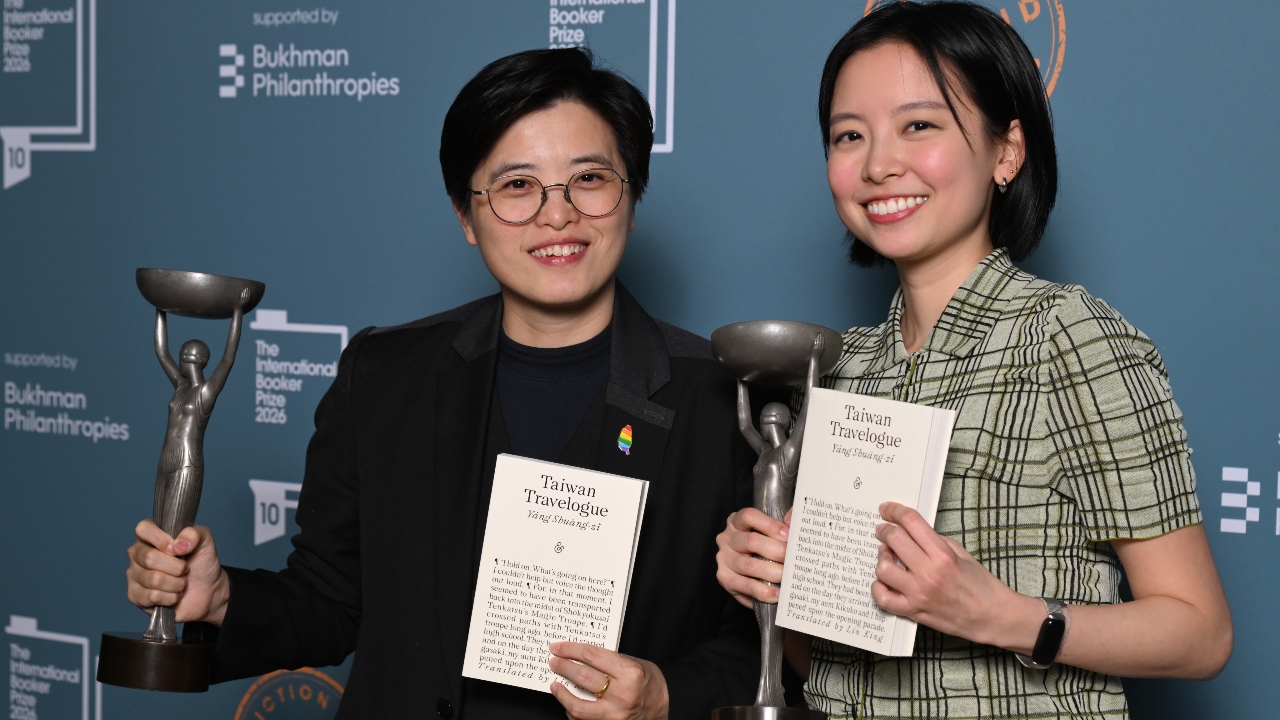
"Taiwan Travelogue," a literary work depicting forbidden love and Taiwanese colonial-era food culture, has won this year's International Booker Prize, marking the first time a book translated from original Mandarin Chinese has received this award in history.,
At the award ceremony held at the Tate Modern contemporary art gallery in London, England, the novel "Taiwan Travelogue," written by Taiwanese author Yang Shuang-zi and translated into English by Taiwanese-American translator Lin King, was announced as the winner of the International Booker Prize. They received a prize of £50,000 (approximately 2.2 million baht), to be split equally between the author and translator.
This achievement sets a record as the first book translated from Mandarin Chinese to win this award. It also marks the second consecutive year that the independent publisher "And Other Stories" from Sheffield has received this prize.
"Taiwan Travelogue" is set on the island of Taiwan in the 1930s, during the period when Taiwan was under Japanese imperial rule. The narrative unfolds through the perspective of Aoyama Shizuko, a Japanese writer who visits Taiwan on a government-funded culinary study trip and falls in love with Oo Shizuru, a Taiwanese interpreter.
The novel's distinctiveness lies in its cleverly structured format as a "recently discovered travelogue," complete with footnotes and a fictional afterword by characters within the story, intertwined with "real" footnotes by Lin King, the translator.
Natasha Brown, chair of the judging panel and a renowned writer, praised the novel, saying, "This is a captivating and intricately complex novel. It achieves something remarkable by being both a beautiful love story and a sharp postcolonial novel. The use of storytelling within storytelling adds a fascinating dimension to the core romantic narrative."
Due to this seamless structure, when the book was first published in Mandarin Chinese in 2020, many readers believed the book to be a genuine historical record.
Yang Shuang-zi, the 41-year-old author known for essays, manga, and video game scripts, revealed that her inspiration for writing was to explore the complex feelings Taiwanese people have toward their former colonizers.
"While both Korea and Taiwan were once colonies of Japan, Koreans seem to share a unanimous resentment toward that historical period. In contrast, Taiwanese feelings are more complex, mixing dislike with nostalgia. I wanted to use a contemporary Taiwanese perspective to unravel the complicated situations faced by our ancestors and explore the future path we should take," she explained.
Prior to winning the International Booker Prize, the work had already been widely recognized. The original Mandarin Chinese version won Taiwan's highest literary honor, the Golden Tripod Award, in 2021, while Lin King's English translation received the U.S. National Book Award for translated literature in 2024.
Translator Lin King spoke about the book's charm, saying it balances the suffering and happiness of Taiwanese people under Japanese rule very well. "No matter how difficult the times, I believe humans always find fragments of happiness and sources of love. During that era, they still had humor, delicious food, movies, schools, petty quarrels, and love. To say none of these existed would diminish the cultural value to mere emotional wounds."