

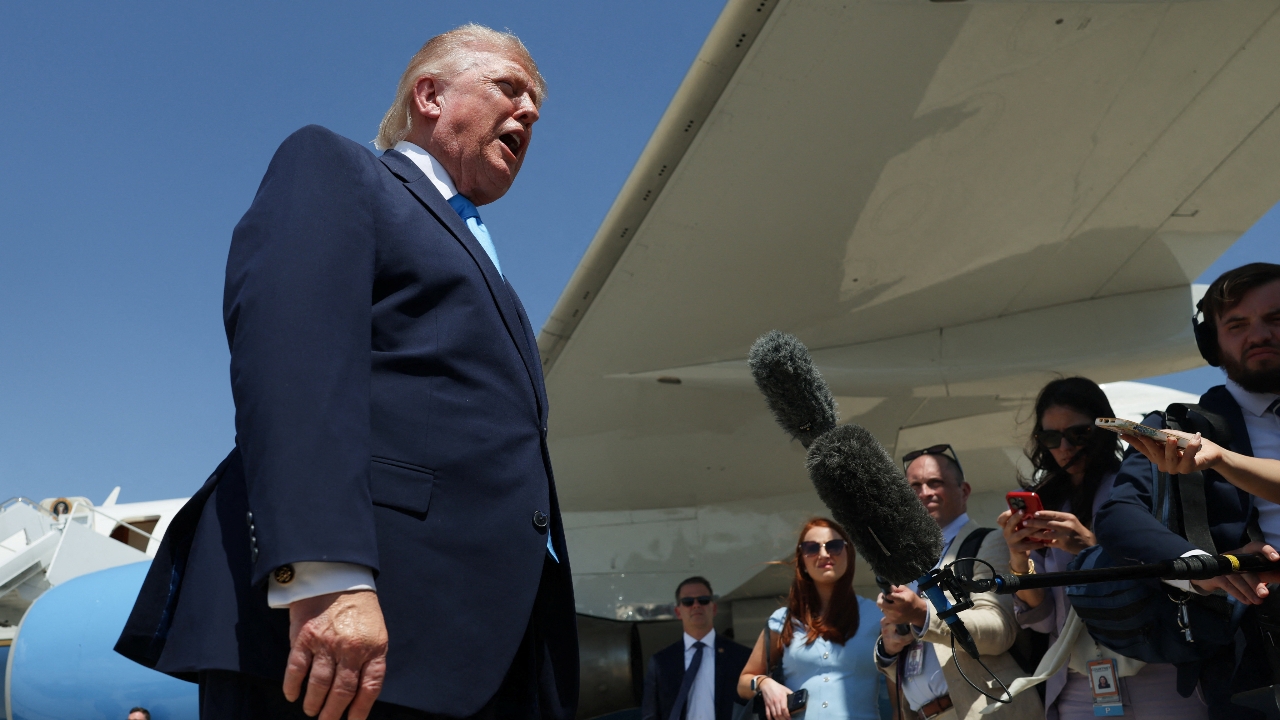
US President Donald Trump announced plans to speak directly with Taiwan's President Tsai Ing-wen to discuss an arms sale deal valued at over $14 billion, marking a major break from the diplomatic practices the US has followed since 1979.
US President Donald Trump revealed plans to speak directly with Taiwan's President Tsai Ing-wen about the possibility of approving a major arms sale deal. This move is a significant breach of diplomatic protocol, as US and Taiwan leaders have not engaged in direct talks since 1979, the year the US formally severed diplomatic ties with Taiwan to recognize the Chinese government.
When asked if he planned to speak with Tsai before deciding on the arms sale, Trump candidly replied, "I will talk to him. I talk to everyone. We'll sort that out, which is the Taiwan issue." He also praised his relationship with Chinese President Xi Jinping as "very good" following their two-day summit in Beijing last week.
Currently, Trump stated he has not made a final decision on approving the $14 billion arms sale to Taiwan (approximately 457 billion baht). Reports indicate the weapons package includes anti-drone equipment and air defense missile systems. Under the Taiwan Relations Act of 1979, the US is legally obligated to provide Taiwan with defensive arms but has historically balanced this carefully to avoid harming diplomatic relations with China.
According to the Financial Times, the Chinese government is currently delaying approval of a visit by Elbridge Colby, a senior US Defense Department policy official. China has conditioned approval on Trump making a clear decision regarding the Taiwan arms deal.
Trump also revealed that he discussed the Taiwan arms sale "in great detail" with President Xi Jinping during their meeting in Beijing. If confirmed, this would violate another US policy—the 1982 Six Assurances—which promised Taiwan that the US would not consult China before selling arms to Taiwan. However, when asked about the 1980s-era commitments aboard Air Force One, Trump dismissed them as "a long time ago" and emphasized, "I have to talk to the people running Taiwan now. You know who he is."
At last week's summit in Beijing, Chinese authorities made clear that Taiwan is the most sensitive issue in US-China relations. Presidents Putin and Xi warned that "conflict" could arise if the issue is mishandled. Although Trump downplayed the risk of war, he acknowledged that President Xi holds a "very tough" stance on this matter and that Trump himself has not made any promises to China.
Following the summit between Trump and Xi Jinping, Taiwan's President Tsai Ing-wen issued a statement reaffirming that Taiwan is "a sovereign and independent democratic country" and that peace in the Taiwan Strait must not be "sacrificed or used as a bargaining chip." She emphasized that purchasing arms from the US is key to maintaining regional security. Under Tsai's leadership, Taiwan has significantly increased its defense budget to counter growing military pressure from China.
This is not the first time Donald Trump has broken diplomatic norms. Back in 2016, shortly after winning the US presidency, he spoke directly with then-Taiwanese leader Tsai Ing-wen, prompting an official protest from the Chinese government. Furthermore, last December, the US approved a $11 billion arms sale to Taiwan—one of the largest ever—which greatly displeased China.