

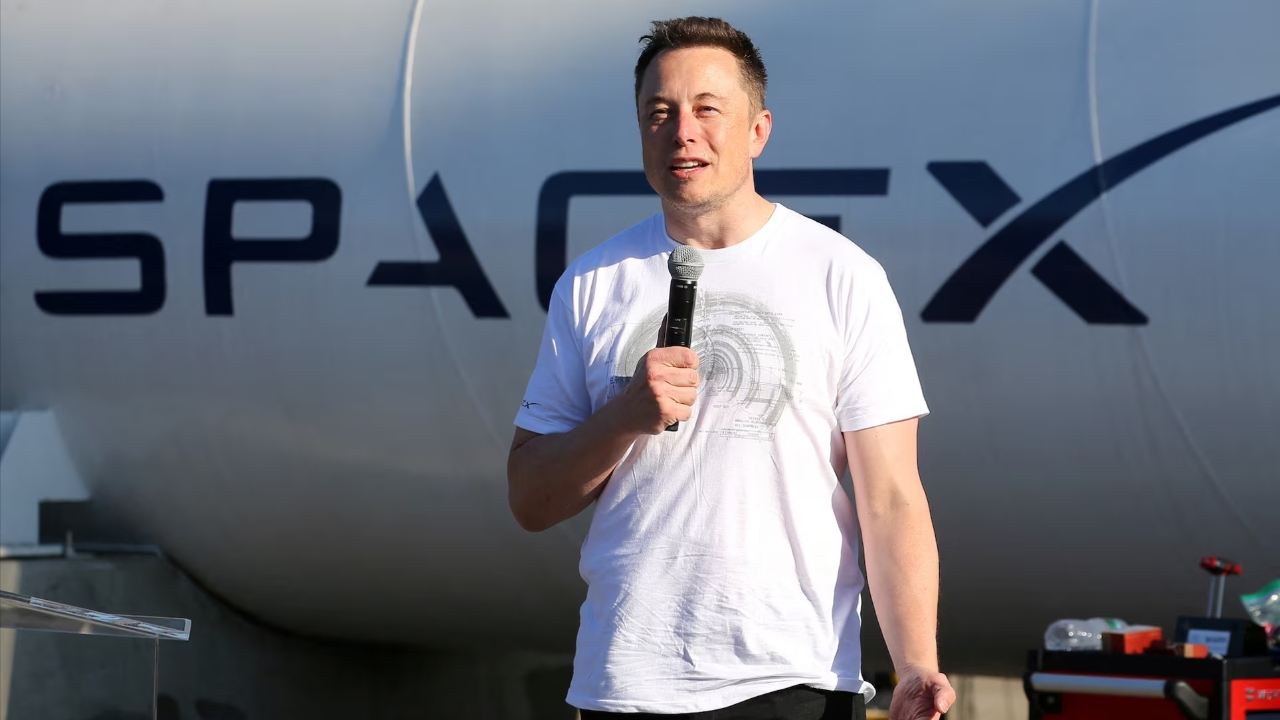
SpaceX, the space technology giant led by Elon Musk, has filed documents with the U.S. Securities and Exchange Commission (SEC) to launch a historic IPO, aiming to raise up to $75 billion, approximately 2.45 trillion baht. This move could push the company's valuation to $1.75 trillion and boost Musk’s total assets beyond $1 trillion, or about 32.4 trillion baht.
SpaceX, officially known as Space Exploration Technologies, has submitted a registration statement to the U.S. SEC in preparation to list on the stock market. This is expected to be the company's first public offering (IPO) of new shares, potentially the largest in Wall Street history.
Reports indicate that SpaceX aims to raise up to $75 billion (about 2.45 trillion baht) through the capital markets, pushing its total valuation to between $1.25 trillion and $1.75 trillion. Since Elon Musk holds a majority stake, potentially worth over $600 billion, this would raise his net worth above $1 trillion (32.4 trillion baht), breaking global records and cementing his position as the world’s richest person.
This filing marks the first time in 24 years since the company's founding that SpaceX has publicly disclosed its financial figures. In 2025, the company generated total revenues of $18.7 billion but recorded a net loss of $4.9 billion due to heavy investments in next-generation rocket development and artificial intelligence (AI) systems.
In the first quarter of 2026, SpaceX reported sales of $4.7 billion but posted a net loss of $4.3 billion in that quarter alone. Currently, SpaceX holds total assets, including rockets and equipment, valued at $102 billion, with liabilities amounting to $60.5 billion.
Starlink, the satellite internet business, is SpaceX’s main revenue driver, generating $11.4 billion in 2025, which is nearly a 50% increase compared to the previous year.
The AI business segment, including the X platform and the xAI startup, earned $3.2 billion but suffered operational losses of $6.4 billion. This was due to investments of $12.7 billion in 2025 and an additional $7.7 billion in the first quarter of 2026 for data centers to train AI, competing with giants like Google, Meta, and Amazon. However, Musk plans to dissolve xAI to consolidate all AI activities directly under SpaceX.
Additionally, SpaceX has leased excess computing capacity from its massive data centers, COLOSSUS and COLOSSUS II, to AI competitor Anthropic, developer of the chatbot Claude, in a deal valued at $15 billion annually—or $1.25 billion monthly—extending through May 2029.
The filing reveals that SpaceX will adopt a dual-class share structure, allowing Elon Musk to hold all key positions—CEO, Chief Technology Officer (CTO), and Chairman of the Board. Musk will control 85% of voting rights despite owning approximately 42% of shares. This structure is designed to protect him from shareholder votes regarding compensation and board independence, issues that previously led to legal disputes at Tesla.
SpaceX also candidly warned investors of risks, including anticipated legal expenses exceeding $500 million from multiple lawsuits. These include cases alleging that the xAI chatbot Grok was used to create fake pornographic images of women and girls, copyright infringement claims, data leaks, and a recent court loss against OpenAI led by Sam Altman.
The most striking business plan in the prospectus is SpaceX’s intention to build data centers in outer space, reasoning that solar power captured in orbit is "the only scalable solution" to meet the massive electricity demands of AI computing systems.
The company aims to launch its first AI computer satellite into orbit as early as 2028, with a long-term goal of installing 100 gigawatts of processing power in orbit annually. This mission will require transporting over one million metric tons of payload with thousands of rocket flights per year. SpaceX is confident it is the only commercial company capable of this, estimating the market opportunity at $28.5 trillion, excluding China and Russia.
Source: AFP /BBC