

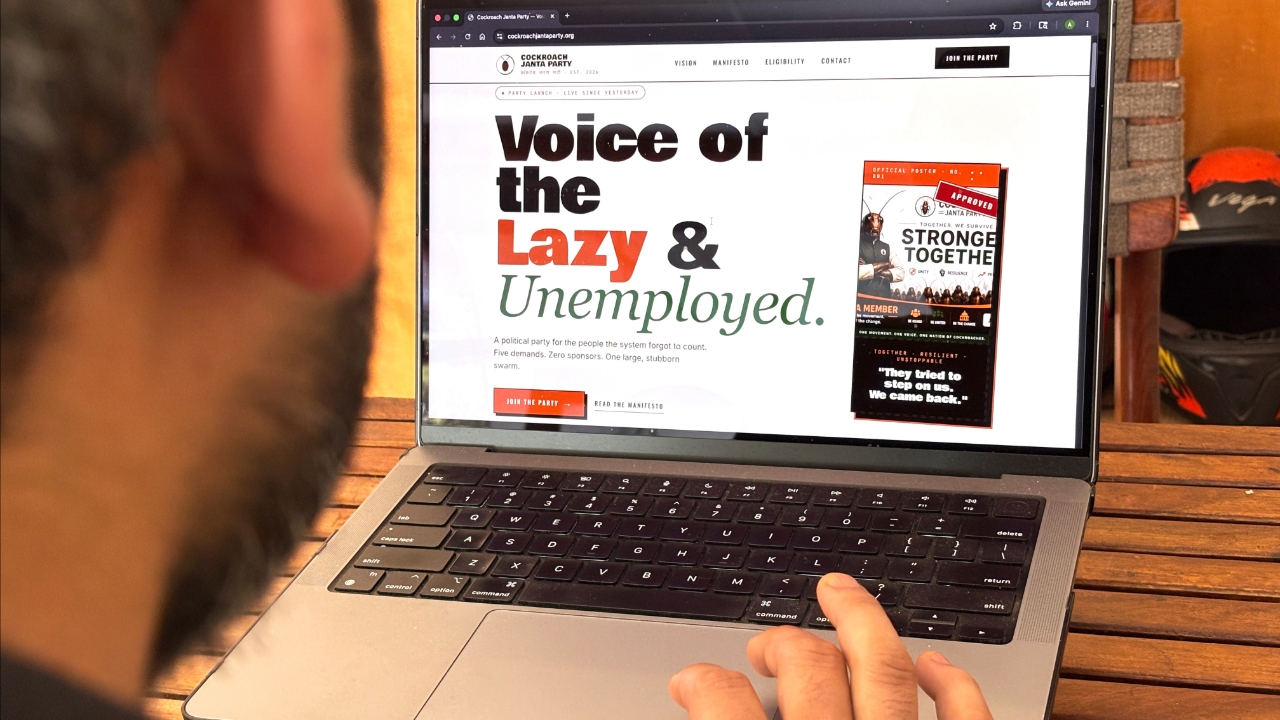
The Cockroach Party, a satirical online political party in India, is rapidly gaining support. Originally a darkly humorous project, it has evolved into a space for young people to voice their discontent.
The story began as an online satire after India's Chief Justice compared unemployed youth to "cockroaches." Now, millions of young Indians are engaging with the party to vent their frustrations.
The Cockroach Party is rapidly growing across India's social media, transforming dark humor into protest. Memes and short videos mocking corruption, unemployment, and political failures flood users' feeds.
Millions of users have embraced the "cockroach"—known for its resilience in harsh environments—as an ironic symbol representing endurance and persistence.
This online surge is unusually fast. The Cockroach Party, officially called the Cockroach Janta Party (CJP), with "Janta" meaning "people," launched its website and social media accounts just last Saturday.
By Thursday, the party’s Instagram page had surpassed 15 million followers, overtaking the official account of Prime Minister Narendra Modi’s ruling Bharatiya Janata Party (BJP), which had 8.8 million followers on the same platform.
“Nothing about this project was intended to spiral out of control like this,” said Apichit Dipke, CJP’s founder, who is currently a political communication strategist and a student at Boston University in the United States.
He added that this growth reflects mounting frustration among India’s youth. “It’s the younger generation who truly feel trapped and hopeless. They have no outlet and are very angry at the government.”
The CJP appeared online following remarks by Surya Kant, Chief Justice of India, which sparked intense criticism among young Indians already angry about unemployment, rising living costs, and a recent scandal involving leaked government exam papers that disrupted public job recruitment.
During a court hearing last week, Kant criticized a group he described as "parasites" attacking institutions, comparing unemployed youth and some activists to cockroaches.
“There are young people like cockroaches—those without any employment or place in their careers,” Kant said, noting that some have turned to social media activism, journalism, or public campaigns and then “began attacking everyone.”
His remarks quickly spread online and were widely seen as derogatory. Later reports said Kant clarified that he referred to those using fake degrees and did not intend to insult India’s youth.
Nevertheless, the controversy led to the rapid creation of the CJP Instagram account, which adopted the cockroach as a political symbol. The page began posting memes, satirical slogans, and critiques targeting Modi’s government. Within days, the group attracted tens of thousands of online volunteers via Google Forms and gained some opposition leaders’ support.
“We must understand that five years ago, no one was ready to openly oppose Modi or the government. The times are changing,” Dipke said. He previously worked with the Aam Aadmi Party (AAP), which emerged from India’s anti-corruption movement in 2012.
Dipke said the CJP has no ties to any formal political organization but its growth reflects a broader trend across South Asia, where youth have played key roles in recent protests against governments, including uprisings in Sri Lanka, Bangladesh, and unrest in Nepal.
“Young people feel truly trapped and hopeless, yet governments refuse to listen to their concerns,” Dipke said.
These pressures are especially intense in India, where over one-quarter of the population is young but many face bleak job prospects and chronic unemployment. Many young voters are angry at Modi’s BJP over issues like rising religious polarization, widening inequality, and economic pressures.
The CJP emphasizes self-mockery, setting ironic membership criteria: one must be unemployed, lazy, addicted to screens, and skilled at complaining professionally.
Its policy statements use satire to address contentious issues in Indian politics, including opposition allegations of election corruption, critiques of ties between major media conglomerates and the government, and the appointment of retired judges to political positions.
Critics, mainly Modi supporters, dismiss the Cockroach Party as an online political stunt allied with the opposition, citing Dipke’s past work with AAP. They claim the party’s popularity will fade as quickly as it rose, arguing it is merely a digital campaign rather than a grassroots movement.
Dipke countered that what began online will not remain confined to social media. “This is a movement that has arrived in India... It will change political discourse... It will continue online and, if necessary, take to the streets.”
The movement is slowly spilling out of the online world, with some young volunteers dressing as cockroaches at protests. Meanwhile, pushback is becoming clearer.
On Thursday, Dipke posted on X that the CJP account, with about 200,000 followers, was suspended in India—a clear sign of increasing restrictions. The reason for the suspension remains unclear.
Minutes later, he announced a new account launch with the message, “The cockroaches are back,” adding, “Thought you could get rid of us? Lol.”
Follow international news:https://www.thairath.co.th/news/foreign
Source:The Guardian