

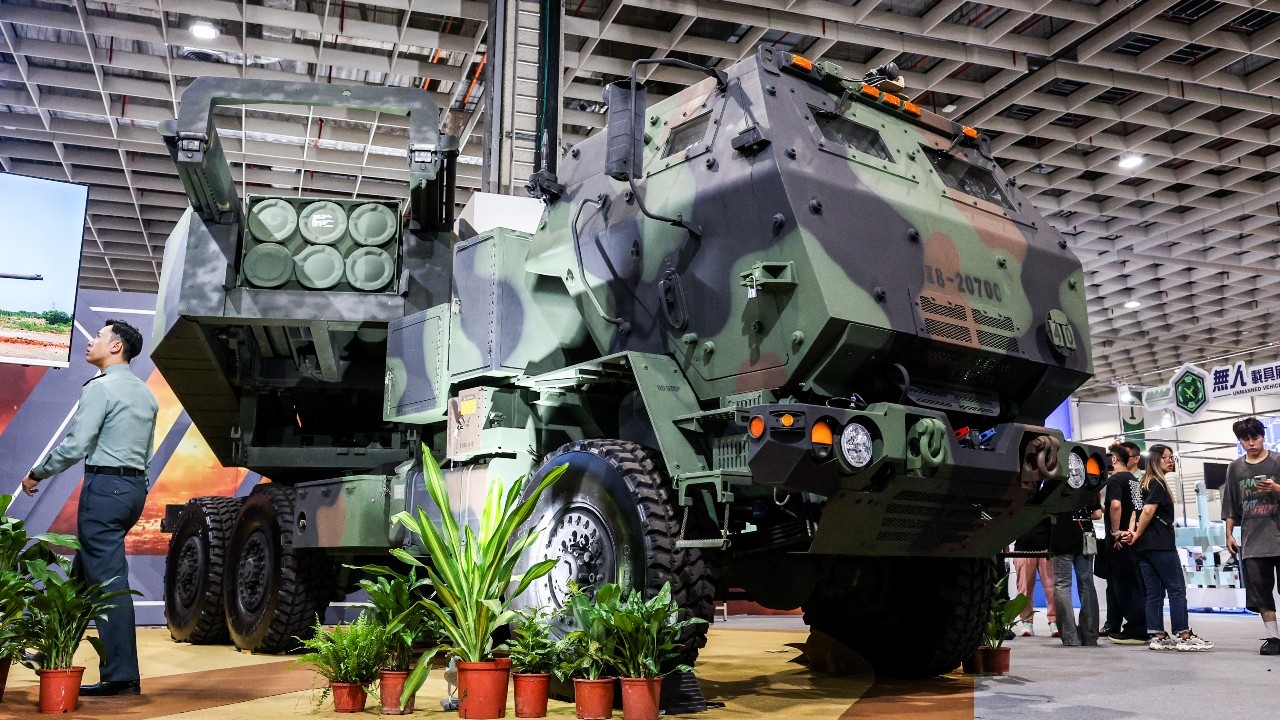
The Acting US Secretary of the Navy announced in Congress the temporary suspension of a $14 billion arms sale to Taiwan—over 500 billion baht—to reserve the arsenal for joint military operations with Israel against Iran.
Hung Cao, Acting US Secretary of the Navy, told a Senate committee on Thursday that the US government has "paused" the $14 billion (around 500 billion baht) arms deal with Taiwan temporarily to ensure that the US military has sufficient weaponry for operations in Iran.
During the congressional session, Cao said, "We are temporarily suspending the agreement to ensure we have the necessary ammunition and weaponry for Operation Epic Fury, of which we already have a substantial amount." The term "Epic Fury" is the classified codename for the joint US-Israeli military operation in Iran. "We are simply making sure everything is ready, and arms sales to foreign countries will resume when the government deems it necessary."
When asked how Taiwan reacted to the suspension of the deal, Cao candidly admitted, "I have not yet spoken with Taiwan." Meanwhile, the US State Department and Department of Defense have not issued further comments on this statement.
Karen Kuo, spokesperson for the Office of the President of Taiwan, told reporters that Taiwan has not received any information from the Washington government regarding any "adjustment to the US arms sales agreement." Previously, Taiwan’s President Tsai Ing-wen has consistently emphasized that US arms support is crucial for maintaining regional stability and peace. Under her leadership, Taiwan has significantly increased its defense budget to counter military pressure from China.
Meanwhile, the spokesperson for China’s Ministry of Foreign Affairs reiterated the country's longstanding position, stating, "China firmly and consistently opposes US arms sales to the Taiwan region, which is an integral part of China."
This $14 billion arms package has been awaiting final approval from President Donald Trump for several months. Reports indicate the deal includes Lockheed Martin’s PAC-3 air defense missile systems and other surface-to-air missile systems.
However, Trump has maintained an ambivalent stance and recently told Fox News that this arms sale deal is an "excellent bargaining chip" in negotiations with China. This comment came after Trump’s trip to Beijing, where he met with President Xi Jinping, who emphasized that the Taiwan issue is the most sensitive and important matter between the US and China.
Trump acknowledged having in-depth discussions about the arms sale to Taiwan with Xi Jinping, a move that breaks from the 1982 "Six Assurances" by the US to Taiwan, which included not consulting Beijing before arms sales to Taiwan. Trump also mentioned plans to speak directly with Taiwan’s President Tsai Ing-wen about the matter, a move likely to provoke strong Chinese displeasure since direct US-Taiwan leader talks have not occurred for decades.
Although US law mandates supplying arms to Taiwan for self-defense, Trump’s recent stance combined with the Middle East war crisis has raised serious concerns in Taipei about the reliability of US support.
Previously, in December, the US approved a major $11 billion arms package for Taiwan, prompting China to warn that US actions were "accelerating the risk of a dangerous and severe situation in the Taiwan Strait." The recent suspension of the deal to redirect weapons for the Iran conflict may create a significant strategic gap in the Asia-Pacific region.