

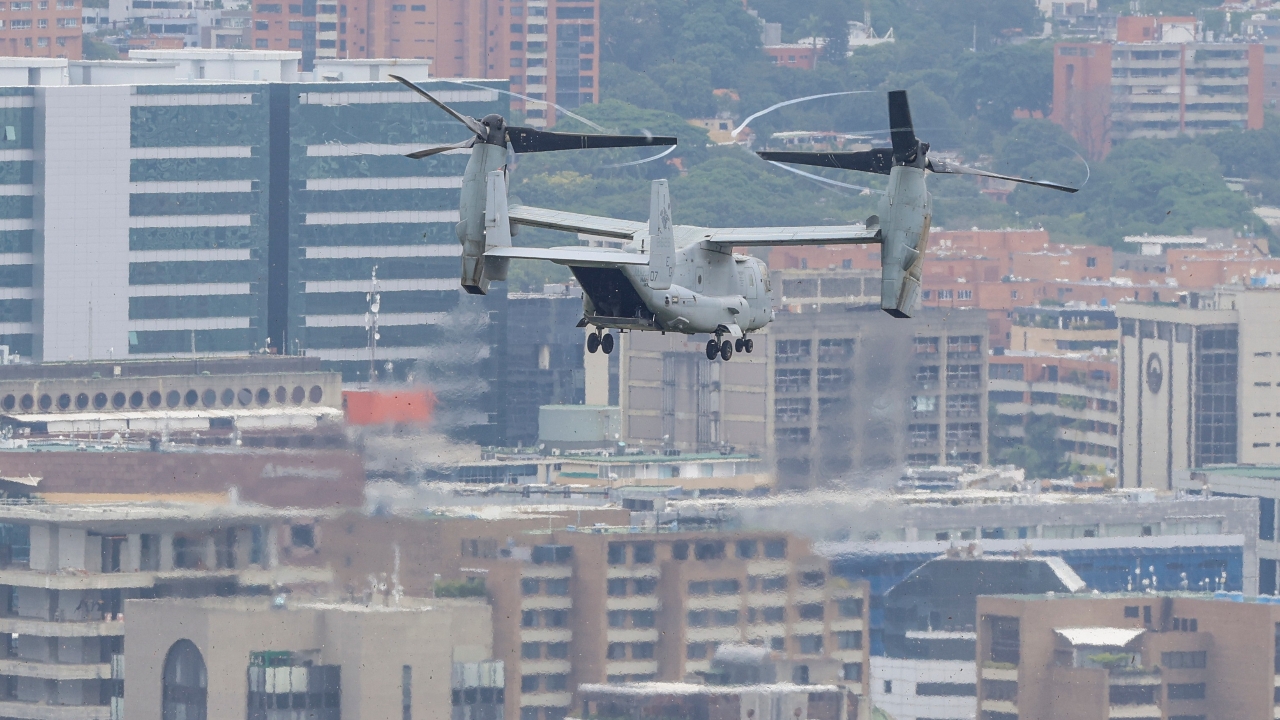
The U.S. military conducted an emergency response drill near the U.S. embassy in Caracas, Venezuela, marking the first such exercise since the overthrow of former President Nicolás Maduro in January. The drill included MV-22B Osprey aircraft landing at the embassy, amid divided reactions from Venezuelan citizens.
The U.S. military carried out a Rapid Response Exercise in Caracas, deploying Marine personnel and high-performance fighter aircraft. This operation followed the capture and removal from power of former President Nicolás Maduro by U.S. special forces in early January.
Reports indicate that two MV-22B Osprey mixed transport and attack aircraft flew over Caracas' airspace and landed on the parking lot of the recently reopened U.S. embassy in Venezuela, which had resumed operations about two months ago. Marines then fast-roped and quickly deployed from the aircraft. Rear Admiral Francis Donovan, commander of U.S. Southern Command, was aboard one of the Ospreys to meet with officials of Venezuela's interim government.
This urban military drill attracted many locals who gathered at a vantage point overlooking the embassy. Maria Beatriz Weinreb, a Caracas resident, said, "We are beginning to sense the breeze of freedom little by little." Another woman waved both the U.S. and Venezuelan flags, expressing excitement about U.S. assistance. She stated that although she did not want Venezuela to become the 51st U.S. state, she fully supported the aid and tools provided by the U.S. to help the country move forward.
Conversely, on the other side of the city, supporters of the former Maduro government protested, waving a large Venezuelan flag emblazoned with the message "No to Yankee military drills." Protest leader Hernán Vargas said, "This is a display of military arrogance meant to trample and diminish the people's dignity."
Additionally, a leftist activist group also protested. Although they opposed Maduro's government due to harsh repression, they viewed U.S. actions as interference and a threat to national sovereignty. Nevertheless, Marta Lea Grahales, one of the group's leaders, stated that for her, national sovereignty had long been lost during Maduro's administration, and the U.S. actions were merely a continuation of the occupation of the nation's sovereignty and its people.
Ivan Gil, Venezuela's Minister of Foreign Affairs, revealed that the current Venezuelan government had pre-approved the drill, describing it as an evacuation exercise to prepare for medical emergencies or major disasters. Meanwhile, the U.S. embassy posted on Instagram that maintaining rapid military response capability is crucial for mission readiness, and that the U.S. remains committed to advancing President Donald Trump's three-step plan, especially efforts to stabilize Venezuela.
Currently, President Trump's administration supports the interim government led by Delcy Rodríguez, a former vice president under Maduro who formed a new government. Recently, legislation was passed allowing the U.S. access to Venezuela's vast crude oil and mineral reserves.
The last time U.S. military aircraft flew over Caracas was on 3 January during a special operation when U.S. forces fast-roped from helicopters to capture former President Maduro and his wife, Cilia Flores. They were then taken to New York to face drug trafficking charges, which both deny. Venezuelan authorities reported at least 100 deaths during that operation.
On the same day, Maria Corina Machado, a Venezuelan opposition leader and Nobel Peace Prize laureate internationally recognized as the true winner of the 2024 presidential election, addressed hundreds of Venezuelan migrants in Panama City. She has been in hiding since December.
Machado, who maintains good relations and seeks favor with President Trump, declared, "The moment I return to our homeland is approaching. What is about to happen is monumental and will be a tremendous driving force for our country."