

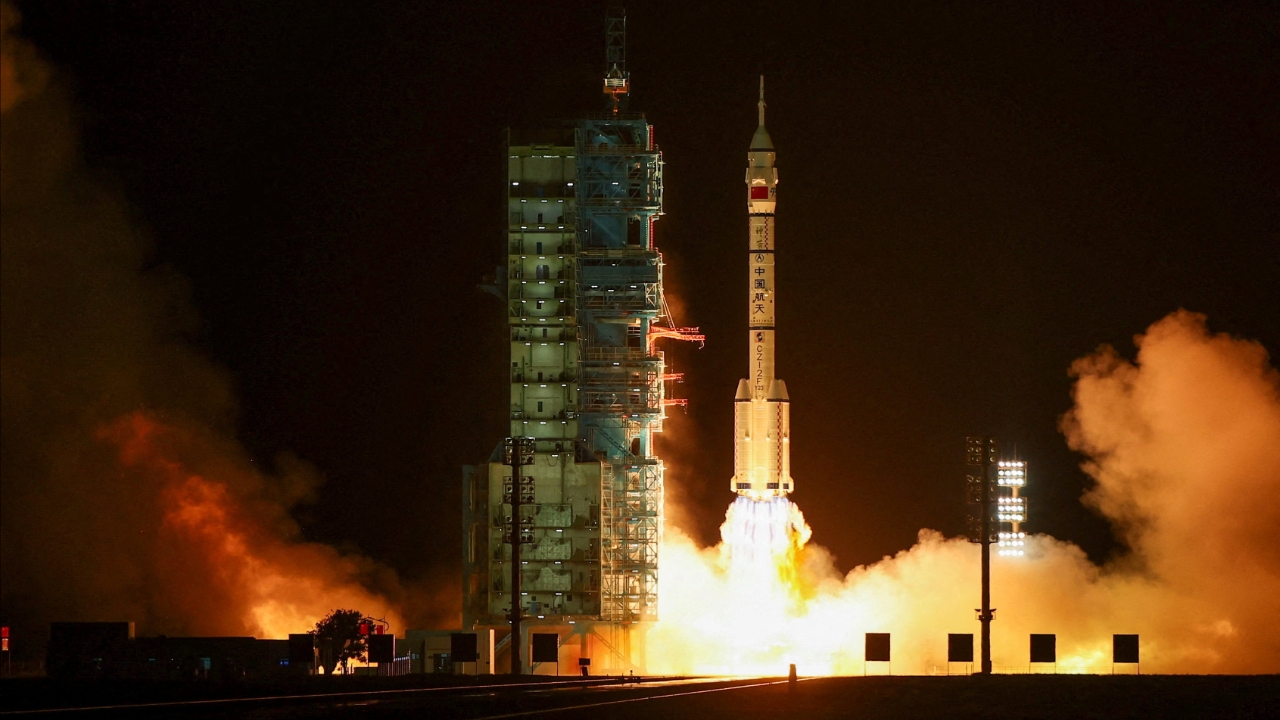
China has launched a spacecraft carrying three astronauts into Earth orbit. The crew will undertake a one-year mission to lay the groundwork for sending humans to the Moon by 2030.
On Sunday, 24 May 2026 GMT+7, China conducted the launch of the Shenzhou-23 spacecraft, marking the first time Chinese astronauts will spend a full year in orbit. This represents a significant step toward Beijing's plan to send humans to the Moon by 2030.
The Long March 2-F rocket soared into the sky amid flames and smoke precisely at 23:08 local time from the Jiuquan Satellite Launch Center located in the Gobi Desert in northwest China.
The China Manned Space Agency (CMSA) announced on social media that the spacecraft separated from the rocket about 10 minutes after launch and successfully entered orbit.
“All astronauts are in good health, and the launch was completely successful,” the space agency added.
For this mission, Li Jiaying, a payload systems specialist and former Hong Kong police inspector, will make history as the first astronaut from Hong Kong to participate in a Chinese space mission.
The rest of the crew includes mission commander Zhu Yangzhu and pilot Zhang Yuanzhi, both from the People's Liberation Army Astronaut Corps.
One of the three astronauts is scheduled to stay aboard the Tiangong space station for one year, making this one of the longest space missions to date. However, it remains shorter than the 14-and-a-half-month record set by a Russian astronaut in 1995. CMSA will later decide which astronaut will remain aboard depending on mission progress.
China has sent astronauts to its space station nearly ten times before, but this launch occurs amid escalating competition with the United States over lunar exploration. The U.S. has accused China of planning to claim territory and extract resources on the Moon, allegations that Beijing strongly denies.
NASA aims to land humans on the Moon by 2028, two years ahead of China, with the goal of establishing a long-term presence there as a foundation for future human exploration of Mars.
With less than four years remaining to meet its 2030 deadline, China faces a challenging task to develop entirely new hardware and software specific to the lunar mission, and to demonstrate their readiness. This will ensure that Chinese astronauts, accustomed to relatively safe conditions aboard the low-Earth orbit Tiangong station, can transition safely to the more hazardous lunar surface.
Since 2021, China's Shenzhou missions have sent groups of three astronauts to stay on the space station for six months. Additionally, the Chinese space agency is training two Pakistani astronauts, one of whom may join a short-term mission to the Tiangong space station expected later this year.
Follow international news:https://www.thairath.co.th/news/foreign
Source:cna