

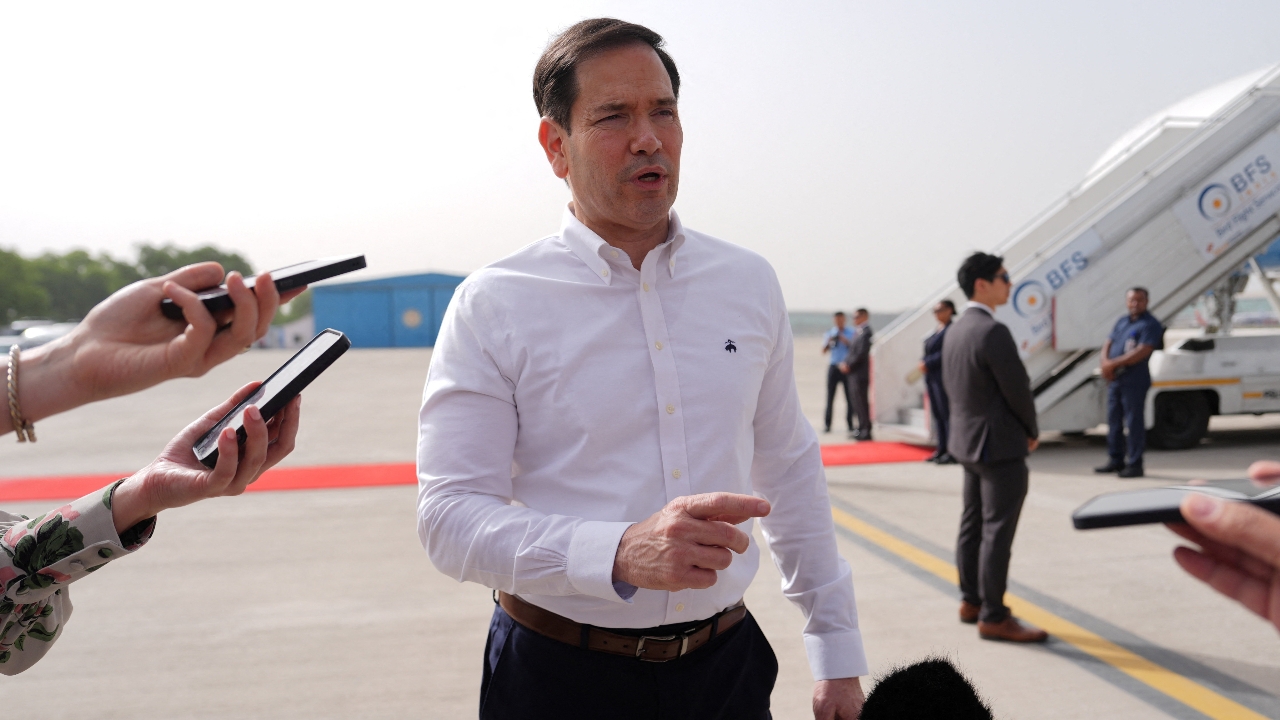
U.S. Secretary of State Marco Rubio said the U.S. remains open to continuing negotiations with Iran, but if no agreement is reached, the U.S. is prepared to use "other approaches." Meanwhile, hopes for ending the conflict and reopening the Strait of Hormuz remain uncertain.
Marco Rubio, U.S. Secretary of State, revealed that the U.S. hopes to reach a favorable agreement with Iran, or else is ready to deal with Iran by "other means." The U.S. government is trying to temper expectations that the prolonged war of over three months will end soon.
During a press conference in New Delhi, India, Rubio stated that the U.S. will fully pursue diplomatic efforts before considering "other options." This follows President Donald Trump's signal to U.S. negotiators that there is no need to rush into an agreement with Iran.
Rubio said, "There is now a fairly solid proposal on the negotiation table involving the reopening of the Strait of Hormuz and entering into genuine, significant nuclear talks with a clear timeframe, which we hope to accomplish."
Just a day earlier, President Trump posted on Truth Social affirming that the U.S. naval blockade against Iranian vessels in the Strait of Hormuz will remain fully enforced until an agreement is reached, approved, and formally signed. He added, "Both sides must take their time and do it right."
Although Iran's government has not officially responded, Tasnim News Agency, linked to the Islamic Revolutionary Guard Corps (IRGC), reported that the U.S. continues to obstruct the agreement on certain points, particularly Iran's demand for the release of frozen funds held overseas.
Meanwhile, Iranian Parliament spokesman Ebrahim Raisi posted on platform X that during wartime, Iran's strategy is "an eye for an eye, a tooth for a tooth," and in diplomacy, "responding with action to action." He emphasized that Iran will not yield to pressure or threats. If the U.S. wants a deal, it must negotiate; otherwise, if it wants to see crude oil prices rise to $6 per gallon, it should keep threatening.
This development caused global crude oil prices to drop by 6%, reaching a two-week low, as investors gained confidence that the U.S. and Iran are moving closer to a peace agreement. President Trump revealed that both sides have agreed on a broad "memorandum of understanding" to reopen shipping routes in the strategically vital Strait of Hormuz, through which one-fifth of the world's crude oil and liquefied natural gas were transported before the conflict.
However, the two sides still disagree on several complex issues, including Iran's nuclear program, Israel's war in Lebanon against the Iranian-backed Hezbollah group, and Iran's demands to lift sanctions and release tens of billions of dollars in oil revenue frozen in foreign banks.
A senior Trump administration official, speaking anonymously, revealed that the current agreement states that Iran has "in principle" agreed to reopen the Strait of Hormuz in exchange for the U.S. ending its naval blockade. Iran must also eliminate all its highly enriched uranium stockpiles. The U.S. believes that Iran's current Supreme Leader, Ayatollah Mojtaba Khamenei, has endorsed this broad framework.
U.S. officials explained that the first step is to reopen the Strait of Hormuz and lift the naval blockade. Detailed negotiations on nuclear measures will require additional time. Another source indicated that the proposed framework gives negotiators 60 days to finalize the agreement.
An insider source from the Iranian side told Reuters that the next phase may involve a practical formula to resolve the highly enriched uranium issue, such as diluting uranium under the supervision of the International Atomic Energy Agency. Iran continues to deny U.S. and Israeli accusations that it is developing nuclear weapons.
President Trump also responded to critics of his negotiation and compromise approach with Iran on social media, saying, "If I make a deal with Iran, it will be a good and proper deal... So don't listen to the losers who criticize what they know nothing about."
The bombing war on Iran by the U.S. and Israel has already killed thousands in Iran before a temporary ceasefire in April. Meanwhile, Israel continues killing people and has displaced hundreds of thousands in Lebanon from attacks on Hezbollah. Iran's retaliatory attacks against Israel and Gulf allies have also resulted in dozens of deaths.
. Reuters