

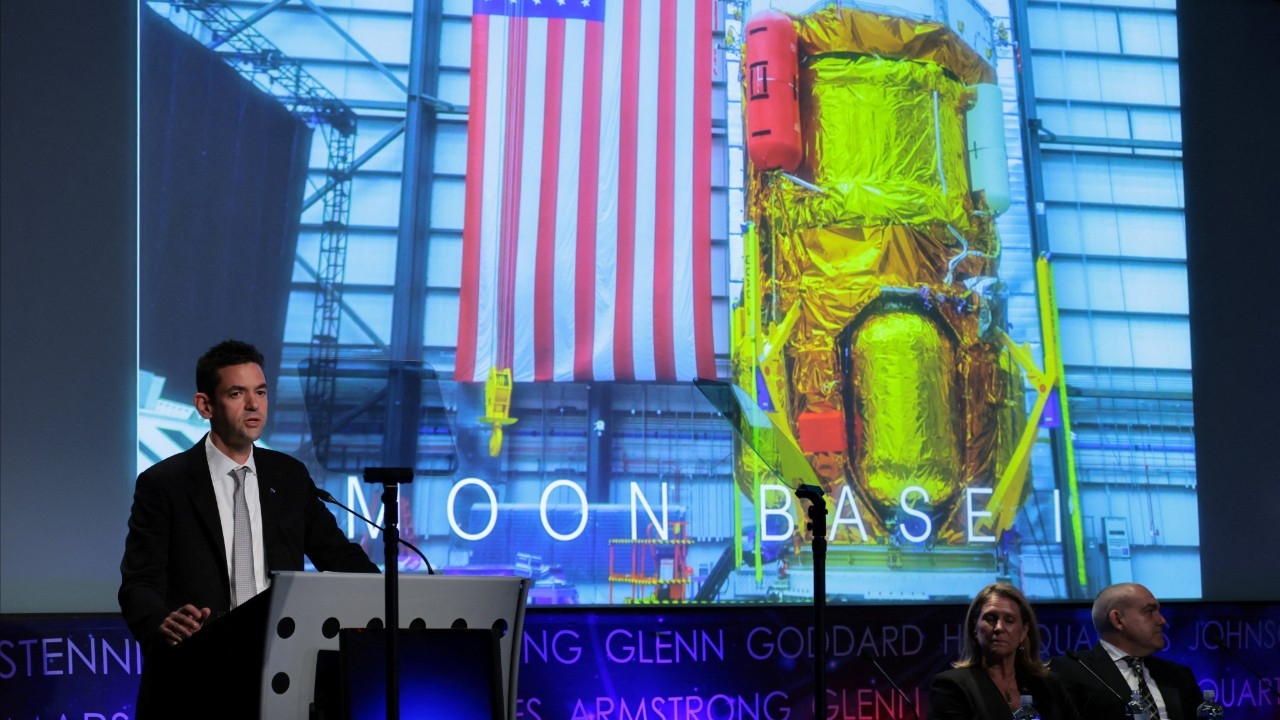
NASA has revealed the next phase in its plan to build a permanent operational base on the Moon amid a new space race with China, which aims to send humans to the Moon by 2030.
On Tuesday, 26 May 2026 GMT+7, the U.S. National Aeronautics and Space Administration (NASA) disclosed details about uncrewed landers, hopping drones, and various vehicles intended for the Moon as part of the U.S. plan to establish a lunar base.
NASA's lunar base project, called the "Ignition Moon Base," is divided into three phases. NASA intends to send uncrewed landers and hopping drones to explore and map the Moon’s challenging terrain.
Next, transport vehicles capable of carrying astronauts across the lunar surface will be deployed, also to carry communication equipment and various scientific instruments.
On Tuesday, NASA named companies including Blue Origin, Intuitive Machines, and Astrobotic as contractors awarded the contracts to build these space machines.
NASA expects Blue Origin's lunar lander, "Endurance," to have precise landing capabilities and autonomous control and navigation systems, while Astrobotic's "Griffin-1" lander is expected to touch down at the Nobile Crater near the Moon’s south pole.
These machines will also transport NASA’s scientific instruments, including high-resolution cameras and laser reflection tools to assist with spacecraft landing control.
Carlos Garcia-Galan, the lunar base program manager, revealed on Tuesday that the robotic uncrewed exploration mission will continue until 2029, involving 25 launches delivering a total of 4 tons of cargo to the lunar surface.
In the following phase, NASA aims to build nuclear and solar power facilities on the Moon, including a fission nuclear reactor, with the goal that by 2032 humans can live in "semi-permanent" lunar habitats.
Rovers will be used to help astronauts travel long distances across the Moon’s rocky terrain.
The U.S. plans to send Americans back to the Moon before President Donald Trump's term ends in 2028, amid competition with China to return humans to the lunar surface. This puts pressure on NASA to prove it can win this new space race.
In March, NASA announced a $20 billion project to build a permanent base powered by nuclear and solar energy at the Moon’s south pole by 2032. On Tuesday, NASA official Jared Isaacman said this announcement signifies that the U.S. will "never give up the Moon again."
Having a base will enable the U.S. to conduct scientific experiments, mine valuable resources, and more easily travel to Mars. However, most experts agree NASA’s timeline seems impractical.
Although the U.S. successfully sent four astronauts around the Moon on the Artemis II mission in April, some scientists believe China is more likely to be the next country to successfully land humans on the Moon’s surface.
All of NASA’s plans depend on the readiness of spacecraft capable of safely transporting humans to the Moon. Elon Musk’s SpaceX has been contracted to build the "Starship Human Landing System," but the project has faced multiple delays and obstacles.
"The main bottleneck and critical limitation right now is getting astronauts down to the lunar surface," explained Simeon Barber, a lunar scientist.
"To me, it sounds like NASA feels they need to start announcing that they have contingency plans, so I think there is a significant political drive behind this," Barber added.
Follow international news:https://www.thairath.co.th/news/foreign
Source:BBC