

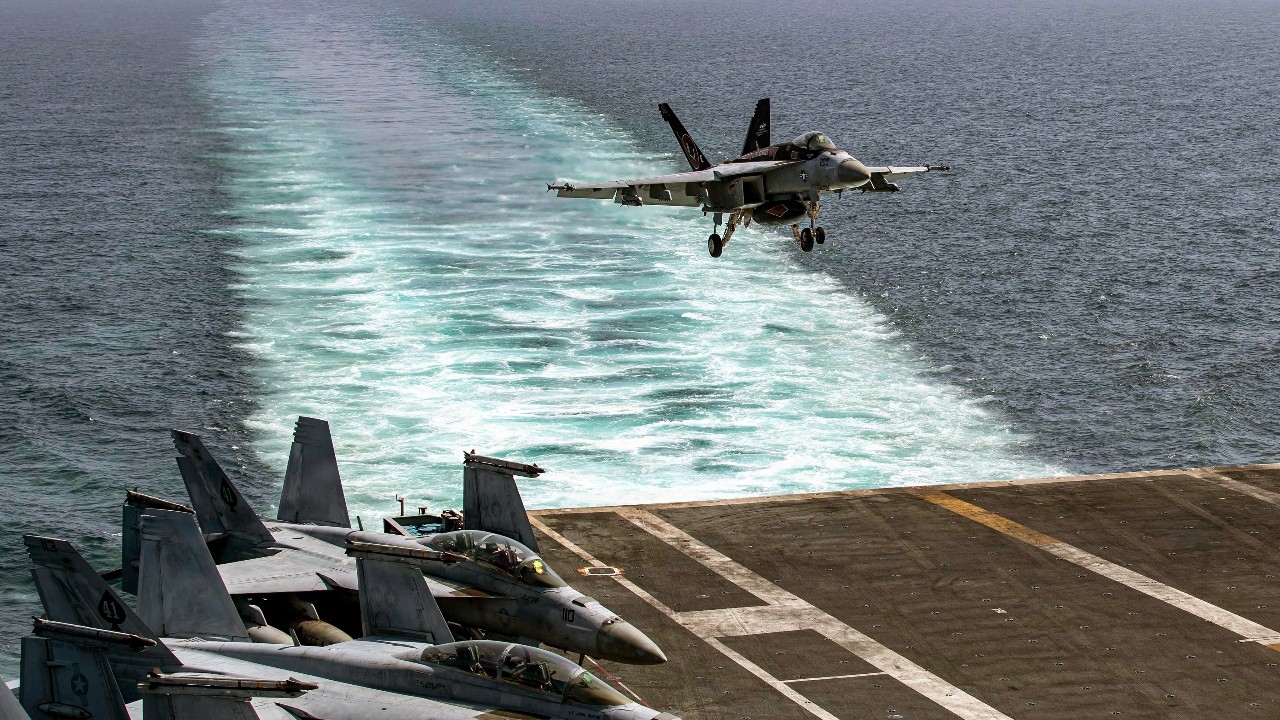
The US military launched an operation targeting the Iranian port city of Bandar Abbas, marking the second attack within three days. It also intercepted four attacking drones near the Strait of Hormuz, citing self-defense and the need to uphold a ceasefire agreement. Iran condemned the strikes as a serious breach of the agreement.
The United States Central Command (Centcom) stated that US forces shot down four Iranian attacking drones because they posed a threat to US troops and commercial shipping near the Strait of Hormuz. Additionally, they struck a ground control station in Bandar Abbas while it was preparing to launch a fifth drone.
A US official said, “This operation was an appropriate response, genuinely for self-defense, and aimed at maintaining the ceasefire agreement,” which has been in effect since early April. However, Iranian local media cited military sources reporting that the Islamic Revolutionary Guard Corps (IRGC) navy fired warning shots at a US oil tanker attempting to pass through the strait, forcing it to retreat before the US struck empty areas around Bandar Abbas. No injuries or fatalities have been reported.
This latest attack occurred just hours after US President Donald Trump, during a cabinet meeting on Wednesday (27 May), denied reports from Iranian state television claiming that the two countries had reached a "joint framework cooperation agreement" to reopen the Strait of Hormuz for commercial shipping within a month, jointly managed by Iran and Oman. The reports also demanded the US lift its blockade of ports and withdraw troops from nearby areas. The White House dismissed these claims as “lies.”
Trump also declared firmly that no single country would have exclusive control over the Strait of Hormuz, warning Oman, a longtime US ally: "No one will control this strait. It is an international waterway, and Oman must comply with the rules like everyone else. Otherwise, we will have to bomb them flat. They understand this well and will not cause problems."
Meanwhile, the US Treasury Department sanctioned the “Persian Gulf Corridor Administration,” an Iranian organization responsible for regulating traffic through the strait, labeling it a threat to US national security.
Ibrahim Asisi, chairman of Iran’s National Security Committee in parliament, responded on X (formerly Twitter), saying that Trump’s rhetoric will not pressure Iran into backing down from its original demands regarding uranium enrichment rights, control over the strait, and the lifting of all sanctions. He added that Trump is facing a strategic dead-end, alternating between threats and pleas for an agreement.
Although Trump had previously shown a positive attitude toward a near-finalized agreement, at the latest meeting he stated that the US is "not satisfied" with the current conditions and is ready to resume large-scale bombing if Iran refuses to accept Washington’s terms. At the same time, the US is pushing Gulf countries such as Saudi Arabia, Qatar, Pakistan, Turkey, Egypt, and Jordan to sign the “Abraham Accords” to normalize relations with Israel, but these countries have so far declined.
Currently, the US has about 15,000 troops enforcing a blockade on Iran, supported by additional forces at bases across the region, including Qatar, the United Arab Emirates, and Bahrain. The Iranian nuclear program remains the most critical flashpoint. US Secretary of State Antony Blinken concluded a recent meeting firmly, stating, "The most important takeaway is that Iran will never acquire nuclear weapons, under any circumstances."