

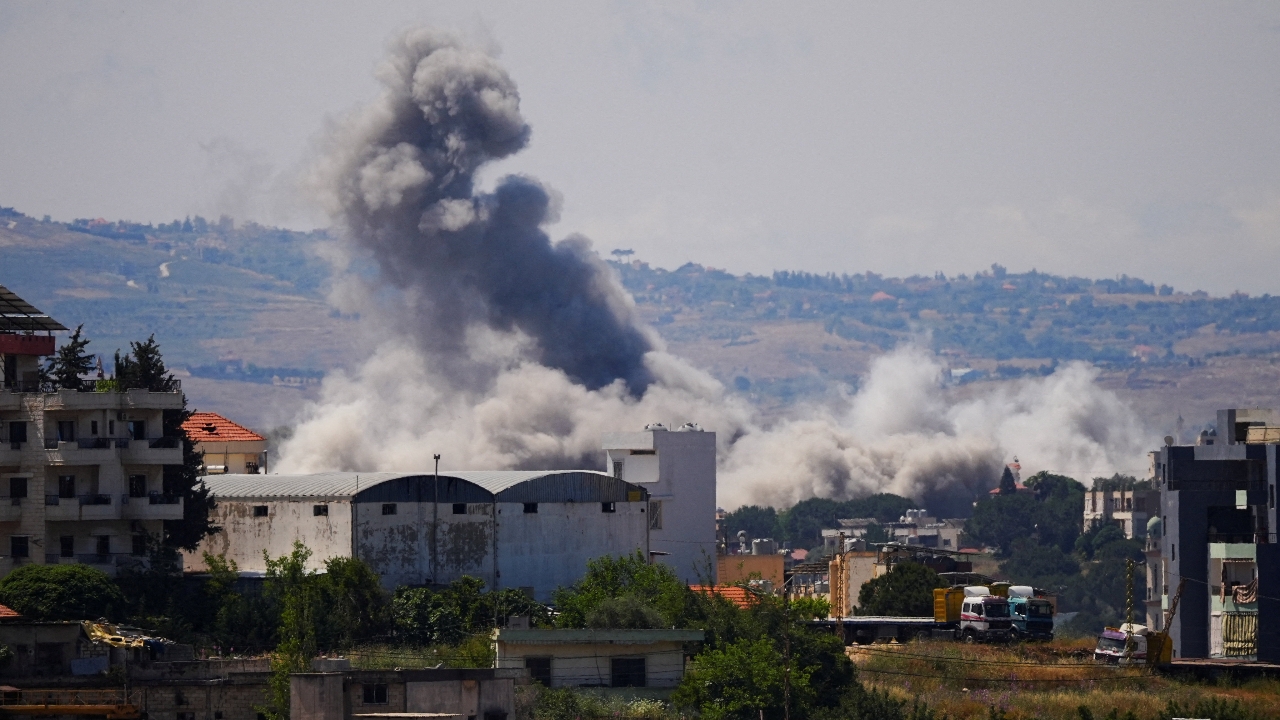
The Israeli military launched airstrikes targeting Hezbollah infrastructure in southern Lebanon after expanding evacuation orders to cover over 14% of the country, citing attacks on Hezbollah facilities amid rising tensions threatening regional ceasefire efforts.
Israel initiated a new wave of intense air operations in southern Lebanon, targeting sites it claimed were Hezbollah military infrastructure. The strikes caused buildings in the city of Tyre, one of Lebanon's largest cities, to collapse amid thick smoke and dust enveloping the area.
This military operation followed Israel's emergency warning ordering civilians to evacuate north of the Al-Sahrani River, about 40 kilometers from the border. Israel declared it would employ "the highest decisive measures," accusing Hezbollah of repeatedly violating the ceasefire. Hezbollah denied these claims, countering that Israel breached the agreement and stating its fighters engaged Israeli forces in intense clashes.
Lebanon's national news agency reported that Israel's attacks struck Tyre twice consecutively, causing large fires that rapidly spread to the city's eastern areas on Thursday morning.
The evacuation order issued on 27 May is the largest since the temporary ceasefire policy took effect on 17 April. The evacuation zone covers 14% of Lebanon's territory and includes more than 300 towns and villages.
The escalation follows Israeli Prime Minister Benjamin Netanyahu's announcement to expand ground operations in response to Hezbollah drone attacks against Israeli troops stationed in southern Lebanon and strikes on civilians in northern Israel.
Agnes Tour, head of the International Committee of the Red Cross (ICRC) delegation in Lebanon, warned that the situation in southern Lebanon is "approaching a dangerously critical point." Ongoing fighting has severely deteriorated civilian living conditions, making the area uninhabitable and potentially causing long-term severe impacts.
Relief officials reported that Sidon, a coastal city south of Beirut, can no longer accommodate the massive influx of refugees and have advised further evacuations to the Bekaa Valley and eastern Lebanon mountain regions instead.
Lebanese media also reported a wave of Israeli airstrikes across southern Lebanon and the Bekaa Valley to the east, resulting in immediate deaths of four people in the towns of Shouqin and Nabatieh.
Meanwhile, Hezbollah revealed its fighters engaged Israeli forces in "close-range" combat in the town of Sawtār al-Sharqiyya, north of the Litani River, approximately 30 kilometers from the border. This area lies outside the "buffer zone" initially declared by Israel.
The intensifying situation threatens to disrupt peace negotiations involving the United States, Israel, and Iran. Iran insists any agreement must include Lebanon's stability, while Israel reserves the right to continue operations to eliminate Hezbollah threats.
Lebanon has been fully drawn into the conflict since 2 March, when Hezbollah fired rockets at Israel in retaliation for Israeli airstrikes that killed Iran's top leader, prompting Israel to respond with heavy air bombardments across Lebanon and a ground invasion.
Lebanon's Ministry of Health reported at least 3,213 deaths since the conflict began, while Israel stated 23 soldiers and 4 civilians have died in border clashes during the same period.
/sourceBBC