

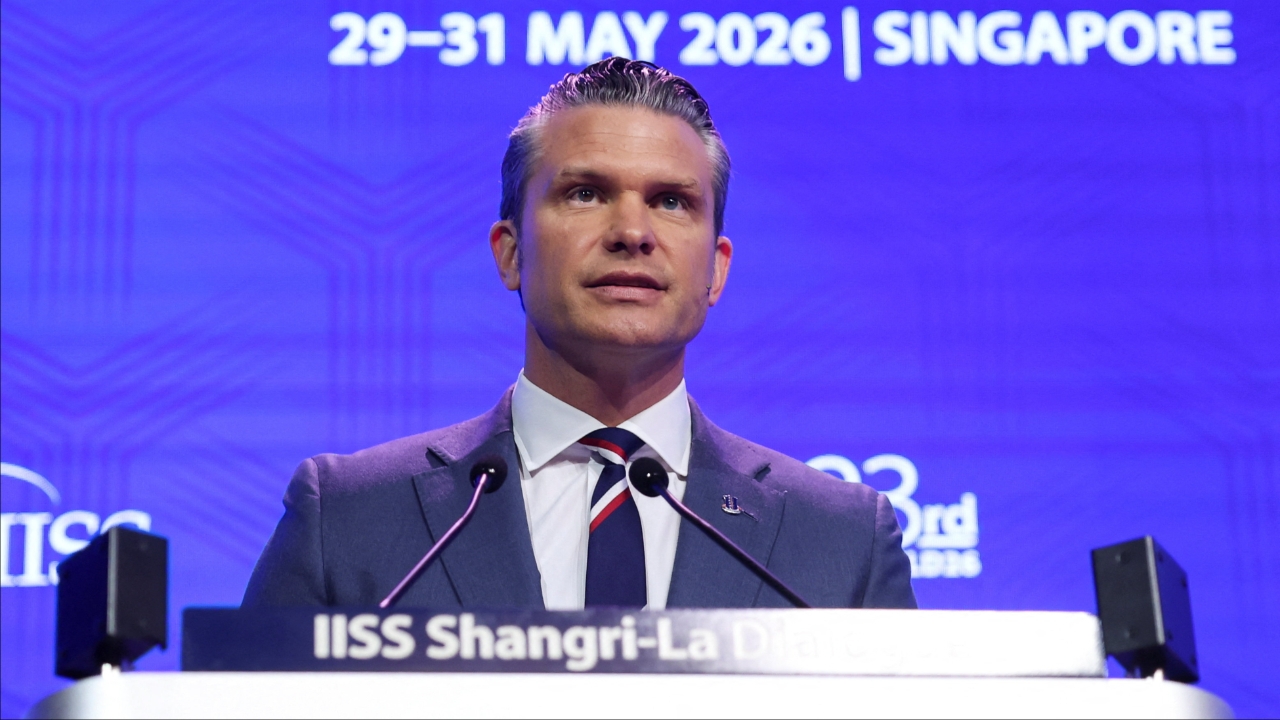
The US Secretary of Defense confirmed that the United States is not turning its back on its Asian allies but wants these allies to increase their defense budgets.
On Saturday, 30 May 2026, US Secretary of Defense Pete Hagerty spoke at the Shangri-La Dialogue, a regional security forum in Singapore, stating that the US military is not "turning its back" on Asia while undertaking various "global commitments," such as the Iran war.
During the meeting, Japan's Defense Minister sought clarity on US commitment, saying, “Some countries may underestimate this level of commitment” and might try to “drive a wedge” between the US and its allies.
Hagerty responded that part of the US defense strategy focuses on "demonstrating military power" in the Pacific Ocean and working with allies.
“People often confuse our global commitments with the idea that we are turning our back on this region,” he said, denying that was the case.
“We can do both at the same time,” he affirmed, stating that the US is working with allies “quietly but very strongly” with a “serious and concrete” approach in the Pacific region, while also maintaining “global commitments to ensure Iran cannot acquire nuclear weapons.”
Hagerty sought to reassure Asia-Pacific allies about the US's commitment to the region, including arms deliveries under agreements, despite recently suspending a weapons package for Taiwan. He also reiterated calls for Asian allies to increase their defense budgets.
A participant raised questions about the US's ability to deliver arms to allies after suspending Taiwan's weapons package to conserve ammunition for the Iran war.
Hagerty said he wanted to “completely separate these two issues,” affirming that the US is in a “very good position... and a very strong status” regarding overall arms stockpiles, including the capacity to produce more if necessary.
In his speech, Hagerty emphasized the US’s “strong, calm, and clear” approach to the region, which involves having the ability to “speak softly” while holding a “big club.”
He asserted that the core of this approach is having more weapons rather than relying on “empty globalist rhetoric about a rules-based international order.”
“Rules are good, but if you cannot back them up with tangible power, those rules are worth no more than scraps of paper,” Hagerty said. “We don’t need more meetings, but we need more combat power... fewer Shangri-La Dialogues, but more warships and submarines.”
Hagerty also reiterated his previous calls for Asian allies to increase defense spending, aiming for 3.5% of each country's GDP, praising countries that have increased budgets and cooperation with the US in recent months, such as South Korea, Japan, Australia, and the Philippines.
However, Hagerty criticized countries he labeled as “free-riders,” including New Zealand, and warned that “Europe and NATO have big decisions to make.”
Follow international news:https://www.thairath.co.th/news/foreign
Source:bbc