

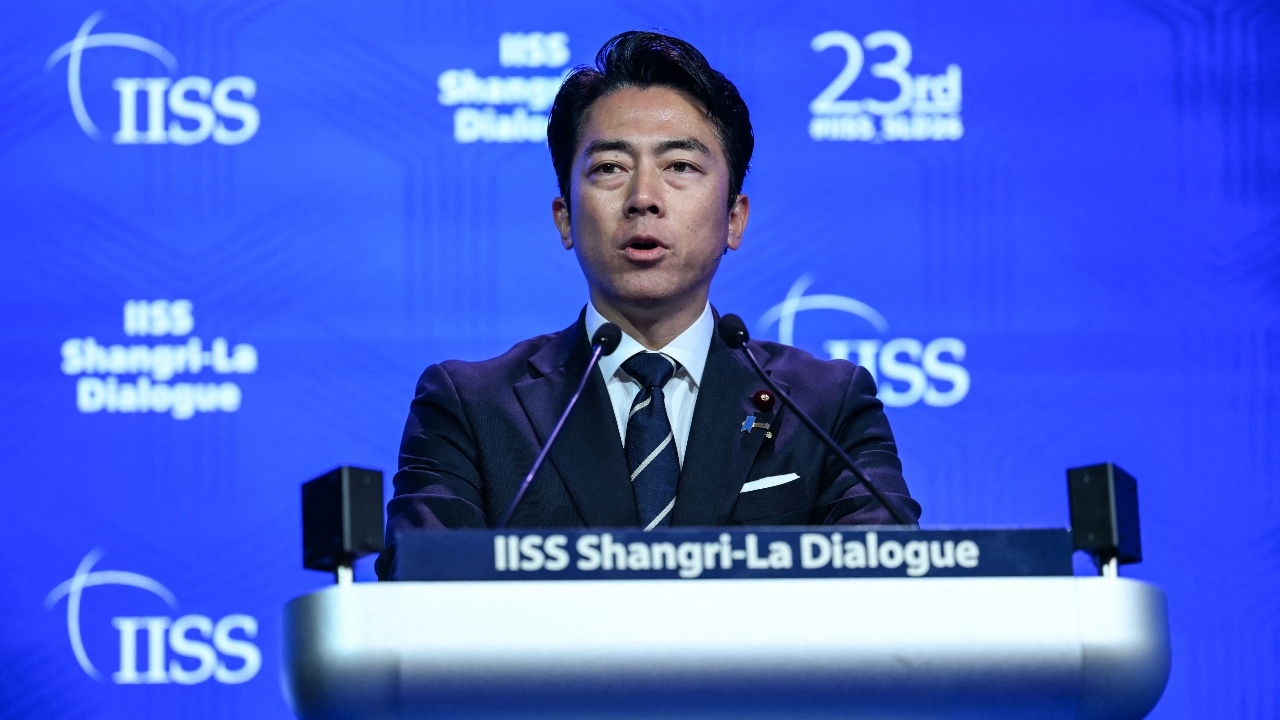
Japanese Defense Minister Shinjiro Koizumi rejected China's allegation that Japan is reverting to "neo-militarism." He countered by questioning China, which possesses nuclear warheads and a full arsenal of strategic bombers, for branding Japan—a country without such weapons—as a threat. He also criticized China's rapid military capability expansion and defense budget increases conducted without transparency.
At the Shangri-La Dialogue security summit in Singapore, Japan's Defense Minister Shinjiro Koizumi delivered a forceful response to accusations from the Chinese government. He denied that Japan is moving toward "neo-militarism," as alleged, and openly criticized China for significantly increasing its defense budget and military capabilities in a non-transparent manner.
Koizumi, without naming China directly, stated, "Consider this: there is a country with a massive nuclear arsenal and strategic bombers, yet Japan does not possess any of these weapons. Still, Japan is labeled 'neo-militaristic'? Isn't that strange? Nothing could be further from the truth." It is widely understood he was referring to the Chinese government, which holds several hundred nuclear warheads and is rapidly advancing its military technology.
The Japanese Defense Minister emphasized that since the end of World War II, Japan has consistently respected international law, including the United Nations Charter, and has sincerely worked to uphold and strengthen a free and open international order. This reality, as a peace-loving nation, will not be shaken by false accusations.
Relations between the two Asian powers have hit their lowest point in years after Japan’s Prime Minister Sanae Takaichi signaled in November that Japan might need to take military countermeasures if China were to attack Taiwan. Subsequently, China’s Ministry of Foreign Affairs called on Asia-Pacific countries to be vigilant and "jointly oppose Japan's reckless neo-militaristic actions."
Under Prime Minister Takaichi’s leadership, Japan has accelerated reforms to make its security policy more alert and proactive, with support from the United States, shedding its post-World War II image as a pacifist nation.
Koizumi stated that China’s military behavior and overseas activities are a serious concern for both Japan and the international community. Therefore, Japan is "committed" to building robust defense capabilities and updating new technologies with high transparency, including artificial intelligence (AI), drone systems, and cyber and space defense. Japan is also open to cooperation on defense equipment within the Asia-Pacific region to strengthen credible deterrence. In April, Japan enacted the most significant arms export reforms in decades, lifting restrictions on arms sales abroad and allowing exports of warships and missiles.
However, the Japanese Defense Minister expressed "regret" over not having the opportunity to meet and engage with China’s defense minister at this forum, noting that for the second consecutive year, Chinese Defense Minister Dong Jun did not attend in person, sending only a deputy-level delegation instead.
Koizumi concluded at the conference, which included officials and security experts from over 45 countries, saying, "Nonetheless, we continue to keep the door open for dialogue. I remain committed to communicating with relevant countries, including China, for the peace and security of the region and the world."