

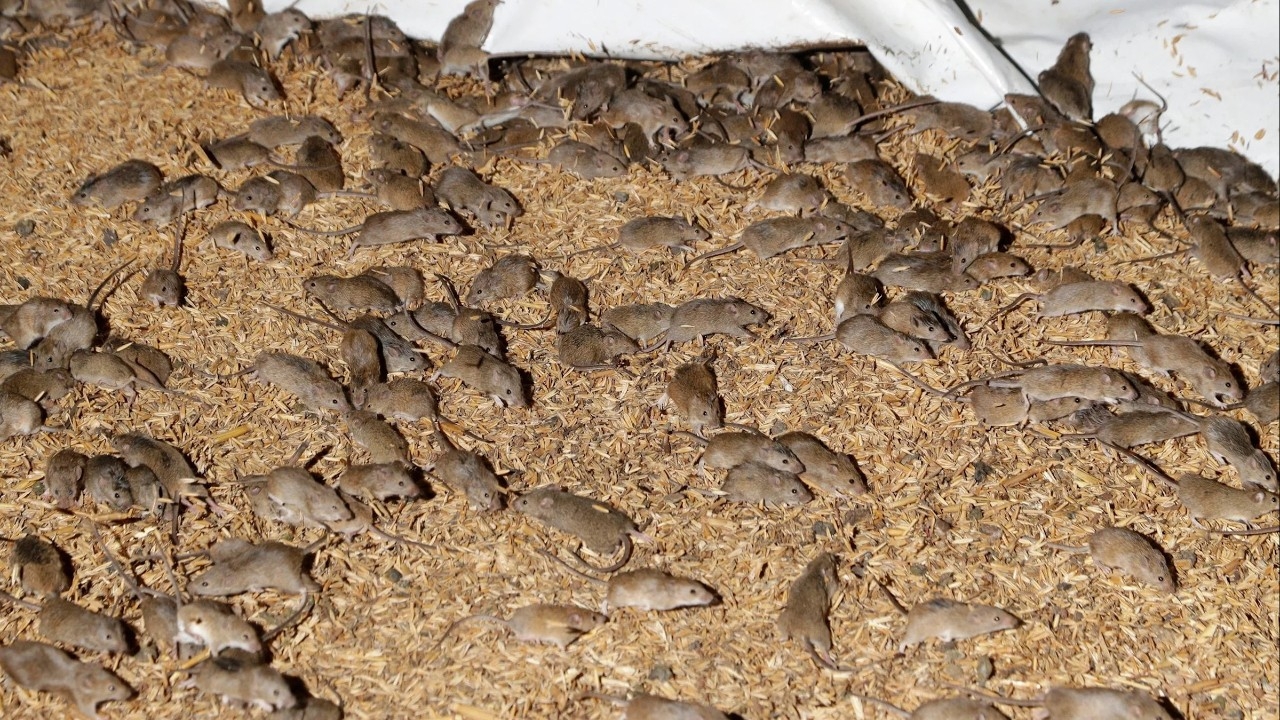
The "army of mice infestation" crisis is causing widespread alarm and severe damage to the agricultural industry in many parts of Australia. Various mouse species are aggressively damaging grain crops and invading homes, further burdening farmers who are already under pressure from sharply rising oil and fertilizer prices.
Farmers in Western Australia and South Australia are battling a severe mouse infestation crisis after huge numbers of mice were found destroying grain crops and invading homes, causing significant economic damage and mental health impacts among farmers.
Jeff Cosgrove, a 43-year-old farmer owning a 14,000-hectare farm in Mingenew, Western Australia, revealed that he has farmed for 25 years and previously used mouse bait only a few times, but this year's infestation is clearly worse than the major outbreak in 2021. "Mice are everywhere—on the ceilings, in the air conditioners, and in the corners of the house. You hear them all the time and smell something like decomposing carcasses."
Many farmers have incurred hundreds of thousands of Australian dollars in expenses, both from purchasing mouse bait and replanting crops to replace seedlings damaged by mice.
Agricultural scientists say the main cause of this outbreak is last year's record-high agricultural yields, which left large amounts of grain residues on the ground, providing excellent food sources for mice. Combined with summer rains that caused weak plants and weed growth, this created an ideal environment for mouse breeding.
Belinda Easthoff, an agricultural scientist and wheat, canola, and lupin farmer in Nollab, near Geraldton, stated that in some areas, mouse numbers reached 8,000-10,000 per hectare—equivalent to the size of a rugby field. "Normally, when food runs out, mouse populations decline, but this year food is still abundant, so numbers have not decreased at all. It feels like a nightmare."
Autumn is a critical period for grain farmers as it is planting season, but in many areas, mice immediately began eating seeds right after sowing, causing many rows of crops to disappear overnight.
At the same time, farmers are coping with rising production costs, especially higher diesel and fertilizer prices driven by tensions and conflicts in the Middle East, which have impacted global supply chains.
Steve Henry, a mouse expert researcher from the Commonwealth Scientific and Industrial Research Organisation (CSIRO), explained that a mouse outbreak is generally defined at around 800 mice per hectare, but in many parts of Western Australia, numbers have surged to several thousand per hectare. Recent field surveys found 30-40 active mouse burrows in an area just 1 meter wide and 100 meters long, which calculates to over 3,000-4,000 burrows per hectare.
Researchers explained that mice can start breeding at just 6 weeks old, producing 6-10 pups every 19-21 days, and females can become pregnant again within days after giving birth, leading to rapid population growth.
Beyond economic damage, many farmers face chronic stress from having to deal with mice 24 hours a day, as the rodents are not only in the fields but also invade homes, storage rooms, and even bedrooms.
Recently, Australian regulatory authorities approved the use of a concentrated mouse bait formula long requested by farmers, which has begun being distributed across affected areas.
Damien Ryan, a 67-year-old former farmer from Morawa, north of Perth, revealed that he catches 20-30 mice daily in his house and about 150 in his storage shed. "In my 50 years of farming, I've never seen an infestation this severe. At night while driving, you see mice running everywhere."
However, some farmers are beginning to feel hopeful as cooler weather, increased rainfall, and the use of more effective mouse bait have led to a reduction in mouse numbers in certain areas.
Experts believe that when winter fully arrives, lower temperatures and damp conditions will help slow mouse reproduction, potentially alleviating the crisis currently troubling Australia's agricultural sector.
.SourceBBC