

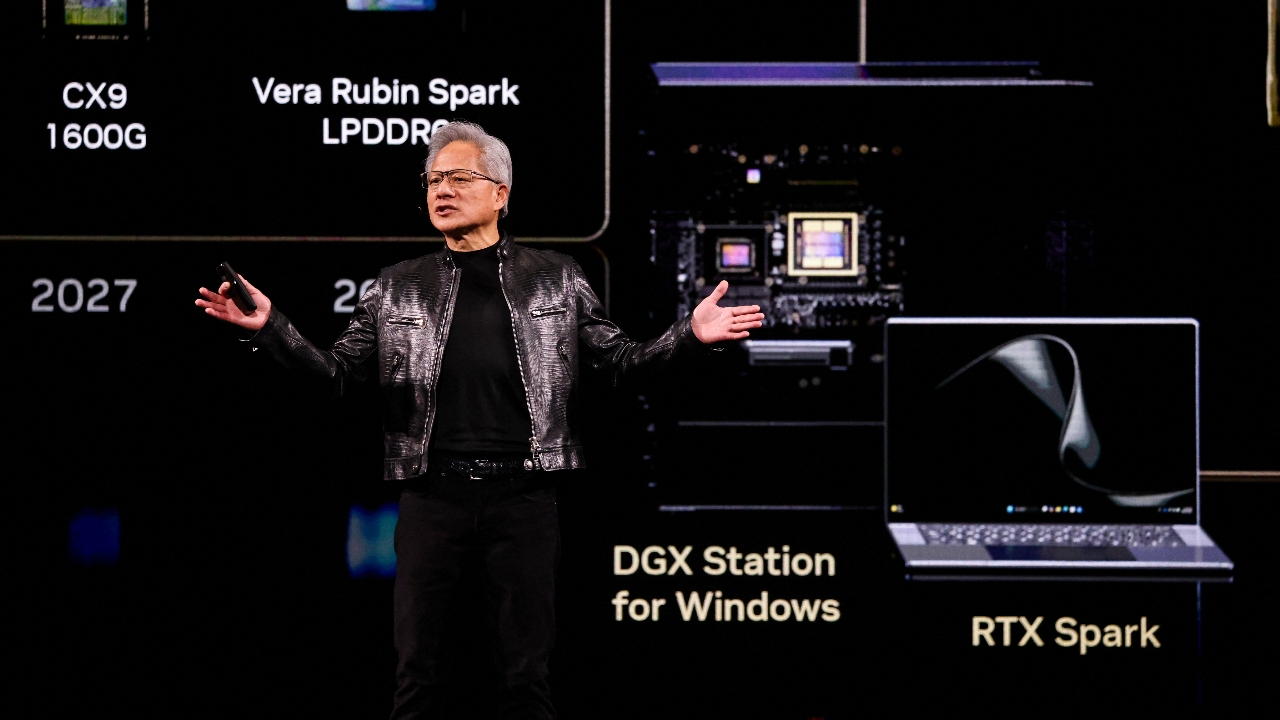
NVIDIA The hardware technology leader announced the launch of its latest processor chip for Windows-based personal computers, named "RTX Spark," advancing into the general consumer market with devices fully integrating artificial intelligence (AI) technology. Experts suggest this move challenges established market leaders such as Apple, Intel, and AMD.
Jensen Huang, CEO of Nvidia, delivered a keynote speech before the start of the global technology exhibition Computex in Taipei, Taiwan, unveiling the latest CPU chip for Windows operating systems called "RTX Spark."
Jensen Huang described this chip launch as a historic turning point, stating, "This computer revolution is as significant as the transformation of traditional mobile phones into what we now call smartphones." He added that it is an extraordinary computer capable of handling tasks from digital biology to earthquake processing and astrophysics without difficulty.
Nvidia's website describes RTX Spark as a "superchip" for the era of AI Agent-driven personal computers—artificial intelligence operating as agents—that elevates computers from mere "tools" to "colleagues" capable of performing tasks on users' behalf with ease.
New personal computers and laptops powered by the RTX Spark chip from leading manufacturers such as Lenovo, HP, Dell, Microsoft Surface, Asus, and MSI are scheduled for release this fall, with Acer and Gigabyte expected to follow later.
This move by Nvidia signals a direct challenge to major personal computer market leaders like Apple, Intel, and AMD, even though these new devices may launch at relatively high prices. Research firm Gartner reports that Lenovo, HP, Dell, and Apple collectively held nearly 75% of the global PC market share in the first quarter of this year.
This is not Nvidia's first time powering Windows devices, as some tablets used the company's chips in the early 2010s. However, the current industry views this as a key strategy for Nvidia to diversify its business into the general consumer market after consistently earning huge profits from selling data center processors to global tech giants, boosting Nvidia's market value beyond $5 trillion, surpassing the GDP of Japan or India.
Stephen Wu, former AI software engineer and founder of Carthage Capital fund, told AFP, "Nvidia is bypassing the traditional PC supply chain to build a comprehensive hardware monopoly from upstream to downstream." He views this new architecture as an "existential threat" to current laptop chip designs, with Intel and AMD expected to be the first directly affected.
However, Alena Yee, senior editor of PC World magazine, noted that amid a memory chip shortage driving hardware prices up, "The most important question might not be how powerful next-generation PC hardware will be, but whether buyers will still be able to afford it."
Additionally, Jensen Huang showcased the next-generation chip platform called "Vera Rubin," stating that the rising popularity of AI Agents is driving a massive increase in processing power demand. He dismissed concerns that AI would take away human jobs worldwide as "nonsense."
However, in this press conference, Jensen Huang did not address the political tensions between the U.S. and China regarding attempts to sell chips used to train and run AI systems in China, where the Washington government has tried to block Chinese companies from accessing advanced chips.
The U.S. Department of Commerce has closed legal loopholes that might allow the export of advanced AI technologies, such as Nvidia's Blackwell processors, to Chinese subsidiaries outside China. Although the U.S. eased export restrictions on the H200 chip to China in December, there are currently no signs of large orders from major Chinese tech firms, as Beijing is accelerating domestic chip development to compete with U.S. tech powers.