

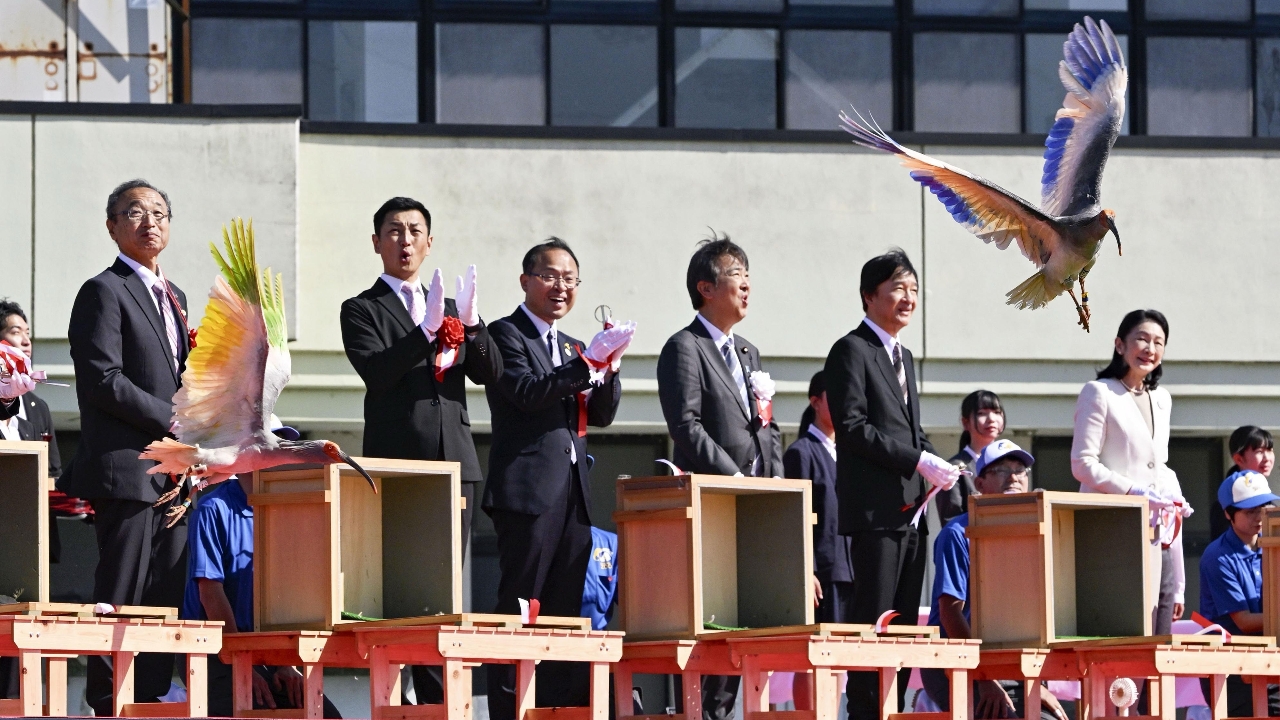
Japan held a ceremony to release eight crested ibis, also known as "Toki," back into the forests of the Noto region. The last wild crested ibis on Honshu Island was captured in Ishikawa Prefecture in 1970, more than 56 years ago, due to hunting and environmental degradation.
Japan officially released eight crested ibis (Crested Ibis), locally known as "Toki," back into the wild in an area recognized as the last natural habitat where these rare birds were spotted. In 1970, the last wild crested ibis on Honshu Island was captured in Ishikawa Prefecture.
The ceremony was attended by Crown Prince Akishino of Japan, Crown Princess Kiko, and senior officials, who jointly cut the ribbon to open the wooden cages. The crowd cheered as the white birds with red accents took flight once again. These eight birds were raised at a conservation center on Sado Island in Niigata Prefecture nearby, with ten more birds currently awaiting release into the wild.
The crested ibis is a native East Asian bird characterized by its pure white feathers with a pinkish-orange shade under the wings and bright red markings around the eyes. Historically, they faced intense hunting and habitat loss, leading to extinction on Honshu Island—the main island of Japan—in the 1970s. The last native Japanese crested ibis died in 2003 on Sado Island.
However, the species was revived through assistance from China. Japan's Ministry of the Environment revealed that in 1999, China gifted a pair of crested ibis to Japan, enabling successful artificial breeding and the birth of the first captive chick. Conservation efforts progressed steadily, and in 2008, Japan began releasing captive-bred birds back into the wild on Sado Island. Today, the population there has grown to around 500 birds.
The release of the Toki in the Noto region marks not only an environmental success but is also seen by local residents as a positive omen and symbol of hope for Noto, which is still recovering from the devastating earthquake that struck in 2024, both physically and psychologically.
The trend of conserving and reintroducing crested ibis is not limited to Japan. In 2019, South Korea successfully released 40 crested ibis back into the Upo Wetland in the southeast of Seoul, after the species had been extinct on the Korean Peninsula since 1979. The last sighting had been near the Demilitarized Zone between North and South Korea.