

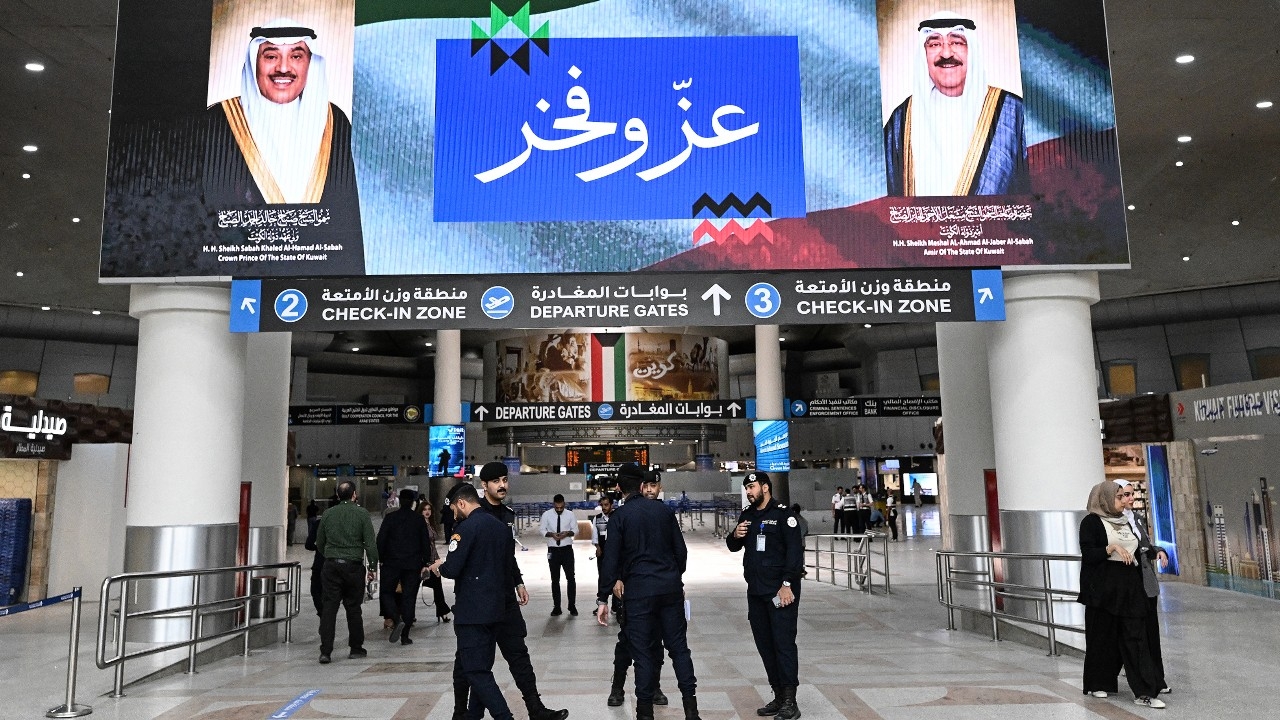
Tensions in the Middle East flared again after Iranian drones attacked the passenger terminal of Kuwait International Airport, resulting in one death and multiple injuries, and causing temporary suspension of flights. Meanwhile, the United States and Iran accused each other of initiating the new round of attacks.
Kuwait's Civil Aviation Authority reported that Iranian drone and missile strikes on one passenger terminal at Kuwait International Airport caused injuries and severe damage. The authority stated that all flights were suspended and redirected to alternative airports until further notice, with inbound flights rerouted accordingly.
Kuwait Airways announced it is resuming flight services from Kuwait International Airport, which had been damaged by previous Iranian drone and missile attacks. Kuwait Airways operates flights from Terminal 4 at the airport.
Earlier, the civil aviation authority said the damage from the Iranian attack occurred at Terminal 1, which is used by international airlines.
Kuwait's Ministry of Foreign Affairs stated, "Iran's aggression resulted in one death and multiple injuries." It also caused damage to key facilities and embassies.
Lieutenant Colonel Saud Abdulaziz Al-Atwan, spokesperson for Kuwait's Ministry of Defense, condemned the incident as "a malicious aggression by Iran," causing material damage and injuries. While not specifying exact numbers, he confirmed that the injured are receiving medical care. Kuwait Airport had only fully reopened on 1 June after suffering several attacks during the war.
This attack is a significant test of the ceasefire agreement reached on 8 April. The recent tensions began when Iran's Islamic Revolutionary Guard Corps (IRGC) claimed that US forces initiated attacks on a communications tower on Iran's Qeshm Island, prompting Iran to retaliate with missiles and drones targeting US airbases, helicopters, and the US Fifth Fleet in the region.
Meanwhile, the US Central Command announced it intercepted Iranian attacks, stating that two Iranian missiles fired towards Kuwait fell short or exploded mid-air before reaching their targets, while three missiles aimed at Bahrain were destroyed by air defense systems.
As both Kuwait and Bahrain were targeted simultaneously, Anwar Gargash, advisor to the President of the United Arab Emirates (UAE), called for Gulf countries to adopt a firm and united stance, saying, "Iran's aggression is not aimed at one country but at all of us."
Elsewhere, the conflict between Israel and the Hezbollah group in Lebanon continues intensely despite peace talks in Washington. US Secretary of State Marco Rubio identified Hezbollah as a major obstacle to a peace agreement.
Israeli Prime Minister Benjamin Netanyahu ordered intensified attacks in southern Beirut, Hezbollah's stronghold, citing repeated violations of the ceasefire by the armed group. However, US media Axios reported that former President Donald Trump directly called Netanyahu, expressing displeasure over the escalation, labeling it "crazy."
Since 2 March, more than 3,465 people have died in Lebanon, including six fatalities in a recent attack near the city of Tyre. Israel has lost at least 26 soldiers and one civilian contractor. In Kuwait, Terminal 1 suffered heavy damage with multiple injuries reported, though exact numbers remain unknown.
The situation remains precarious and risks escalating into a full regional war, as Iran has warned that if Israel continues expanding attacks in Lebanon, the ceasefire agreement between the US and Iran, effective since 8 April, may end immediately.
,AFP