

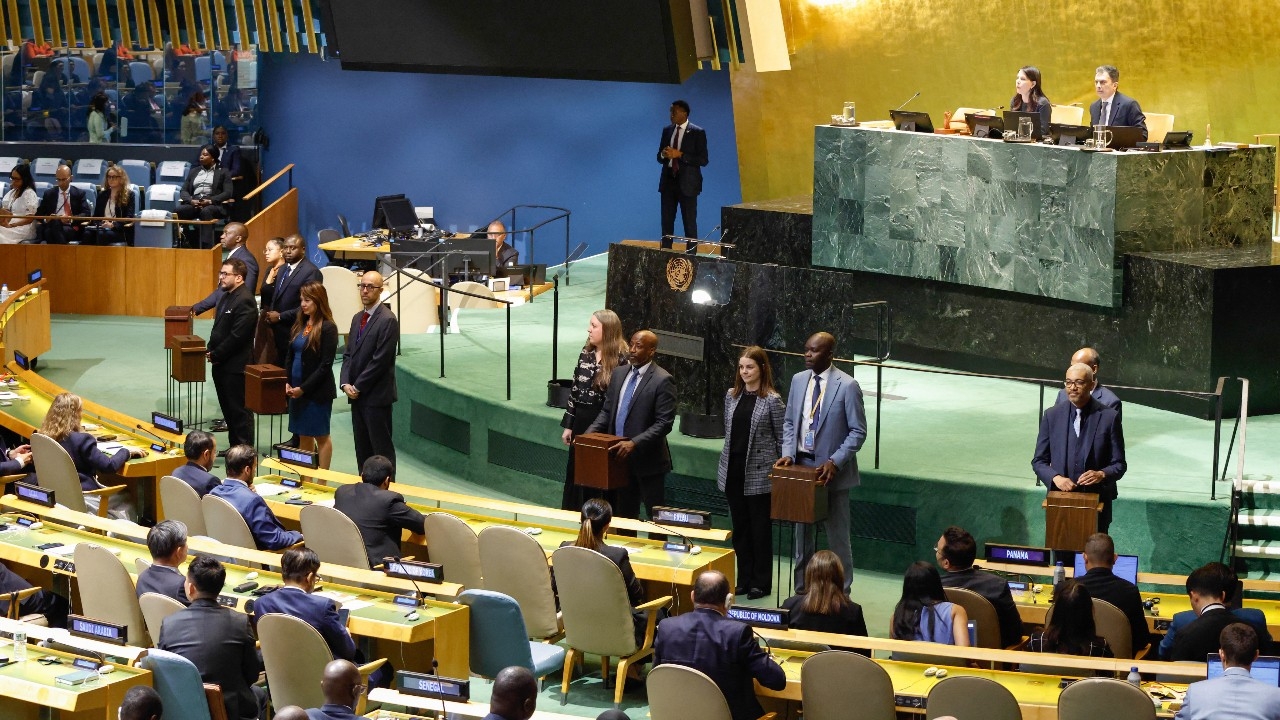
The United Nations General Assembly (UNGA) voted to elect five new non-permanent members to the United Nations Security Council (UNSC) for a two-year term starting in 2027. In a major upset, Germany, a European power, lost the vote to Portugal and Austria. In the Asia-Pacific group, Kyrgyzstan defeated the Philippines to win a seat for the first time since its founding.
In the UNSC non-permanent member election held on Wednesday (3 June), a major upset occurred in the Western European group when Germany, Europe’s largest economy which had lobbied heavily for the seat, was defeated in a secret ballot, receiving only 104 votes.
As a result, Portugal (134 votes) and Austria (131 votes) won the two seats in this group, replacing Denmark and Greece whose terms are ending. This defeat marks the first time Germany has failed to retain a seat on the Security Council, having previously served six terms.
Another significant vote was in the Asia-Pacific group between the Philippines and Kyrgyzstan. The voting was closely contested and required four rounds before Kyrgyzstan secured 142 votes against 49, surpassing the two-thirds majority required of General Assembly members. This made Kyrgyzstan the first time in its history to win a UNSC seat since joining the UN, replacing Pakistan.
In other regions without competition, Zimbabwe was elected from the African group with an overwhelming 182 votes, replacing Somalia. Trinidad and Tobago was elected from the Latin America and Caribbean group with 181 votes, replacing Panama.
The five new members—Austria, Kyrgyzstan, Portugal, Trinidad and Tobago, and Zimbabwe—will begin their two-year terms on 1 January 2027. They will join the current non-permanent members serving until the end of 2027: Bahrain, Colombia, the Democratic Republic of Congo, Latvia, and Liberia.
The UN Security Council consists of 15 members: five permanent members with veto power—the United States, Russia, China, France, and the United Kingdom—and ten non-permanent members elected on a regional rotation. The UNSC is the only UN body with the authority to pass legally binding resolutions, such as economic sanctions or authorizing military force.
Additionally, in the same week, the General Assembly elected Bangladesh’s Foreign Minister, Dr. Abdulla Shahid, as President of the 81st UN General Assembly session, who will officially take office in September.