

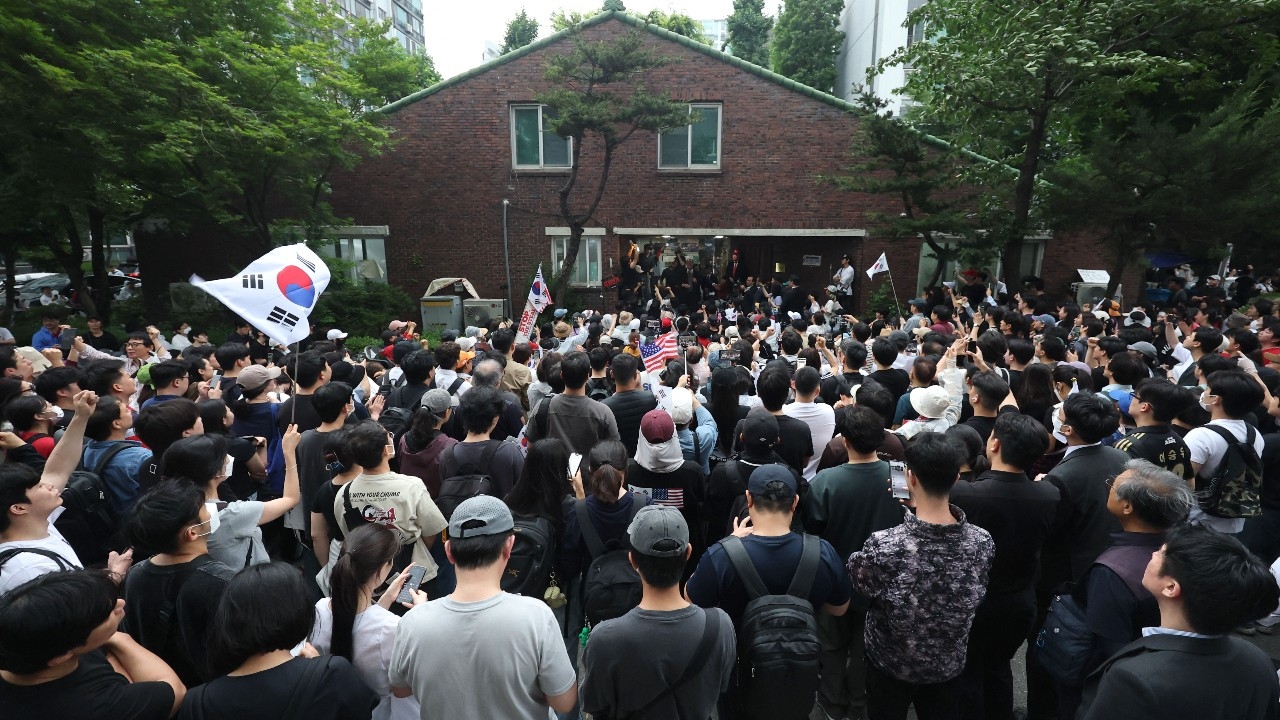
South Korean riot police dispersed over 1,000 protesters who had besieged a polling station in Seoul for 35 hours to prevent the transport of ballot boxes. The protesters were angered by "insufficient ballots" at several polling stations, which caused delays and concerns about election fraud, forcing extended voting hours.
Tensions arose on 3 June, the day of South Korea's ninth nationwide local elections. At polling station number 2 in Jamsil 7, Songpa District, Seoul, voting was suspended early due to "running out of ballots," prompting the Seoul Election Commission to extend voting hours until 10:00 p.m. for those already queued—a first-time measure. At least 14 other polling stations in Songpa, Gangnam, and Gwangjin districts faced similar shortages, causing long waits for many voters and some leaving without casting ballots.
The incident sparked intense public outrage, leading over 1,000 protesters to gather outside the polling station, holding signs saying "Stop counting votes!" and "This election is invalid!" They blocked officials from moving two ballot boxes containing about 2,000 votes, effectively trapping election commission staff inside the building from the night of 3 June until the morning of 5 June.
After a 35-hour standoff, on 5 June, South Korean riot police decided to disperse the protesters. Local TV footage showed officers forcefully carrying and dragging demonstrators blocking the polling station entrance amid shouting and violent resistance. One protester shouted, "Is this a country governed by the rule of law?"
Ultimately, officials regained control and safely transferred all ballot boxes to the vote counting center.
Heo Cheol-hoon, Secretary-General of the National Election Commission, issued an urgent apology to the public, acknowledging the mistake of underestimating voter turnout, which caused concern and damaged public trust in election transparency.
Meanwhile, Jang Dong-hyuk, leader of the People Power Party (PPP), which supports former President Yoon Suk-yeol who recently suffered a heavy defeat in local elections, visited the election commission office to file a legal petition under Election Act Section 196. He demanded "postponing and rerunning the entire election" and called for an immediate halt to vote counting for the Seoul governor seat, alleging officials attempted illegal ballot box transfers.
These local elections were a key test of popularity in President Lee Jae-myung’s first year in office, who came to power after former President Yoon Suk-yeol declared a short-term martial law that led to political chaos and his impeachment. Yoon is currently imprisoned and facing treason charges.
Although President Lee’s ruling coalition won in many regions, they failed to secure the Seoul governor seat. President Lee ordered an urgent investigation into the ballot shortage incident, condemning it as an "unacceptable failure."
Furthermore, the incident fueled right-wing YouTubers and supporters of former President Yoon to spread conspiracy theories about "election fraud" online, citing Yoon’s previous claims that the election commission’s data system was weak and vulnerable to North Korean interference, further eroding public confidence in South Korea’s election management.