

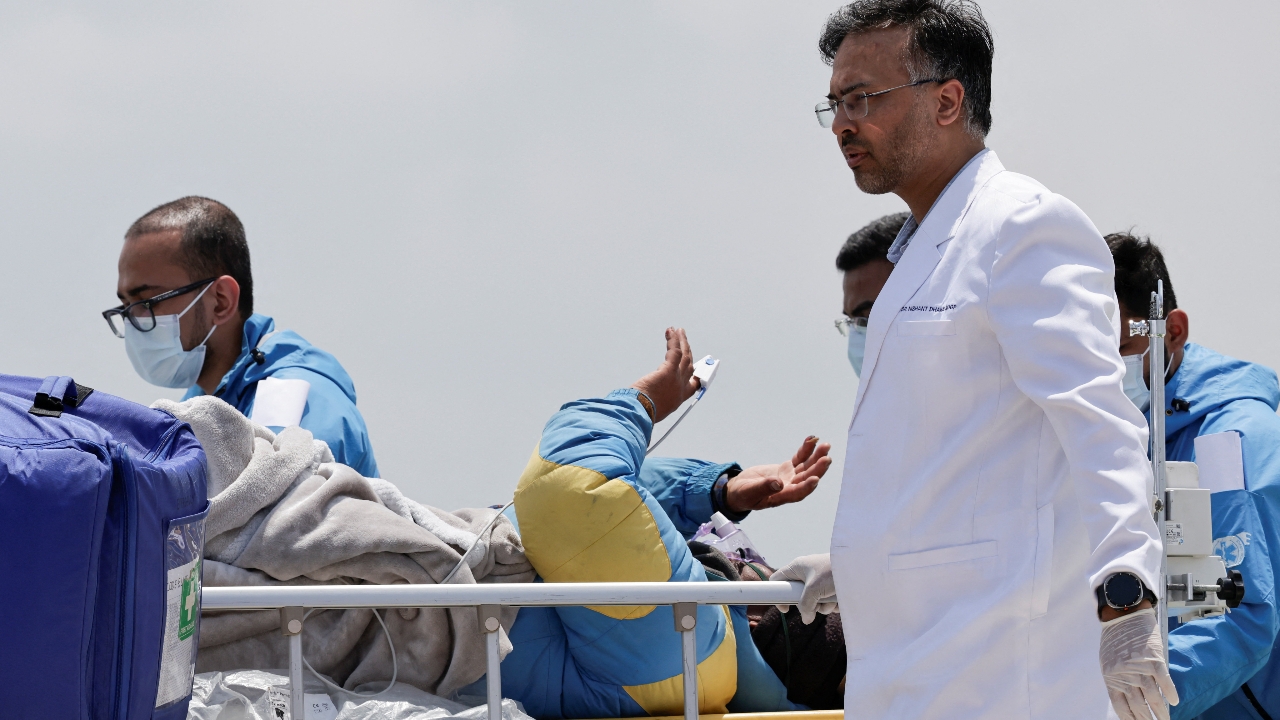
A Sherpa guide opened up about his six-day survival on the summit of Mount Everest, sustaining himself by chewing ice and eating a few remaining pieces of chocolate in his pocket before being rescued.
Dawa, a 57-year-old Sherpa guide, was found crawling down the mountain heading toward the base camp after everyone had presumed him dead on the world's highest peak.
Earlier, his family in Kathmandu, Nepal's capital, had begun funeral preparations according to their customs, as the search team believed he was unlikely to survive the harsh weather conditions on Everest.
But when a mountain cleanup team spotted his body sliding and crawling downward, everyone was stunned before rushing him to a hospital in Kathmandu.
While recovering from dehydration, frostbite, and broken bones, Dawa told the BBC he never thought he would survive and believed he was going to die right there.
He insisted he did not disappear during the descent but had to stay behind because he ran out of oxygen and couldn't continue walking. He said, "When the oxygen ran out, I couldn’t walk anymore. I didn’t eat anything for the first two days. Then I started chewing ice. It hurt my teeth a lot, but I had to do it."
He considered himself lucky to find a few pieces of chocolate in his pocket and was able to melt ice to drink and sustain himself.
Previously, Chris Throll, a British climber and former soldier, was the last person to see Dawa alive near Everest’s Camp 3 at about 7,500 meters elevation.
Throll recalled that Dawa was sitting on his pack resting as he had done hundreds of times before and appeared to be taking a temporary break.
After helping a Polish climber who was out of oxygen and suffering severe frostbite, Throll looked back toward Dawa again but saw no light from his headlamp and thought he might not be able to descend.
While trying to move down the mountain, Dawa fell into a crevasse and was trapped inside for as long as two and a half days.
He had almost no way out until an avalanche filled the crevasse with snow, creating a chance for him to climb out. After emerging, he found a rope left on the path and used it to slowly make his way down the world's highest mountain.
Despite facing another avalanche, he continued moving, walking all night until he approached the base camp.
There, he encountered people for the first time in nearly a week—a group collecting trash on the mountain—who then helped bring him down.
News of Dawa’s survival surprised the Sherpa community, fellow climbers, and his family.
Pemba Sherpa, executive director of 8K Expeditions, which managed the search, said this survival was a true act of self-rescue. He described Dawa’s ability to survive several days in nearly impossible conditions as nothing short of a miracle.
Chris Throll said he initially thought the social media news of Dawa being found alive was fake. He found it incredible, especially after moments when he had to hold back tears with his daughter. But soon after, seeing Dawa crawling back was beyond words.
Dawa’s wife, Damu Sherpa, said the family had lost hope after being informed rescue might be impossible and had begun funeral preparations. She admitted she was very shocked upon first seeing him and could hardly believe he was alive.
Doctors at HAMS Hospital in Kathmandu revealed that Dawa remains under close ICU care, with his condition stable and dehydration improving significantly.
This Everest climbing season saw more than 1,000 climbers reach the summit, making it the busiest season on record. Since records began in the 1920s, over 300 people have died on Everest.
Source:BBC
Click to read related news aboutInternational News