

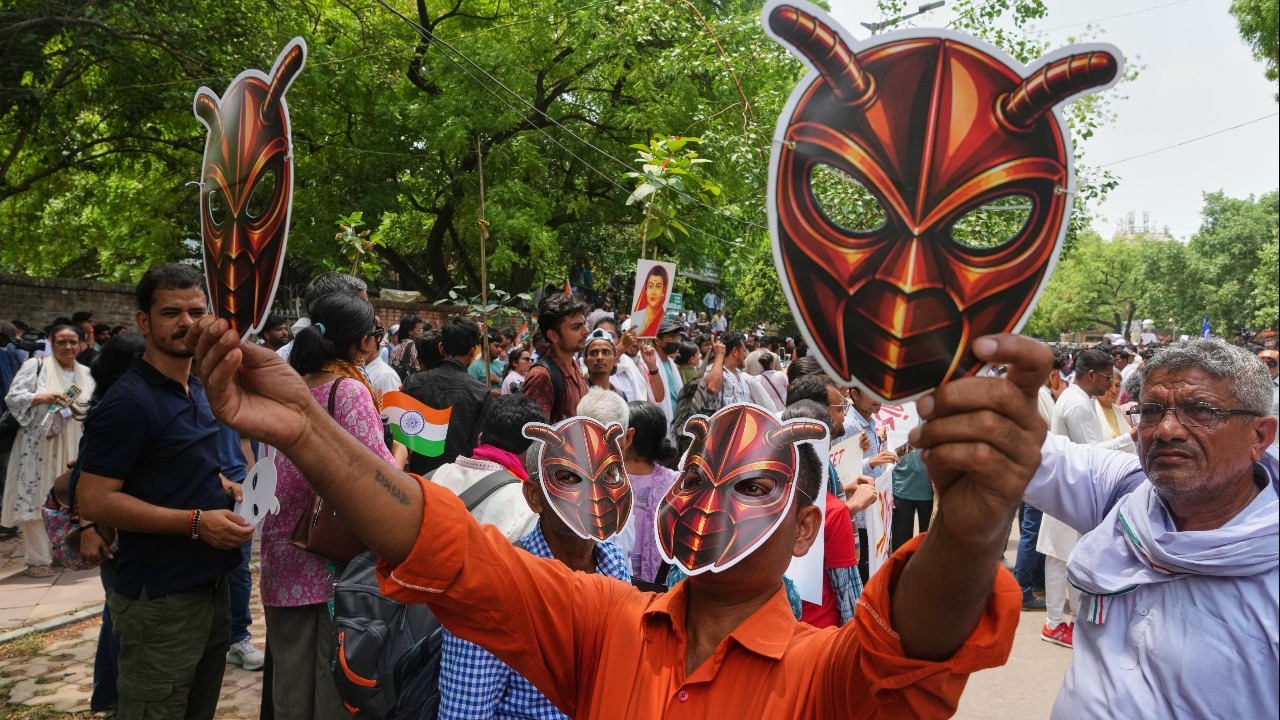
India's "Cockroach Janata Party" (CJP), which began as a political parody online with over 22 million followers, held its first street demonstration in New Delhi amid growing youth dissatisfaction with the education system, examinations, and unemployment. Protesters demanded the Education Minister resign within seven days.
Hundreds of supporters of the "Cockroach Janata Party" (CJP), mostly young people, officially gathered for the first time on Saturday, 6 Jun 2024 GMT+7, near Jantar Mantar close to the Parliament building in New Delhi. The movement had gone viral and dominated Indian media for several weeks prior.
The key trigger for this protest was recent reports of corruption and lack of transparency in competitive exams, which became an outlet for Indian youth frustrated with the education system and extremely limited job opportunities. The official CJP account on platform X posted before the protest: "It's time to turn this little joke into a revolutionary strategy." Notably, India's youth make up more than a quarter of the country's population.
Apichit Tipke, an Indian student at Boston University and founder of the online movement, returned from the U.S. to join the rally. Initially, police set up metal barricades at the arrivals area of New Delhi International Airport, but Tipke later revealed that authorities allowed the protest to proceed peacefully.
Leaders and participants raised the Indian national flag and held "books," which organizers said symbolized reclaiming educational rights and equal opportunities. They repeatedly chanted for the resignation of Dharmendra Pradhan, Minister of Education. On Saturday evening, CJP issued an ultimatum giving the government seven days to remove Pradhan or have Prime Minister Narendra Modi dismiss him. Without action, the "Cockroach" movement vowed to expand and escalate protests nationwide.
Protester Mansi Sehgal, 26, said, "The protest may have started over exam issues, but deeper problems are that young people have no platform to voice concerns or question authority. CJP provides that space, becoming the first place where people can connect to demand truth."
The CJP was founded only three weeks ago online, sparked by a derogatory metaphor used by India's Chief Justice in May 2024 GMT+7, who called government critics and unemployed youth "cockroaches" during a court case. Political communications strategist Tipke turned this insult into satire by creating a mock political party. The party's Instagram page quickly gained over 22 million followers.
"Cockroach" has become a symbol of resilience and sharp political expression, with memes and humorous videos mocking unemployment, corruption, and government mismanagement that have amassed millions of views. Supportive youth often jokingly call themselves unemployed internet dwellers, feeling excluded from policy participation under Modi's government.
This rally serves as a crucial test of whether an online-famous movement can convert digital popularity into grassroots power to tackle economic challenges facing young Indians. Moreover, observers will watch how the "Cockroach Party" handles government crackdowns, as Modi's administration has a decade-long record of forcefully breaking up protests, including citizenship law and farmers' protests, with many activists arrested.
Meanwhile, supporters of India's ruling Bharatiya Janata Party (BJP) dismissed the movement as a mere "social media gimmick" with temporary popularity, arguing that online fame cannot translate into sustainable mass street power.
Nevertheless, the CJP phenomenon reflects a broader South Asian trend where youth leverage social media to lead anti-government protests, as seen in Sri Lanka, Bangladesh, and Nepal. Young people are losing faith in traditional politics and worry about rising inequality and increasing religious divisions in Indian society.