

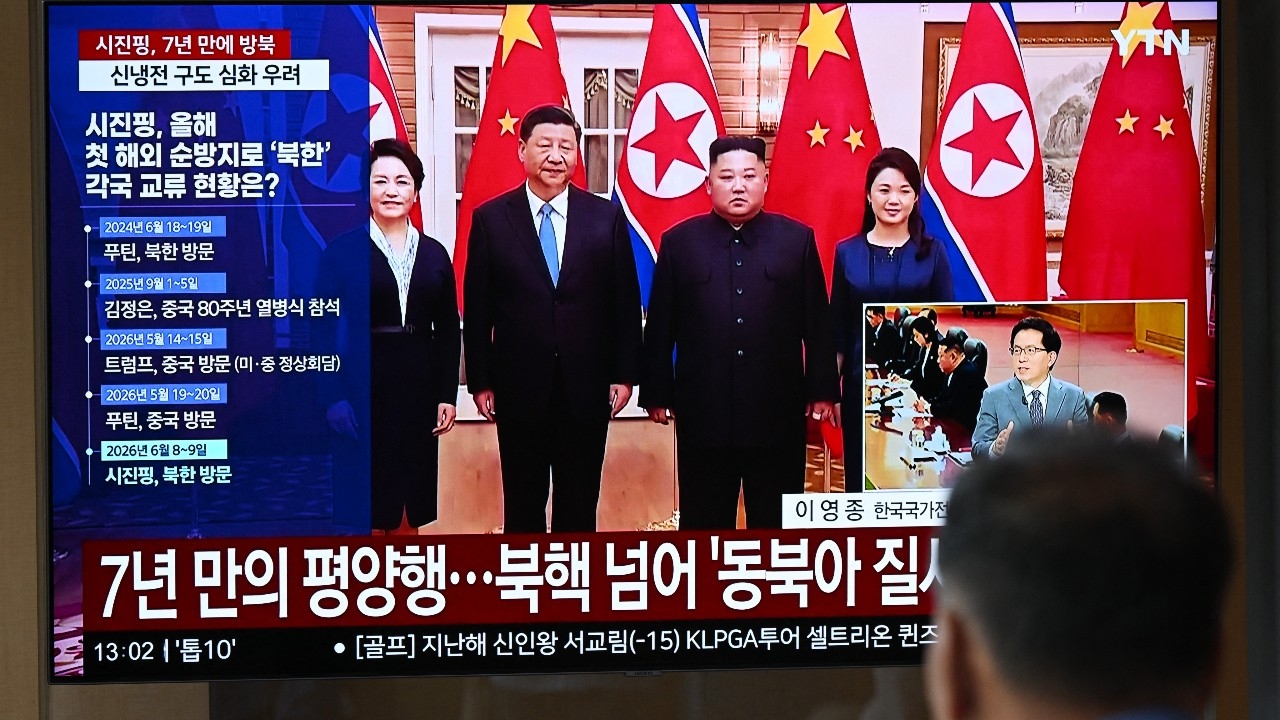
Chinese President Xi Jinping made his first official visit to North Korea since 2019, receiving a grand welcome from Kim Jong Un. He reaffirmed an "unbreakable friendship" after previously attending summits with Donald Trump and Vladimir Putin, during which China pledged to guarantee North Korea's security.
Chinese President Xi Jinping officially arrived in Pyongyang, North Korea, today (8 June), marking his first foreign trip this year. This follows his recent hosting of U.S. President Donald Trump and Russian President Vladimir Putin at a summit in Beijing.
Video footage from China's Xinhua News Agency showed an Air China plane landing, greeted by an honor guard lined up on a red carpet. North Korean Supreme Leader Kim Jong Un and his wife Ri Sol Ju personally welcomed Xi Jinping and his wife Peng Liyuan at Kim Il Sung Square, amid military band music and crowds waving national flags and flowers. Large banners read "Warmly Welcome Comrade Xi Jinping" and "Eternal Friendship Between North Korea and China."
Xi Jinping conveyed a message through a front-page article in North Korea's Rodong Sinmun newspaper, stating, "No matter how times change or how the international situation evolves, the traditional friendship between China and North Korea will always remain strong and unbreakable."
This visit comes amid a stalemate in denuclearization talks between North Korea and the United States, despite the White House revealing that at the recent Beijing summit, Xi Jinping and Donald Trump "confirmed a shared goal of North Korea's denuclearization."
Additionally, on the night before Xi's arrival, Kim Jong Un's sister, Kim Yo Jong, officially declared that North Korea's nuclear weapons program is a "line that will never be crossed back." This aligns with North Korea's longstanding stance as a nuclear-armed state that is "unchangeable," ever since talks between Kim and Trump collapsed in 2019.
South Korean President Lee Jae-myung stated that South Korea will not give up on North Korea's denuclearization, warning that "North Korea continues to produce nuclear materials even at this very moment."
Minseon Ku, a diplomacy professor at DePaul University, told AFP, "The Chinese government may have effectively accepted North Korea as a nuclear state, but what Xi will tell Kim is that China desires maximum stability."
Meanwhile, Sungyun Lee, a visiting scholar at Harvard University's Asia Center, analyzed that China is shifting its strategy from pressuring denuclearization to "guaranteeing the survival of North Korea's regime." China's regional strategy benefits from having North Korea as a heavily armed "buffer state" allied with China, diverting the U.S. and its regional partners like South Korea and Japan's military attention and cooperation elsewhere.
Moreover, this visit is seen as China's effort to counterbalance Russia, which has sought to extend its influence over North Korea by sending military forces and technology amid the Ukraine war, as well as sending a warning to Japan under Prime Minister Sanae Takaichi, a security hawk who has threatened military intervention if China invades Taiwan.
The relationship between the two countries is not only a legally binding formal military alliance but China also remains North Korea's most important economic pillar amid heavy international sanctions.
Data shows that trade value between China and North Korea in the first two months of 2026 surged by 22% compared to the same period in 2025. North Korea relies on nearly all imports from China, including fuel, food, electronics, machinery, vehicles, and textiles.
Conversely, China is a major market for North Korean exports such as hairpieces and wigs, which constitute a large share of exports, as well as tungsten ore, frozen seafood, iron and steel products, and watch parts. Additionally, United Nations reports state that North Korea continues to earn income by sending tens of thousands of workers abroad, especially to China and Russia, in construction, logging, manufacturing, and fishing sectors. These funds and goods give Xi Jinping significant leverage and influence over Kim Jong Un.
Source: AFP /BBC