

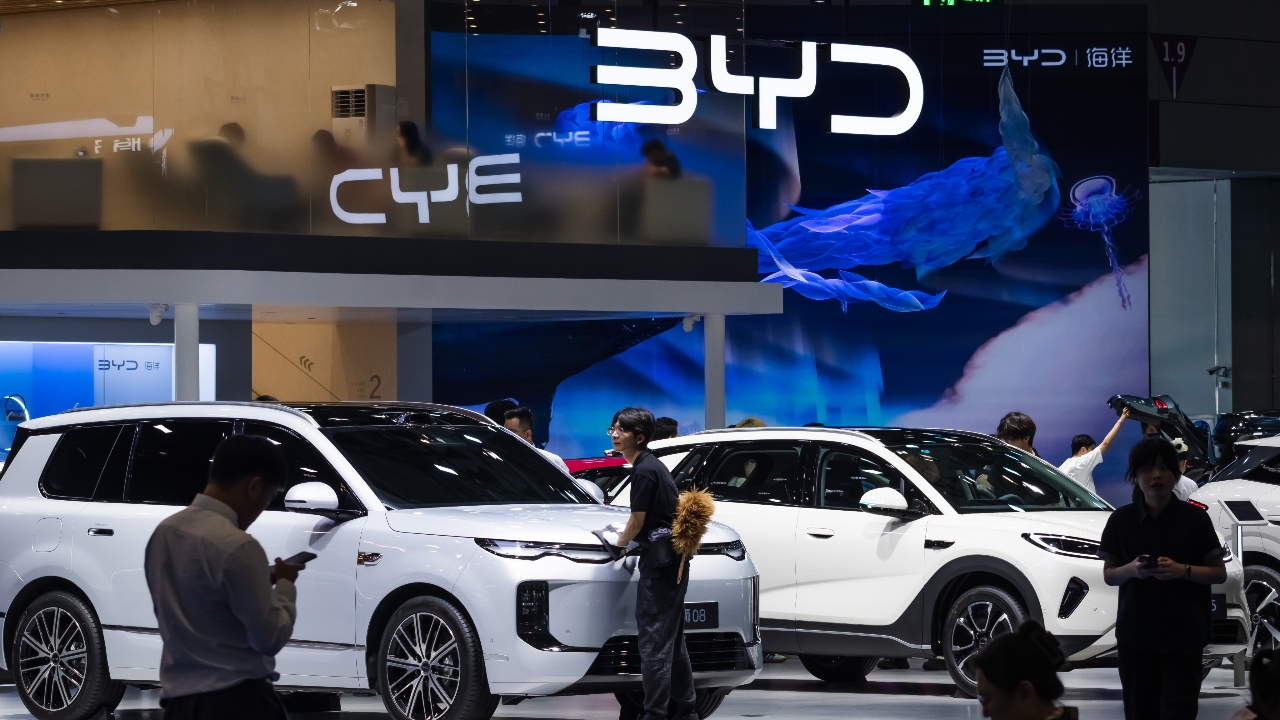
The US Department of Defense has added leading Chinese technology and industrial companies, including BYD, Alibaba, and Baidu, to a list of firms accused of connections to the Chinese military amid strategic competition between the two superpowers. China immediately responded, calling the measure discriminatory and harmful to a fair business environment.
The US government announced a significant escalation in economic pressure on China, with the Department of Defense (Pentagon) officially updating a list in a government statement to include several major Chinese technology and electric vehicle firms under the "Companies with Links to the Chinese Military" list, known as Section 1260H. This move risks intensifying tensions between the US and China.
The newly blacklisted global Chinese companies include e-commerce giant Alibaba, Baidu, a leader in search engines and artificial intelligence (AI), BYD, the world's largest electric vehicle manufacturer, as well as electric car maker Nio and commercial aircraft producer Comac.
Additionally, leading Chinese memory chip industry giants CXMT and YMTC, biotech company WuXi AppTec, and top robotics developers Unitree and RoboSense were also blacklisted. Notably, Unitree was recently in the news for plans involving US chip giant Nvidia to collaborate on robotics research.
Although being named on the Section 1260H list does not immediately impose economic sanctions, new US legislation clearly prohibits the Department of Defense from directly contracting with these companies, as well as from procuring goods or services through third parties, effective from 2027 onward.
This measure sends a strong warning to Pentagon suppliers, as well as all US government agencies and businesses, about the risks of engaging with these Chinese firms. The US government views their business models as examples of "civil-military fusion," where commercial technologies might enhance China's military capabilities.
John Mulanar, chairman of the US House Special China Committee, stated, "This updated list serves as a warning to American businesses, all levels of government, and the public that these Chinese companies are collaborating with the Chinese military against our national interests."
Following the Pentagon's announcement, the Chinese giants strongly denied the allegations. An Alibaba spokesperson said, "These claims are completely unfounded. Alibaba is not a Chinese military company and is not part of any civil-military fusion strategy. We will take all legal measures to protect our company's reputation from this distortion of facts."
Baidu also rejected the accusations as "lacking credible basis" and is prepared to pursue all channels to remove its name from the list. Similarly, WuXi AppTec called the designation "an error" and vowed to file an immediate objection.
Meanwhile, the Chinese Embassy in Washington issued a strong statement condemning the blacklist as discriminatory and unfairly targeting Chinese companies. It urged the US to cease such wrongful actions and to create a fair, equal, and non-discriminatory business environment for Chinese firms.
Craig Singleton, a China expert at the Foundation for Defense of Democracies in Washington, said the announcement serves as a wake-up call after President Donald Trump’s recent visit to Beijing and meeting with President Xi Jinping to ease trade war tensions a few weeks ago.
"The US no longer views these companies as independent private entities but sees all of China's technological infrastructure as a strategic competition zone that cannot be conceded."