

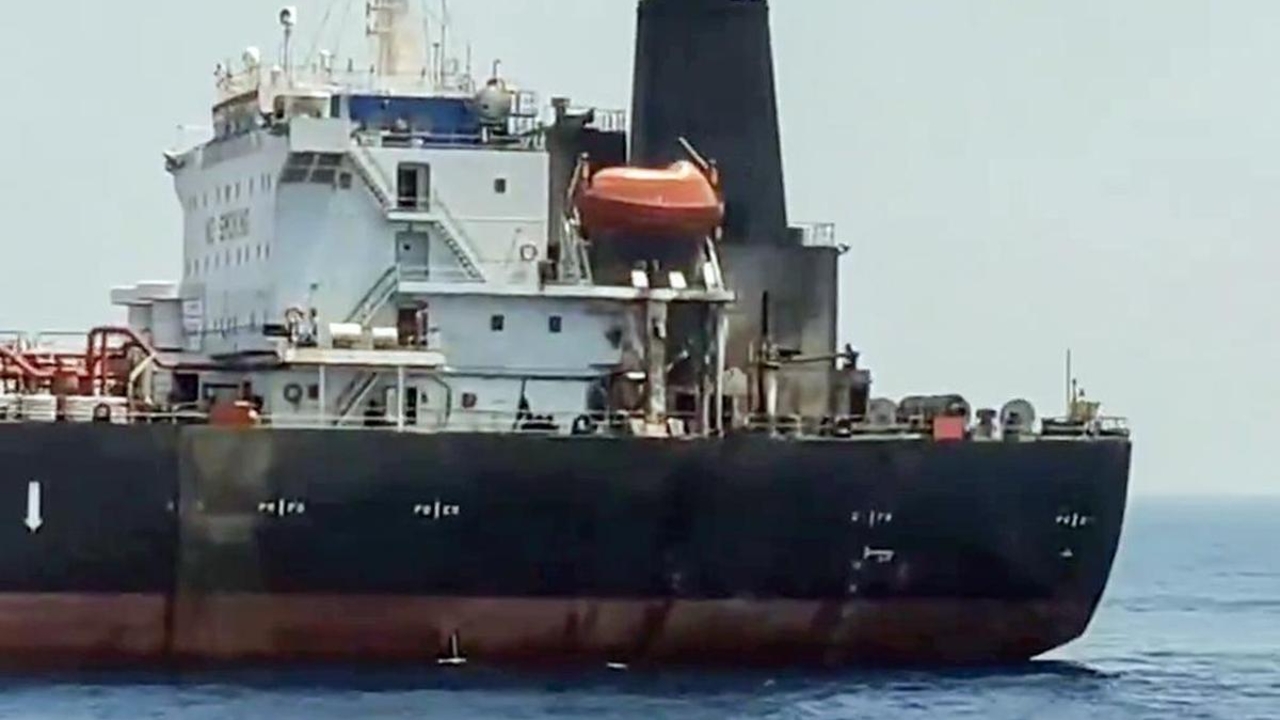
The Indian government has confirmed that three Indian crew members died as a result of a U.S. military operation against an oil tanker in the Gulf of Oman. This operation is part of efforts to intercept oil shipments linked to Iran. These are the first casualties since the U.S. began its maritime blockade in April. Meanwhile, India summoned the U.S. diplomat to lodge a strong protest.
Sarbananda Sonowal, India's Minister of Ports, Shipping and Waterways, issued a statement confirming that the three Indian crew members previously reported missing have now been confirmed dead after authorities recovered and identified their bodies.
The incident occurred when the U.S. Central Command deployed fighter jets to precisely strike the oil tanker named "MT Settebello," flying the flag of Palau, in the Gulf of Oman. The U.S. military stated it was necessary to launch guided missiles at the ship's engine room because the crew repeatedly ignored orders from American forces while attempting to violate sanctions by transporting oil from Iran.
Following the attack, the Royal Navy of Oman dispatched rescue units responding to distress signals from the Settebello, as a severe fire broke out in the engine room. India's Ministry of External Affairs stated that 21 Indian crew members were rescued alive.
A senior source indicated that the Indian government immediately summoned the U.S. Deputy Chief of Mission in India to deliver a formal letter of "strong protest" against what it considered an excessive military operation.
India's authorities are particularly displeased because this is the second attack on a merchant vessel with predominantly Indian crew within a week. On 8 June, the U.S. military struck another Palau-flagged oil tanker named "MT Marivex" in the Gulf of Oman after the empty vessel attempted to head towards an Iranian port. Oman dispatched helicopters to evacuate 24 Indian crew members amid thick black smoke emanating from the bridge and accommodation areas.
Additionally, on Thursday, the Indian Embassy in Oman received reports of another oil tanker incident. The Indian Seafarers' Union identified the vessel as "MT Jalveer," with details still under investigation.
Sarbananda Sonowal stated, "It is deeply tragic that such a calamity occurred on the MT Settebello. The government stands firmly with the families of the deceased during this difficult time. I have ordered officials to expedite the repatriation of the surviving crew and coordinate the swift return of the deceased for religious rites in their hometowns."
This loss marks the first crew fatalities since the U.S. government initiated its maritime blockade on 13 April 2026 to intercept shadow naval forces, primarily old vessels lacking insurance from Western financial institutions but used to circumvent laws to transport sanctioned Iranian oil. The U.S. Central Command reports that the blockade has disabled eight violating vessels, forced 134 compliant ships to turn back or change course, and allowed 42 relief cargo vessels to pass.
The situation raises serious concerns for the commercial shipping industry since India is the world's third-largest exporter of maritime labor, with over 300,000 Indian nationals employed as seafarers across global merchant fleets.
Arsenio Dominguez, Secretary-General of the United Nations' International Maritime Organization (IMO), issued a statement condemning "in the strongest terms any actions by any parties that endanger the lives of seafarers and the safety of international shipping. Such actions are completely unacceptable."
This maritime crisis occurs amid heightened political tensions, as next week the Group of Seven (G7) summit is scheduled. Indian Prime Minister Narendra Modi is expected to hold bilateral talks with U.S. President Donald Trump, where the killing of Indian crew members could become a significant point of contention threatening the relationship between the two powers.
SourceReuters/ AFP