

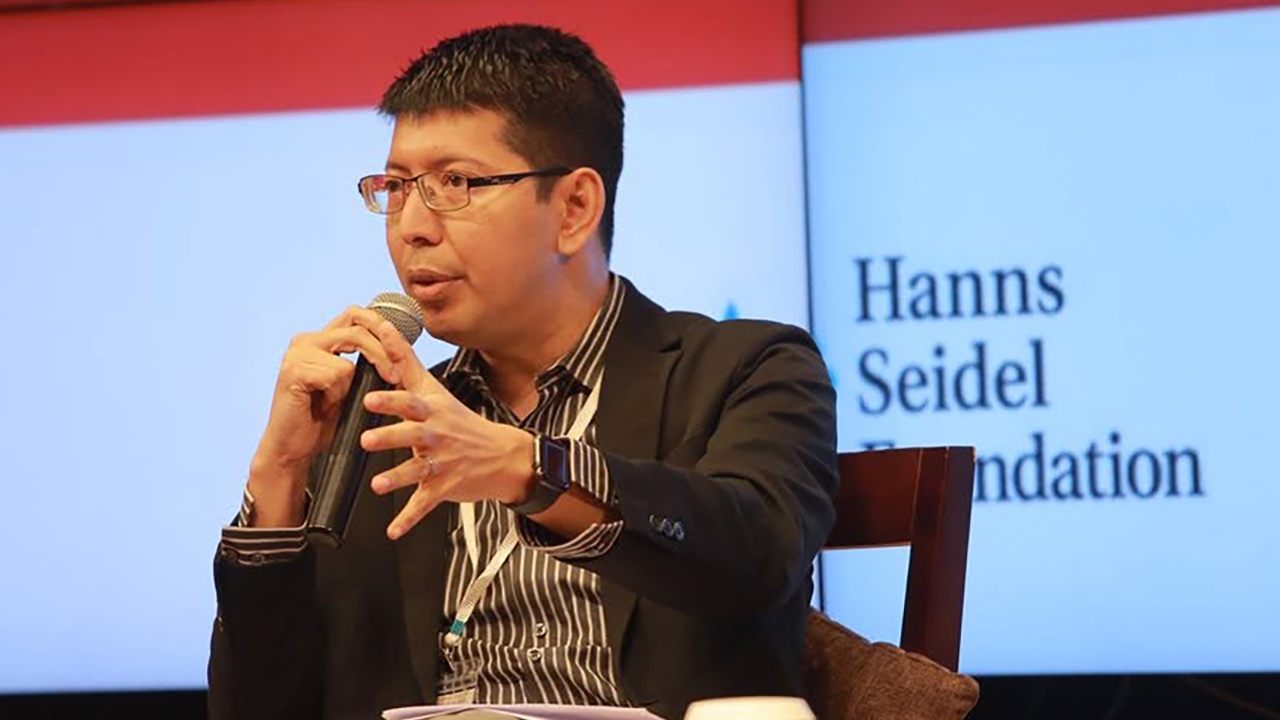
China's Ministry of Foreign Affairs confirmed the detention of Min Zin, an American scholar and director of a Myanmar research institute, stating he is suspected of involvement in espionage and activities threatening China's national security. Meanwhile, the United States has yet to issue an official comment on the matter.
Lin Jian, spokesperson for China's Ministry of Foreign Affairs, revealed during a daily press briefing that Mr. U Min Zin was legally detained by relevant authorities on criminal charges due to suspicion of involvement in espionage activities harmful to national security.
An anonymous source, citing the sensitivity of the issue, disclosed that Min Zin, executive director of the Institute for Strategy and Policy-Myanmar (ISP-Myanmar), was detained by Chinese authorities on 3 June upon arrival at Kunming International Airport in Yunnan Province, which borders Myanmar. The source added he had come to attend a meeting in China. His family and colleagues are currently coordinating closely with the U.S. consulate amid growing concern.
Regarding Min Zin’s background, he was a student leader participating in the major 1988 pro-democracy movement in Myanmar, known as the 8888 Uprising, before pursuing political science studies at the University of California, Berkeley, in the United States, where he later obtained American citizenship.
Min Zin is a co-founder of ISP-Myanmar, originally based in Myanmar but forced to relocate to Chiang Mai, Thailand, a hub for Myanmar political exiles, following the 2021 military coup in which Myanmar’s armed forces seized power from the democratically elected government of Aung San Suu Kyi.
Under Min Zin’s leadership, ISP-Myanmar is a think tank closely monitoring and researching Myanmar’s political dynamics, natural resources, and conflicts, especially the prolonged civil war between the Myanmar military and ethnic armed groups and pro-democracy forces.
Recent articles and research reports published by ISP-Myanmar have deeply examined Myanmar’s political transition after Senior General Min Aung Hlaing, the military leader, assumed the presidency following an army-organized election widely criticized for excluding major opposition parties and amidst Myanmar’s economic failures.
Some reports have also exposed and analyzed "China’s influence" along Myanmar’s border areas, with analysts and ISP-Myanmar noting that the Chinese government has alternately supported both Myanmar’s military and ethnic rebel groups over time to protect its own economic and security interests, a stance conflicting with China’s current official support for Myanmar’s new government.
However, Chinese authorities have not yet disclosed specific details regarding the espionage activities Min Zin is alleged to have committed. Meanwhile, the U.S. State Department and ISP-Myanmar have not issued official statements regarding this detention.
. Reuters/ AFP