

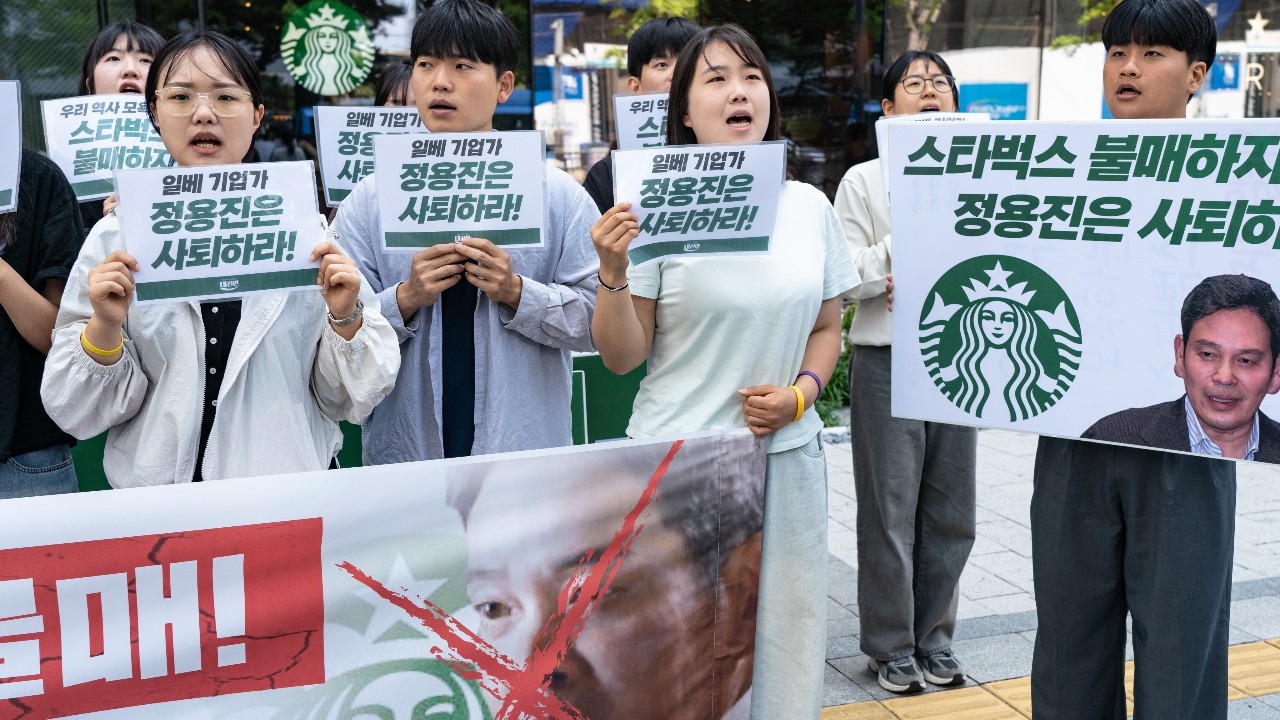
Shinsegae Group and Starbucks South Korea are preparing to conduct historical awareness and social issue training for all employees, from the company chairman to baristas at stores. They also announced an early nationwide closure of all Starbucks branches for the first time in history to allow staff to attend the training, following a scandal involving the "Tank Day" marketing campaign, which was criticized for mocking and disrespecting the Gwangju Massacre.
On 18 May, which marked the anniversary of the military dictatorship's suppression of the democracy movement in Gwangju, Starbucks Korea launched a promotional campaign called "Tank Day" for a special cup.
The term "Tank" is slang used by far-right online communities in South Korea to refer to former President Chun Doo-hwan, the military dictator responsible for violently suppressing civilians, resulting in hundreds of deaths. Moreover, the campaign's promotional materials included the phrase "Tak! on the desk!"—where "Tak" mimics a loud slap sound. This phrase is infamous from the dictatorship era, when police claimed that after slapping a table, a student named Park Jong-chol died of a heart attack during torture in 1987, using this as a justification.
This incident caused significant public outrage, prompting Jung Yong-jin, chairman of Shinsegae Group, to issue an official apology on 19 May. He acknowledged it as "an unforgivable mistake and a desecration of the pain and sacrifices of democracy activists," and pledged to overhaul the content review system.
To demonstrate responsibility and prevent recurrence, Shinsegae Group announced a measure described as a "historic step." On 17 June, Jung Yong-jin, along with executives and staff from E-Mart and Starbucks Korea headquarters, will undergo training on history and social sensitivity.
On 22 June, Starbucks Korea will close all branches nationwide at 3:00 p.m. so that all baristas and store staff can watch the training video together. This marks the first early nationwide closing since Starbucks began operations in South Korea in 1999. Then, on 24 June, Chairman Jung and CEOs of all E-Mart affiliates will attend a special training session before the monthly executive meeting to reaffirm management's shared responsibility. Starting 1 July, retail employees at E-Mart will begin a two-week online training course.
The historical training will be delivered by Professor Oh Jae-yeon from the History Department at Sungkyunkwan University, an expert on contemporary Korean history, covering key events from the 1950s onward. The social sensitivity training will be conducted by Professor Koo Jung-woo from the Sociology Department at Sungkyunkwan University, focusing on issues businesses must consider, including history, labor, gender, and human rights.
In addition to training, Starbucks Korea has reformed its marketing campaign approval system for both online and offline content. External consultants have been appointed to develop a "social sensitivity assessment" tool.
Under the new system, teams must evaluate risks from the planning stage, expanding beyond legal and brand compatibility checks. It now strictly screens for sensitive social issues such as "history, significant dates, politics, disasters, military, gender, violence, and hate speech" to avoid content that undermines important commemorations or insults any group.
The review period will also be extended to prevent errors caused by rushing. Reporting formats will be simplified for clarity, and all campaigns must receive final approval from multiple departments, including legal and quality control, before public release.
Meanwhile, Starbucks plans to establish a social support fund to aid the restoration of modern historical sites and support projects related to national historical commemorations. Shinsegae Group concluded by stating it will use this opportunity to turn a crisis into a chance to drive the organization toward becoming a socially responsible company that truly grows alongside the South Korean people.