

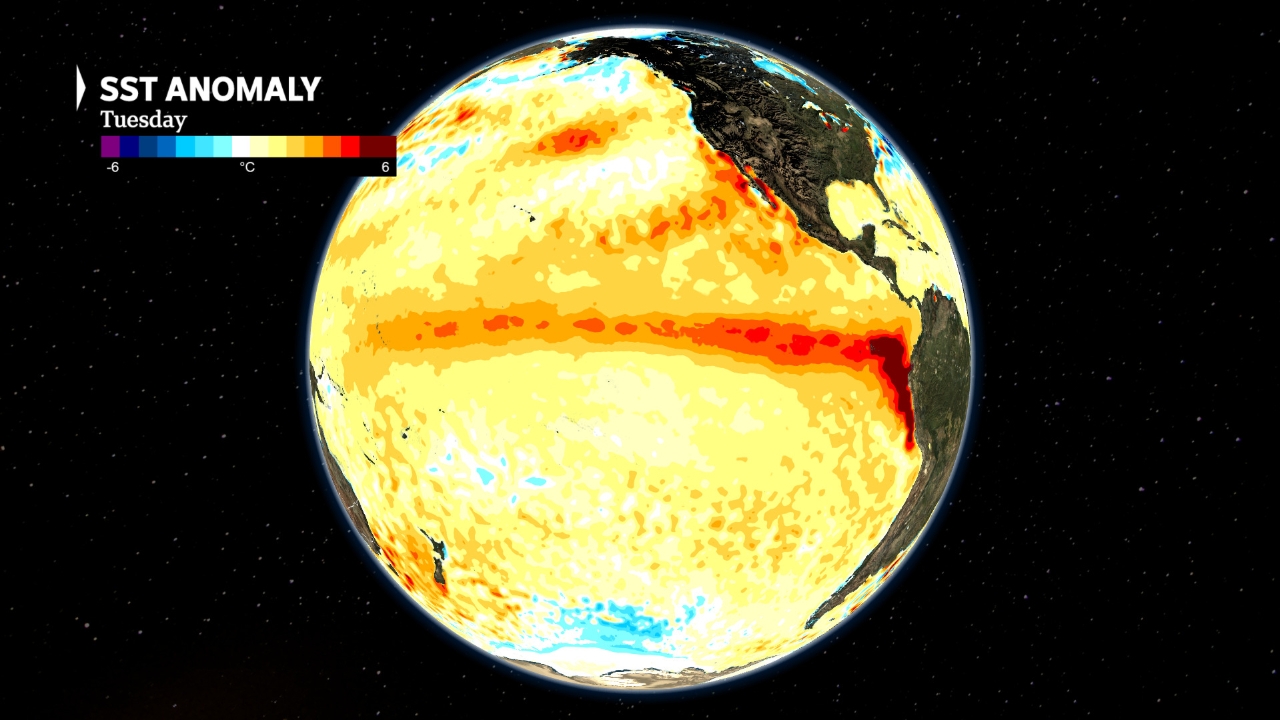
The Australian Bureau of Meteorology has officially warned that the "El Niño" phenomenon has formed in the tropical Pacific Ocean. Climate models clearly indicate it is likely to rapidly intensify in the second half of 2026 and may become the strongest El Niño in 70 years.
The Australian Bureau of Meteorology (BOM) announced that atmospheric indices and sea surface temperatures in the tropical Pacific Ocean have surpassed threshold levels, fully entering El Niño conditions. The rate of sea surface temperature increase in the key monitoring area, Niño3.4, this year is the fastest since 1943.
Furthermore, the 30-day Southern Hemisphere atmospheric variability index plunged to -23.3, far below the typical El Niño threshold of -7, signaling an extreme fluctuation in pressure differences between Australia and Tahiti.
Australia’s climate model, ACCESS-S, predicts this El Niño could push sea surface temperatures along the equatorial Pacific more than 3 degrees Celsius above average, shattering the previous record of 2.65 degrees Celsius set in November 1902. About half of other research institutes estimate this will be the most severe event since 1950, with global warming accelerating these extreme weather conditions.
BOM experts explained that declaring El Niño is an "observation" of conditions in the tropical Pacific Ocean, not a forecast specific to any one country. Australia is surrounded by three oceans; currently, the Indian and Southern Oceans are influencing weather patterns to bring rainfall, temporarily easing drought.
However, as El Niño fully develops in the latter half of the year, southern and eastern Australia are expected to rapidly transition into drought conditions.
Because El Niño is forming early this year, it has time to build strength and peak between November and January. Globally, Asia is expected to face hotter, drier weather than usual, already affecting agricultural growing seasons and raising serious concerns about food security in the world's most populous region.
In contrast, the Americas will likely experience excessive rainfall, increasing risks of major floods and landslides. Australia, as a major exporter of beef, sugar, and wheat, will suffer significant damage. The winter through summer period is expected to see higher daytime temperatures, more frequent nighttime frost, reduced snowfall, prolonged severe drought leading to longer, more intense fire seasons, and a decrease in cyclones in Queensland.
The last El Niño crisis from 2023 to 2024 set records for the driest three-month period ever. The severe 2015–2016 El Niño devastated global grain and oilseed production. Scientists and economists worldwide are closely monitoring the 2026 situation as it may signal the largest shift in global climate patterns this century.