

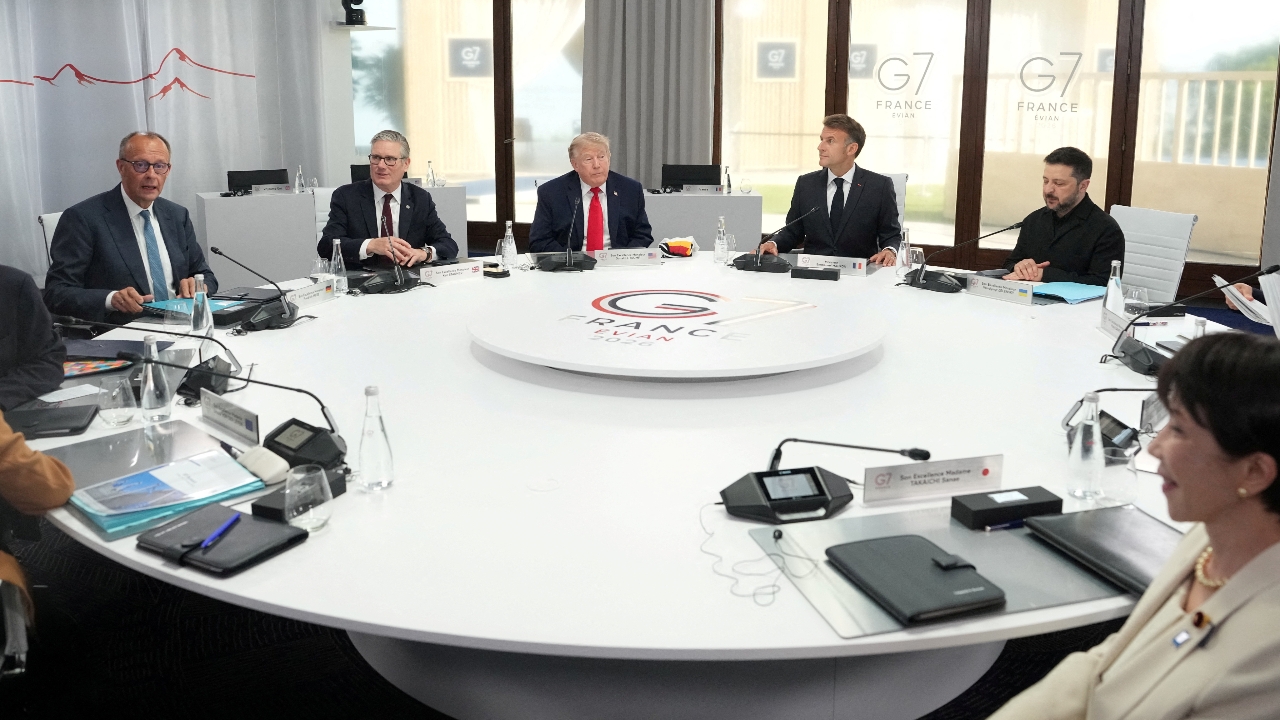
At the summit of the Group of Seven (G7) industrialized nations in France, leaders issued a joint statement reaffirming support for Ukraine's territorial sovereignty and agreed to increase pressure on Russia through additional measures. They also signaled backing for the US-Iran peace framework and planned discussions on critical mineral supply chains, economic competition, and artificial intelligence governance.
Progress at the 2026 G7 annual leaders' summit, held from 15-17 June in Évian-les-Bains, a lakeside resort town in France, culminated today (17 June) with a joint statement by G7 leaders expressing unified support for Ukraine, including its territorial integrity. They also agreed to intensify sanctions against Russia, reflecting Ukraine's strengthened bargaining position as it seeks peace negotiations with Russia.
This joint statement attracted special attention because previously, the team of US President Donald Trump often held uncompromising views with allies, especially regarding ending the Ukraine war. However, the statement follows Trump's key meeting on Tuesday with Ukrainian President Volodymyr Zelensky and other G7 leaders, which Trump described as positive and hopeful for an upcoming peace agreement. Zelensky revealed he might meet Trump again.
Furthermore, the G7's firm stance reflects Ukraine's significantly strengthened position after successfully launching drones deep into Russian territory, weakening Moscow's advantage in the political conflict.
G7 leaders also welcomed the preliminary US-Iran peace framework signed by President Trump just days before the summit, declaring their readiness to support its concrete implementation.
Meanwhile, the meeting agreed to cooperate in seeking and diversifying new energy delivery routes to reduce dependence on the strategically vital Strait of Hormuz and to accelerate increasing each country's energy reserves for future security.
On Wednesday, the core day of discussions hosted by France, the agenda focused on "critical and essential minerals" and global economic imbalances. Diplomats revealed that France is pushing allied countries to sign protective measures for key minerals to help Western nations reduce supply chain dependence on China and shield investors from retaliatory or market-distorting actions by Beijing.
This concern follows China's disruption of the global economy last year by restricting exports of "permanent magnets" made from rare earth minerals, nearly halting several advanced industries in the West. The incident exposed how Western energy, security, defense, and technology supply chains overly rely on China. Additionally, China has progressively tightened exports of specialized minerals and battery metals and restricted American companies' access to tungsten and antimony.
French presidential officials stated that the discussed measures include price support, market standards, subsidies, purchase guarantees, and expanding private sector investment in critical mineral supply chains outside China. However, despite the US proposing a "Critical Minerals Trade Alliance" earlier in 2026, many countries remain divided over operational frameworks, especially facing the White House's "America First" policies.
Regarding global economic imbalances, G7 leaders discussed restructuring world trade and addressing "predatory competition" led by China. France summarized this as "China produces too much, the US consumes too much, and Europe invests too little."
Europe is currently alarmed by China's record-high trade surplus and its advancement up the value chain into high-tech goods. Analysts warn this represents a second "China Shock," following China's earlier dominance in low-cost industries during the 2000s. Last year, the European Union faced its largest-ever trade deficit with China, exceeding 360 billion euros.
Although French President Emmanuel Macron attempted last-minute cooperation with China, Beijing outright rejected EU accusations of unfair subsidies and threatened strong retaliation against the revised "Buy European" regulations and technology sovereignty laws. The contentious use of trade defense measures to block Chinese imports will be hotly debated at the upcoming EU leaders' summit in Brussels on Thursday (18 June).
Additionally, during lunch, G7 leaders discussed artificial intelligence (AI) technology, focusing on legal liability for automation systems and tackling AI-driven fake news or misinformation. Reportedly, Sam Altman, founder of OpenAI, and Dario Amodei, CEO of Anthropic, participated in this special session.