

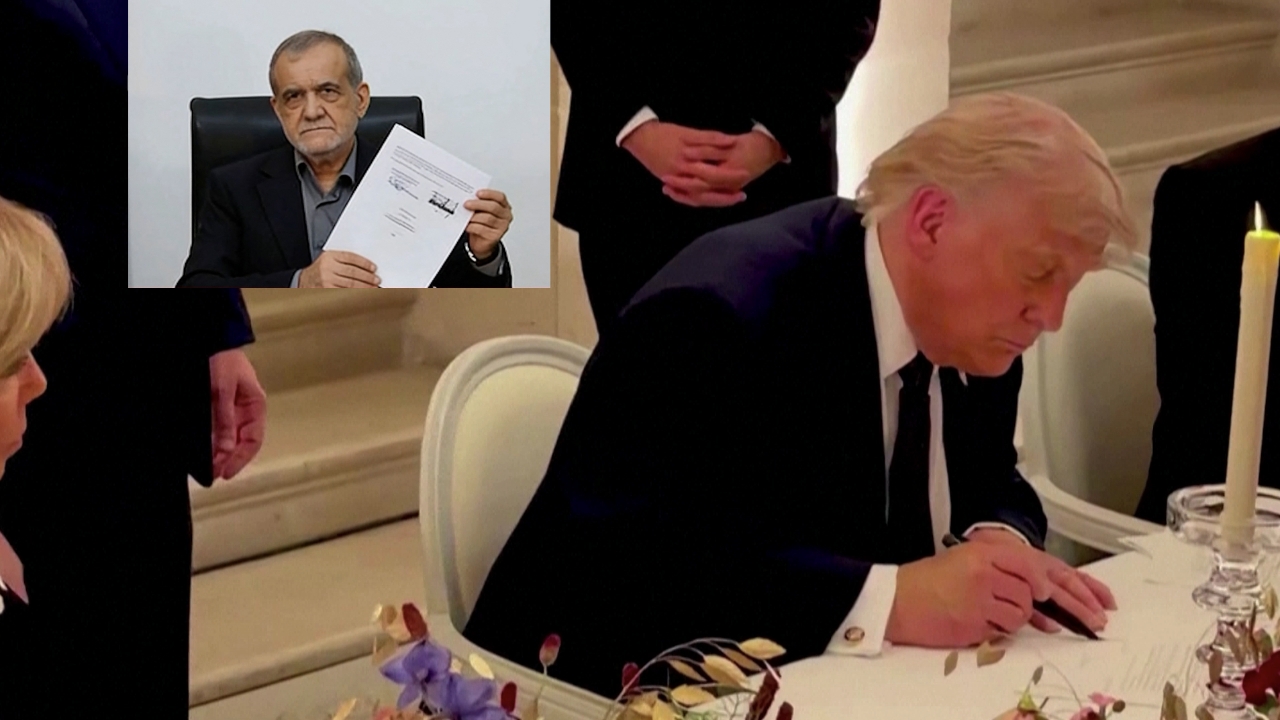
President Donald Trump and Iranian President Masoud Pezeshkian digitally signed an agreement to end the Middle East war at the Palace of Versailles, opening the way for full nuclear deal negotiations within 60 days. This allows Iran to reduce its enriched uranium stockpile in exchange for lifting sanctions, economic aid, and immediate opening of the Strait of Hormuz.
President Donald Trump of the United States and President Masoud Pezeshkian of Iran jointly signed a digital memorandum of understanding (MOU) to officially end the Middle East war, with Pakistan serving as mediator. This agreement is the first document signed by both countries' presidents since Iran's Islamic Revolution in 1979.
Reports state that Trump signed during a dinner at the Palace of Versailles, France, following the G7 summit, amid applause from French President Emmanuel Macron and other world leaders witnessing the event. Previously, the US had planned the official signing ceremony to take place in Switzerland on Friday, 19 Jun 2021 GMT+7.
Iranian Foreign Ministry spokesperson Esmail Baghaei expressed skepticism to IRIB news, saying that since both presidents have already signed, "there will be no signing ceremony held in Switzerland."
European leaders share US concerns about Iran's nuclear program but have never supported the US decision to wage war without United Nations approval. They worry Iran will gain leverage by resisting great power attacks and asserting control over the Strait of Hormuz.
Leaders of France, Germany, the UK, Japan, Italy, Canada, and the US jointly called for an immediate ceasefire in Lebanon. The agreement demands an end to fighting between Israel and the Iranian-backed Hezbollah, which has caused thousands of deaths and displaced over a million people.
The agreement, with a 60-day deadline, aims to end the war that erupted on 28 February after US and Israeli attacks on Iran escalated into a regional conflict. Key conditions include Iran immediately opening the strategically vital oil shipping route of the Strait of Hormuz without fees, while the US lifts its naval blockade of Iranian ports and suspends oil sanctions that have long damaged Iran's economy.
Additionally, Iran agreed to reduce the concentration of its high-grade uranium stockpile under International Atomic Energy Agency (IAEA) supervision, affirming it will not develop nuclear weapons. If a final deal is reached, the US will coordinate releasing $300 billion in post-war reconstruction funds, supported by regional countries, and will lift asset freezes on Iran.
Despite signing, President Donald Trump used stern language in a press conference, stating, "We will bomb them badly if they violate this agreement. I don't want to do that; I want them to keep their promises." He also backtracked on his earlier vow to destroy Iran's missile industry, saying, "If other countries can have missiles, it's unfair if Iran can't have some."
In the US legislature, Senator Bill Cassidy, a Republican aligned with Trump, harshly criticized the deal as the worst foreign policy failure in decades, arguing it fails to genuinely limit Iran's nuclear ambitions and shows that Iran's threats to close the Strait of Hormuz were effective.
Meanwhile, Mohammad Bagher Ghalibaf, Speaker of the Iranian Parliament and head of the negotiation team, praised the deal on national television as a great victory for Iran, stating, "Everything we tried to achieve through war, we have gained many times over through negotiation," since the Iranian government remains intact, uranium stockpiles were not seized, and missiles remain undestroyed.
The news caused Brent crude oil prices to fall below $80 per barrel, the lowest since the war began, before slightly rebounding after Trump issued renewed threats against Iran.
However, although the agreement includes a ceasefire in Lebanon, Israeli Prime Minister Benjamin Netanyahu distanced himself from the deal since Israel was not involved in negotiations. Consequently, the Israeli military continues airstrikes and artillery shelling in southern Lebanon, resulting in at least five deaths, while Hezbollah responded with kamikaze drone attacks injuring five Israeli soldiers.
Trump gently criticized Netanyahu in the media, saying, "Netanyahu is a good man, but sometimes a bit too eager. We have some differences regarding Lebanon. I told him, ‘BB, take it easy; you don’t need to demolish buildings every time Hezbollah members enter them.’"
Both sides will now begin complex technical negotiations over two months, aiming toward a permanent peace treaty.
Source: AFP /Reuters