

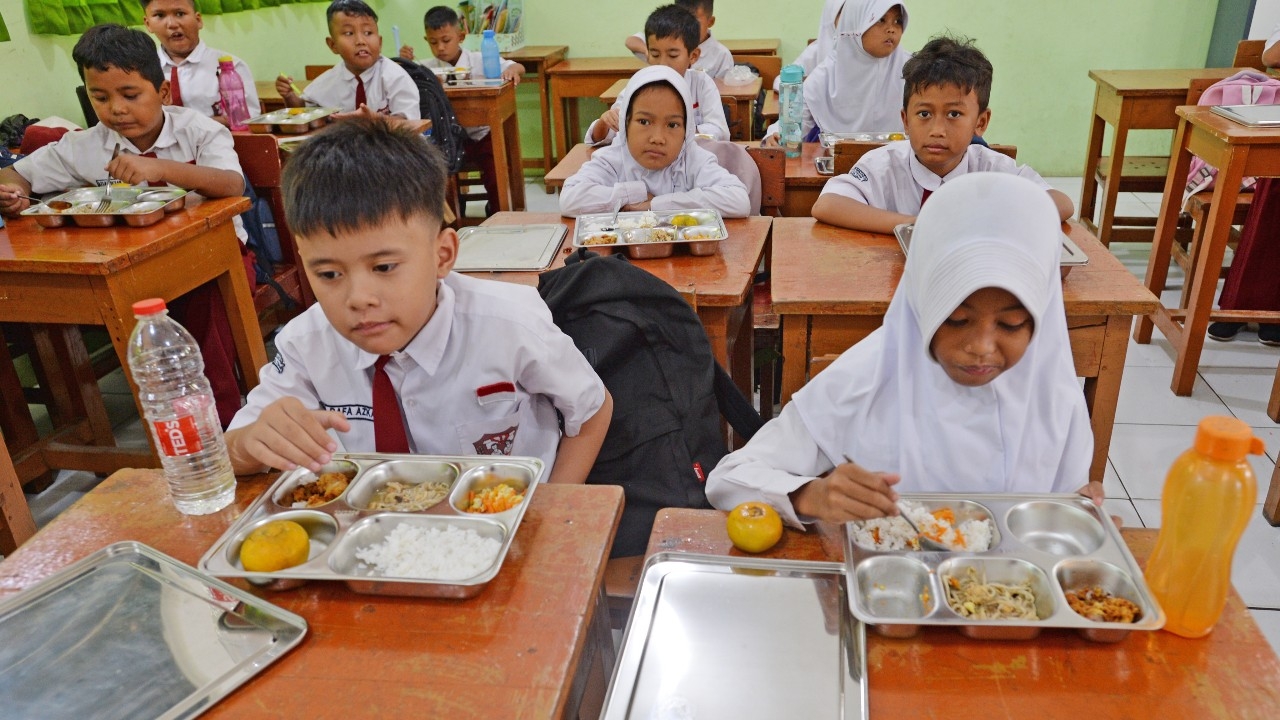
The Indonesian government announced the suspension of the free meal program for children during school holidays, along with a reduction in the program's scope, aiming to control public expenditure and improve budget allocation efficiency amid criticism over high costs, corruption, and calls for the government to address the economic slowdown.
Indonesia's National Nutrition Office issued a statement confirming the temporary suspension of the nationwide free meal distribution program for students during the school holiday period from 22 June to 13 July. This measure will also apply during public holidays, religious holidays, and future weekends, marking a change from previous years when meals were continuously provided even during school breaks.
Agustina Arumsari, Deputy Head and spokesperson for the National Nutrition Office, revealed that beyond suspending meals during holidays, the government will cease funding lunch programs at 76 schools serving about 39,000 students in economically advantaged areas. Resources will be redirected to assist students in remote, underserved regions. She described this move as an organizational reform to enhance efficiency and "ensure that state resources benefit those truly in need."
This program scale-down comes as the Indonesian government seeks to ease financial pressures caused by economic challenges and the Middle East conflict. The program's budget this year has been cut from 335 trillion rupiah to just 268 trillion rupiah.
Additionally, the office plans to propose further budget cuts for next year from the originally planned 270 trillion rupiah, considering it excessively high. The suspension of subsidies and benefits to central kitchens that close during school holidays is expected to save the state up to 3.4 trillion rupiah. Some central kitchens not meeting standards or with low service numbers may face closure in the future.
The free meal and milk distribution program is a key campaign promise of President Prabowo Subianto, targeting the care of over 82.9 million children and pregnant women—nearly one-third of the population—to address Indonesia's child stunting rate exceeding 20 percent. As of March, over 61 million people have benefited from the program.
However, since its launch in January last year, the program has faced heavy criticism due to its large budget overshadowing other development funds, incidents of mass food poisoning among students in several areas, and most recently corruption issues. Earlier this month, President Prabowo ordered the dismissal of Dadan Hindayana, head of the National Nutrition Office, along with two deputies, following charges of "criminal misconduct in organizational management."
Beyond internal issues, the policy sparked major protests in Jakarta last week, with hundreds gathering to demand its immediate cancellation, viewing it as wasteful spending amid worsening living costs and economic conditions. This recent scaling back and reorganization is an urgent government measure to reduce opposition and plug budget leaks.
,Reuters/ AFP