

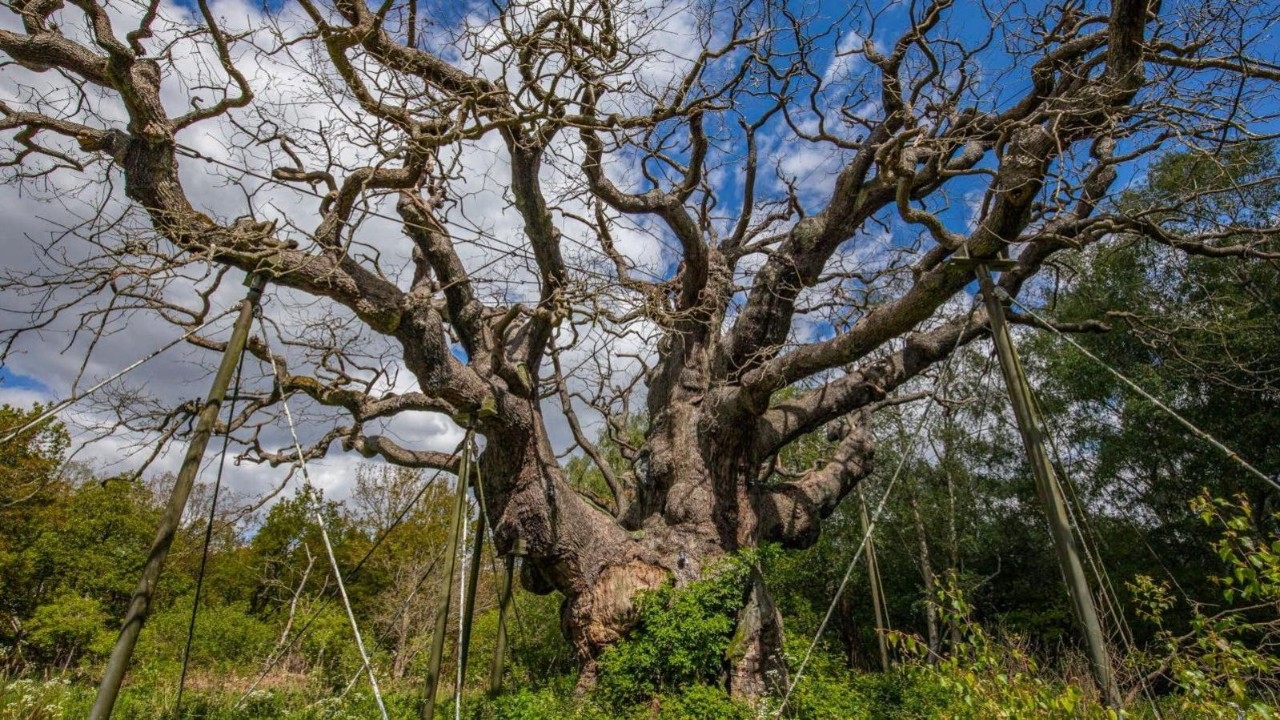
Experts have confirmed that the "Major Oak," a giant tree over 1,200 years old in Sherwood Forest, England, believed in legend to have been Robin Hood’s hiding place, has officially died after failing to sprout new leaves this spring. The cause is thought to be extreme weather from global warming, combined with soil around the base compacted by millions of tourists over two centuries, depriving the roots of oxygen and water.
The Royal Society for the Protection of Birds (RSPB), a UK conservation charity responsible for Sherwood Forest in Nottinghamshire, announced that the Major Oak, over 1,200 years old and one of the UK's most famous and important symbolic trees, has died. Botanical experts observed that this giant oak did not produce a single new leaf during this spring, a departure from previous years when, despite a noticeable decline in foliage, leaves were still present.
Holly Drake, a representative from the RSPB, said in a statement, “The tree’s failure to produce leaves this year is deeply upsetting for everyone.” Although rumors of the tree’s death surfaced during the winter of 2024, the organization maintained it was alive and made every effort to sustain it, including a special irrigation system to water the roots during the heatwave in June 2025.
While experts say it is difficult to pinpoint a single cause of death, it is believed to result from multiple factors, especially human activity. Over two centuries, millions of tourists have come to witness this wonder, whose trunk circumference measures 11 meters. Repeated trampling compacted the soil at the base, severely compressing the root system and preventing rainwater, nutrients, and oxygen from reaching the roots.
Additionally, past conservation efforts such as using supports and steel cables to brace large branches inadvertently interfered with the tree’s natural structure, causing long-term harm. The climate crisis, with recent heatwaves and severe droughts, further weakened this ancient oak, ultimately leading to its death.
According to 13th-century English folklore, Robin Hood, the noble outlaw who robbed from the rich to aid the poor, used a large hollow inside the Major Oak’s trunk as a hiding place from the Sheriff of Nottingham. Scientifically, this hollow was caused by fungal decay.
Originally known by several names, "Major" became the widely recognized name after Major Hayman Rooke, a former British Army officer, wrote about the tree in an oak-themed book in 1790. This sparked a tourism surge to Sherwood Forest. In the 1970s, authorities fenced off the tree to prevent tourists from climbing inside the hollow, allowing only distant admiration. Beyond its historical significance, oak wood from Sherwood Forest was once used to build Royal Navy warships during Admiral Horatio Nelson’s era and as roof beams in London’s St. Paul’s Cathedral.
Ed Pine from the Woodland Trust conservation group likened the Major Oak to the "white rhino of UK conservation," noting that such ancient trees often fall unnoticed. He emphasized that protecting them is crucial for the planet’s health.
However, the RSPB confirmed there will be no felling of the Major Oak. Its trunk and branches will remain standing in the heart of Sherwood Forest as a natural monument, allowing future generations to visit and remember the Robin Hood legend. Meanwhile, its lifeless trunk will continue to serve as habitat for wildlife and support the forest ecosystem. Importantly, saplings propagated from the Major Oak have already been planted worldwide to ensure this legendary tree’s lineage endures.