

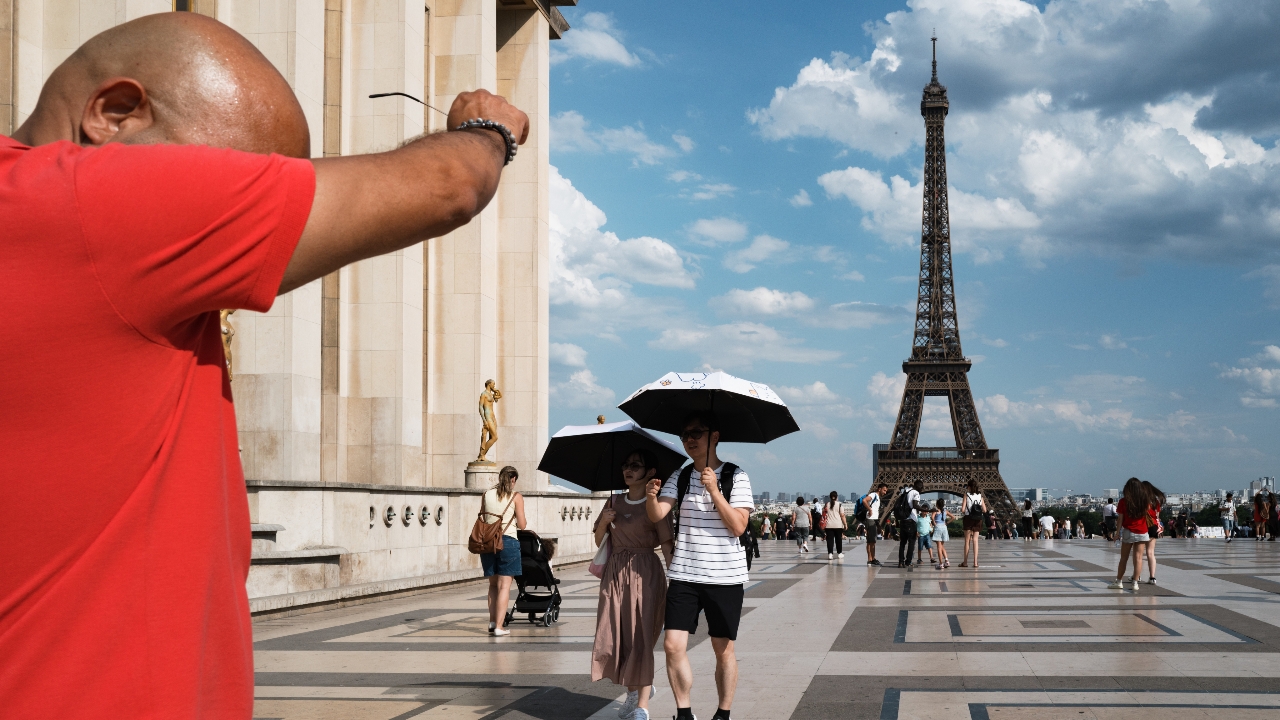
The French government has raised the heatwave alert to red in 35 areas and ordered a ban on the sale and consumption of alcohol in public during music festivals amid a severe heatwave affecting many regions, with temperatures in some places possibly reaching 41 degrees Celsius. Meanwhile, several European countries are rushing to address the impacts of extreme heat.
The intense heatwave is spreading across most of Europe, causing temperatures to soar close to record highs. In France, the government has issued a "red level" heatwave warning—the highest level—in 35 departments out of 96 nationwide, including Paris and the Burgundy region. Temperatures are forecast to reach 39-40 degrees Celsius, with some areas possibly hitting 41 degrees Celsius before peaking.
In response, Prime Minister Sébastien Lecornu has implemented proactive measures banning the sale and consumption of alcoholic beverages in public spaces, including at the national music festival "Fête de la Musique," held annually on the summer solstice—the day with the longest daylight hours—which attracts millions of people to the streets. In previous years, up to 2 million people participated in Paris alone.
The French Prime Minister's Office stated that the alcohol restrictions aim to maintain the stability of emergency services and the healthcare system, allowing medical personnel to focus fully on vulnerable groups such as the elderly and children. The prolonged heatwave has also severely disrupted transportation, leading to the cancellation of dozens of train services and temporary suspension of school classes. Paris authorities have ordered public parks and gardens to remain open 24 hours to provide residents and tourists with places to relax and cool down at night.
France's meteorological agency noted that it remains "uncertain" when the current heatwave will end and expects that about three-quarters of the country's population will be directly affected.
Neighboring European countries are facing similar challenges. Germany has issued a nationwide heat warning, with temperatures nearing 38 degrees Celsius. The German meteorological service warned that the combination of high heat and humidity could trigger severe thunderstorms.
In Italy, temperatures have climbed to 36-37 degrees Celsius, significantly impacting daily life and tourism. Tourists in Rome queued under the blazing sun outside the Colosseum, with some seeking refuge from the heat underground in the cooler remains of the Claudius Temple. In Bologna, residents gathered around the Neptune Fountain, splashing water on their faces to alleviate the heat.
In Spain, the Spanish Football Federation decided to close the fan zone at Plaza de Colón in Madrid, where large screens were set up for watching the World Cup match between Spain and Saudi Arabia, to ensure fan safety. As a result, fans dispersed to watch the match indoors. In contrast, players in Atlanta, USA, will compete in a stadium equipped with solar-powered air conditioning.
Scientists have explained that climate change is the primary factor causing more frequent and intense heatwaves in Europe, increasing risks of health emergencies and causing economic damage during the summer season.
Emmanuel Moulin, Governor of the Bank of France, warned of economic impacts, stating that although short-term effects on economic growth may be mixed due to reduced worker productivity offset by increased energy use, in the medium term, such severe heatwaves will inevitably act as a negative factor, slowing and pressuring the country's economic activities.