

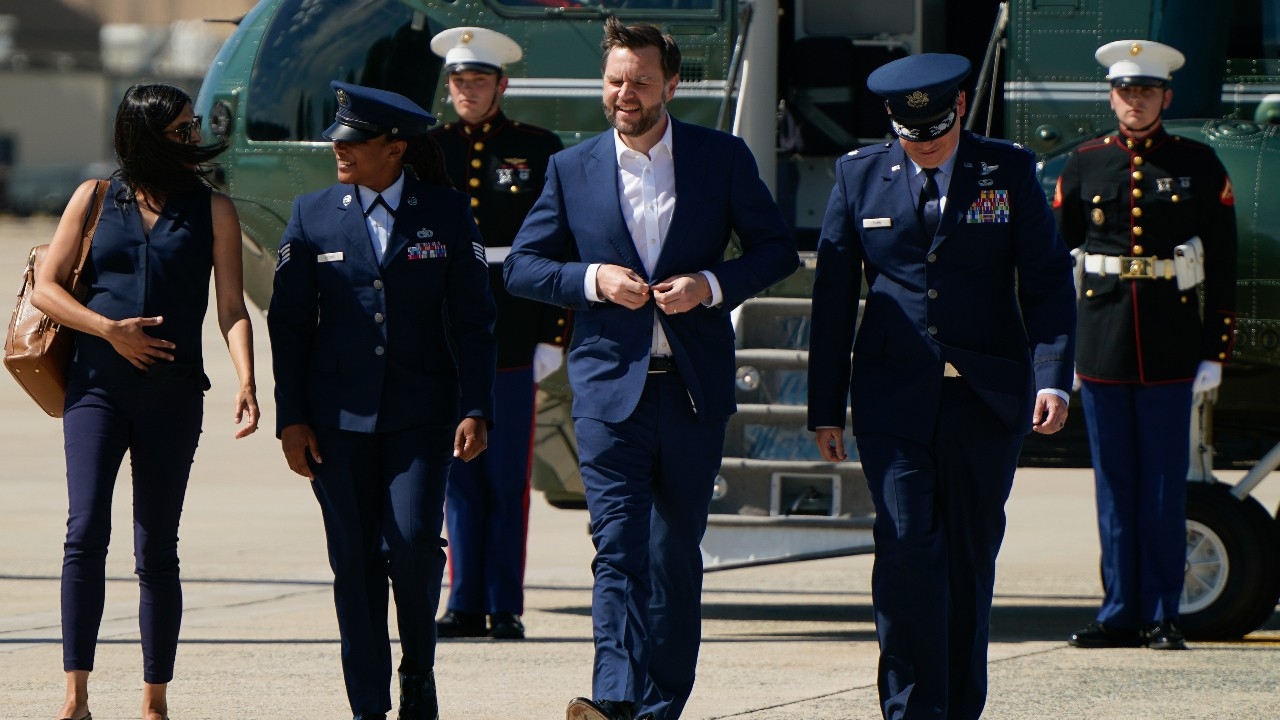
US Vice President J.D. Vance has arrived in Switzerland to officially open talks with Iran, aiming to push for a nuclear program limitation agreement and build on a temporary 60-day ceasefire, while the Middle East remains fragile due to clashes between Israel and Hezbollah and disputes over the Strait of Hormuz.
Vice President J.D. Vance arrived at Emmen Air Base near Lucerne, Switzerland, early Sunday morning (21 June) local time to participate in official talks with senior Iranian leaders, seeking an agreement to control Iran's nuclear program and extend the temporary ceasefire aimed at ending nearly four months of tension between the two countries.
Originally, Vance was scheduled to arrive at the luxury Bürgenstock Resort near Lucerne on Friday, but his trip was delayed due to renewed violent clashes in Lebanon, which initially caused the Iranian delegation to cancel their travel plans before ultimately deciding to send negotiators led by Mohammad Bagher Ghalibaf, Speaker of Parliament, and Foreign Minister Abbas Araghchi, along with senior officials from the Central Bank and Ministry of Oil.
The US negotiation team includes Vice President Vance, Special Envoy Steve Witkoff, and Jared Kushner, son-in-law of former President Donald Trump, who had already begun technical discussions with Iran. Pakistan, represented by Prime Minister Shehbaz Sharif and Army Commander General Asim Munir, together with Qatar, serve as mediators in the talks.
The atmosphere on the first day turned tense when Iran's Islamic Revolutionary Guard Corps (IRGC) announced it had "closed the Strait of Hormuz," a crucial oil and natural gas shipping route, citing Israeli military airstrikes against Hezbollah in Lebanon that killed 20 people in one day and accusing the US of failing to uphold 14 agreed conditions.
However, the US Central Command dismissed Iran's claim, confirming no evidence that the Strait of Hormuz was closed. On the previous Saturday, 55 commercial and oil tankers passed normally through the strait, transporting over 17 million barrels of crude oil to global markets. The US military remains deployed to ensure freedom of navigation.
President Donald Trump posted on social media warning Iran that no toll fees would be charged for passage through the Strait of Hormuz during the 60-day ceasefire. But if peace talks fail, the US might consider imposing fees as a "protection service charge" for countries in the Middle East.
The 60-day temporary agreement, signed by President Trump and Iranian President Masoud Pezeshkian, has drawn both support and criticism. It allows Iran to freely sell oil again and access billions in previously frozen assets in exchange for reducing its stockpile of highly enriched uranium.
The plan faces heavy criticism from hawkish US Republicans who see the deal as too lenient and akin to the Obama-era nuclear agreement that Trump had previously abandoned. A major issue is that neither Israel nor Hezbollah are signatories to the US-Iran agreement.
Israeli Prime Minister Benjamin Netanyahu declared he would maintain military forces in southern Lebanon until threats to Israel are completely eliminated, while Hezbollah launched over 50 missiles in response, vowing to prevent Israeli troop movements in Lebanese territory.
A recent Hebrew University survey found 92% of Israelis believe Iran benefits more from the conflict than Israel, with only 8% seeing Israel as victorious. This reflects internal political pressures in Israel that could complicate a lasting resolution to the Middle East crisis despite ongoing talks in Switzerland.