

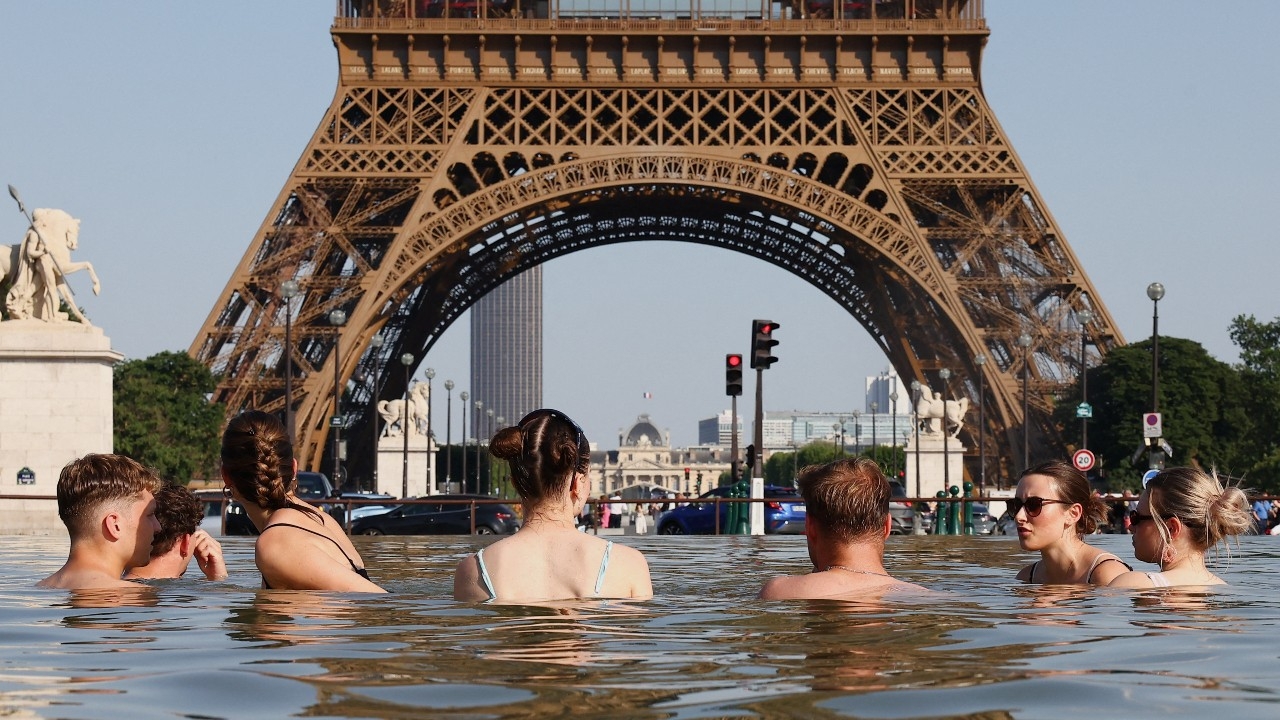
The heatwave devastating Europe has intensified to an extreme level. Recently, French authorities declared a "red alert" covering more than half the country, after average temperatures hit record highs for June. This led to over 20 deaths from unauthorized swimming attempts to cool off in just three days.
Marina Ferrari, France's Minister of Sports and Youth, revealed on France Inter radio on 23 June that the national drowning monitoring unit has reported approximately 20 deaths within three days since the heatwave began, though official numbers are still being compiled.
The National Meteorological Institute expanded the highest-level red alert to 54 departments, affecting over 39 million people, while another 35 departments were placed under orange alerts.
Preliminary reports show France's average day and night temperatures reached 29.2 degrees Celsius, breaking the previous June record set in 2025. In Bordeaux, temperatures soared to 43 degrees Celsius and Paris hit 39 degrees Celsius, prompting the government to temporarily close more than 1,350 schools after many students suffered severe heat-related illnesses, including vomiting and nausea, due to the intense heat inside classrooms.
One of the most concerning complications for the French government is the rising drowning death toll. Since Saturday, 20 June, at least 20 people have drowned, an increase from the 13 reported on 22 June, including teenagers and young children.
In Besançon, two 15-year-old boys drowned in the Doubs River, and in Seine-et-Marne, a 13-year-old girl disappeared in the Seine River; her family later stated she could not swim.
Ferrari said, "During extreme heat, swimming in areas without lifeguard supervision is not a trivial matter. We understand everyone wants to cool off, but please only swim in safe, supervised locations."
This issue ties into France's infrastructure crisis, as over 80% of public swimming pools are more than 25 years old, and over 10% of middle schools lack access to pools for teaching children to swim, due to local budget constraints, especially in rural areas. Additionally, the French Lifeguard Federation reports a shortage of 5,000 water rescue personnel nationwide.
Beyond water-related dangers, a tragic incident occurred in Carpentras, southern France, where rescuers found two young children, aged 2 and 4, unconscious with cardiac arrest inside a private car parked in a residential lot amid scorching heat. Despite rescue efforts, the children did not survive. The cause is believed to be heat buildup in the vehicle during the heatwave. The children's mother is in shock and receiving close medical care.
French Prime Minister Sébastien Lecornu held an emergency meeting to prepare maximum response measures. Several departments have put rescue helicopters on standby, coordinated firefighters to patrol high-risk areas, and arranged mobile cooling equipment to assist the public.
This crisis is not limited to France; neighboring Germany reported five drowning deaths during the past weekend.
In Spain, temperatures in Madrid and Córdoba reached 40 degrees Celsius. Tourist areas became deserted, prompting the capital's municipality to establish "climate shelters" providing water, food, and refuge for homeless and vulnerable people to escape the extreme heat.
The UK Meteorological Office upgraded its warning to "red," the highest level for extreme heat, for the second time in the country's history. The alert covers central and southern England, including London and Birmingham, with indoor temperatures expected to reach 40 degrees Celsius. This forced many schools to close early and rail companies to cancel or reschedule services to ensure safety and protect infrastructure.
Scientists and climate experts from the University of Reading confirm that the increasing frequency and record-breaking nature of heatwaves clearly reflect human-driven climate change. This has caused the atmosphere to retain more heat than in the past, leading to more severe, prolonged, and dangerous weather conditions for Europe in the future.