

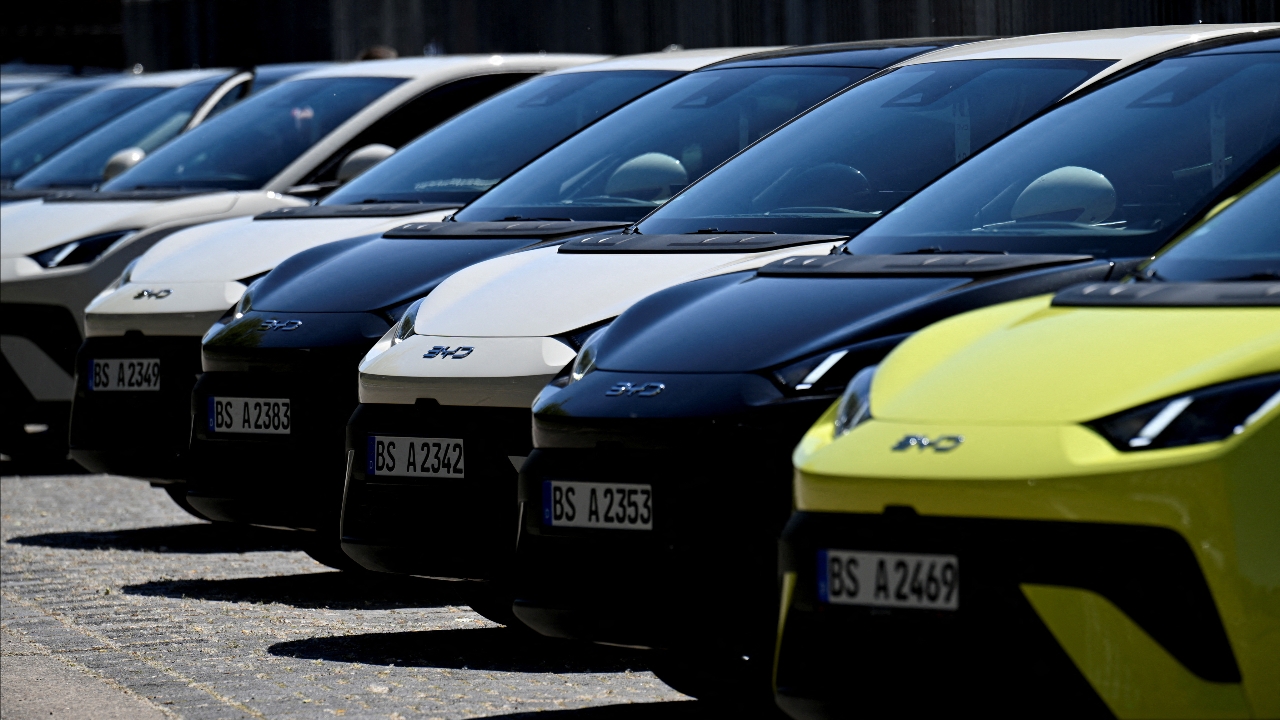
The global automotive industry is undergoing a major transformation as Chinese electric vehicle manufacturers, led by BYD, rapidly expand worldwide, increasing pressure on automakers from Japan, Germany, and the United States.
Throughout the 2000s and 2010s, the global car market was dominated by a few major manufacturers such as Toyota, Volkswagen, Honda, and Ford, while Chinese producers had yet to emerge as global automotive leaders. At that time, Tesla was still a relatively small player in the market.
However, the rapid growth of the Chinese market has reshaped the global automotive industry in the 2020s. Although Toyota and Volkswagen Group remain the largest car manufacturers worldwide, Chinese electric vehicle makers, particularly BYD, are continuously capturing global market share.
The disruption caused by the transition to the electric vehicle era has begun to affect many major automakers.
For example, Honda Motor reported an operating loss of about 400 billion yen (approximately 2.55 billion U.S. dollars) in its latest fiscal year, marking its first loss in nearly 70 years.
Meanwhile, Nissan announced in May 2025 plans to close several factories and cut around 20,000 jobs worldwide following declining sales in the U.S. and China, later adding a further 900 job cuts in Europe.
In Singapore, the change is even more apparent, with BYD surpassing Toyota to become the top-selling car brand in the country in 2025.
An analysis of Singapore's automotive market data over the past 12 years shows that mainstream brands such as Toyota, Honda, Nissan, and Mazda have experienced a continuous decline in market share from 2016 to 2025, while new electric vehicle brands have seen dramatic growth.
BYD increased its market share from 2.5% in 2022 to 21.2% in 2025, while Tesla grew from 2% in 2021 to 6.6% in 2025.
Professor Martin Kriswidzinski, director of the Weizenbaum Institute in Berlin, said the transition to electric vehicles has opened a window of opportunity for new entrants to enter the market.
He believes that traditional manufacturers have underestimated the speed of change, especially the rapid development of Chinese companies' vehicles, which has outpaced expectations.
Experts note that a key factor driving the success of Chinese EV manufacturers is their early and substantial investment in electric vehicle technologies.
Tesla pioneered battery innovation and the concept of Software-Defined Vehicles, cars driven by software, which transformed consumer expectations for modern vehicles.
Chinese companies then followed this path, supported by government industrial policies, including developing charging infrastructure, subsidizing EV buyers, and supporting battery manufacturers and parts suppliers.
While China has invested heavily to build large production capacities, Europe and the U.S. have invested less in EV infrastructure, resulting in a slower transition to electric vehicles.
Additionally, many traditional automakers continue to focus on developing internal combustion engines and have underestimated the potential of the Chinese market.
Professor Stefan Bratzel, director of the Center of Automotive Management in Germany, said many established automakers have chosen gradual business model adjustments and have undervalued the importance of electric technology, software, and digital platforms. This has led to slow, overly cautious responses and products that lack competitive pricing and technology.
Will the success of Chinese EVs be sustainable?
Despite rapid growth, experts see ongoing challenges ahead for Chinese electric vehicles.
Dr. Terrence Van from the Singapore Management University noted that Chinese brands currently expanding abroad are survivors of intense domestic competition.
He explained that succeeding in China, one of the world's most competitive markets, increases the likelihood of success in other countries.
However, Professor Kriswidzinski warned that many Chinese EV makers compete by selling vehicles with very low profit margins to maintain market share, a business model that may not be sustainable long-term.
Another concern is the resale value of Chinese EVs, which remains low compared to established brands with longstanding reputations and reliability.
Toyota and Honda Still Believe in the Future of Hybrid Vehicles
Although electric vehicles continue to grow, many major automakers maintain diverse strategies rather than focusing solely on EVs. Borneo Motors, Toyota's distributor in Singapore, revealed it will continue a multi-pathway approach, offering various types of vehicles simultaneously.
In the first five months of 2026, Toyota registered 2,708 new hybrid vehicles, 45 electric vehicles, and 95 gasoline-powered cars.
Honda registered 325 gasoline-powered vehicles and 737 hybrids during the same period, with no electric vehicle sales reported.
Honda executives stated that many consumers remain satisfied with internal combustion engine vehicles and view this as possibly the last opportunity before many countries phase out gasoline car sales in the future.
While mass-market brands have lost market share, luxury automakers have maintained their customer bases relatively well.
BMW's market share in Singapore increased from 6.2% in 2015 to 9.7% in 2025, while Mercedes-Benz remained stable at around 9%.
BMW and Mercedes-Benz executives believe the key strengths of luxury brands lie in the ownership experience, brand image, and value, which cannot be built quickly.
However, analysts warn that as countries increasingly adopt policies aimed at full electric vehicle adoption, luxury brands will also face competition in the EV market.
Experts view the growth of Chinese EV manufacturers not as a temporary trend but as a structural shift in the global automotive industry. Therefore, the crucial future question is not just who will sell the most cars, but which manufacturers can successfully transition from automakers to providers of technology and mobility solutions. In the electric vehicle era, the advantage lies not only in the engine but in effectively integrating technology, software, production costs, and customer relationships.
Source:channelnewsasia
Click to read related newsInternational news