

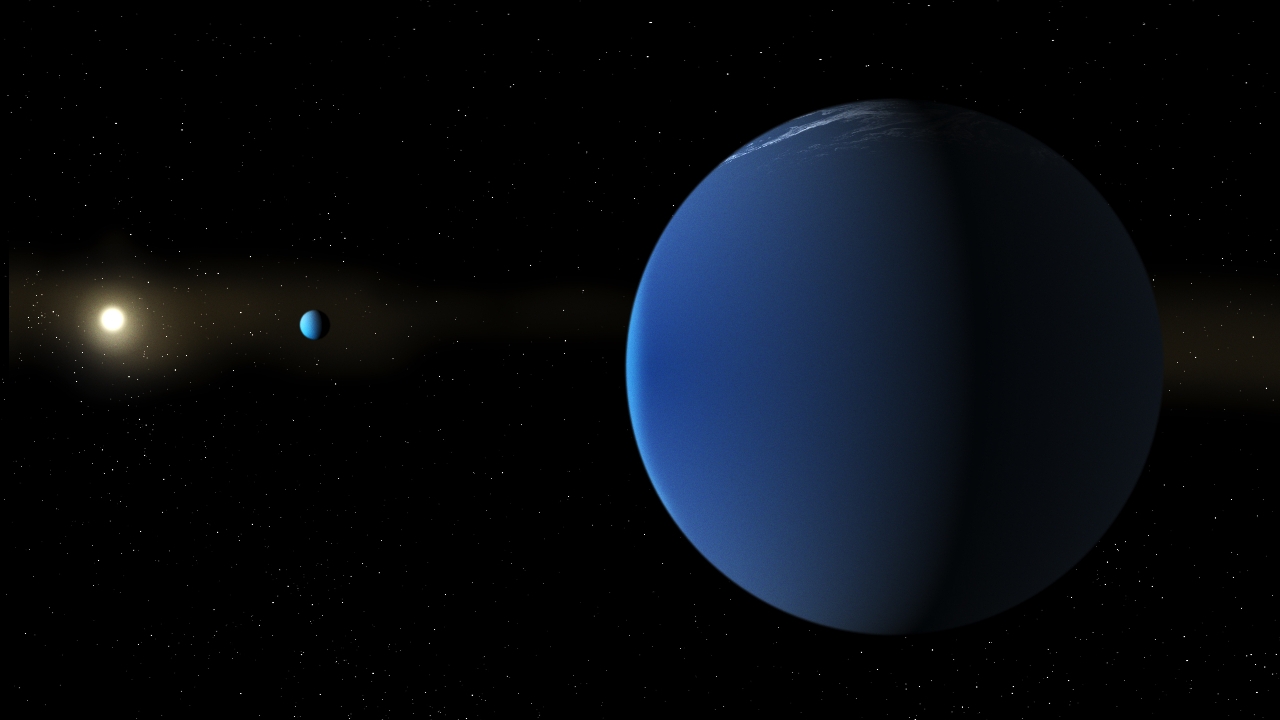
Astronomers have discovered two giant exoplanets with remarkable features. Although their sizes are close to Jupiter's, their densities are so low they have been dubbed giant planets as light as clouds.
These two planets orbit a star approximately 1,110 light-years away from Earth. They were found by NASA's TESS exoplanet survey satellite, which has been searching for exoplanets for several years. These are the largest planets ever found with sizes comparable to Jupiter but with densities lower than silk or cotton, about 35 times less dense than Jupiter.
George Dransfield, a researcher from Oxford University and head of the research team, revealed that both planets have densities similar to shaving foam freshly sprayed from a can. The study was published in the scientific journal Monthly Notices of the Royal Astronomical Society last Wednesday.
Scientists believe these planets are mainly composed of hydrogen and helium gases and may appear white or blue, depending on the cloud conditions in their atmospheres, rather than pink as the nickname 'silk' might suggest.
However, researchers still require additional observations from NASA's James Webb Space Telescope to confirm their true chemical compositions.
Both planets orbit a star in the constellation Volans, known as the 'Flying Fish' constellation in the southern hemisphere. Researchers used ground-based telescopes to analyze their orbits and calculate their densities at a distance of over 1,110 light-years (one light-year is nearly 9.7 trillion kilometers).
Currently, NASA has confirmed nearly 6,300 exoplanets, but fewer than 40 of these are classified as 'super-puff' planets, making them extremely rare celestial objects in the universe.
Scientists believe these planets formed within the gas and dust disks around newborn stars, where gas greatly exceeds dust. Over time, some material was lost, leaving planets with unusually low densities.
Dransfield stated that studying these rare planets will help scientists better understand planet formation mechanisms and may complete important pieces of the puzzle regarding the origin of the solar system and humanity's place in the vast universe.
. Source:AP
Click to read related news aboutInternational news