

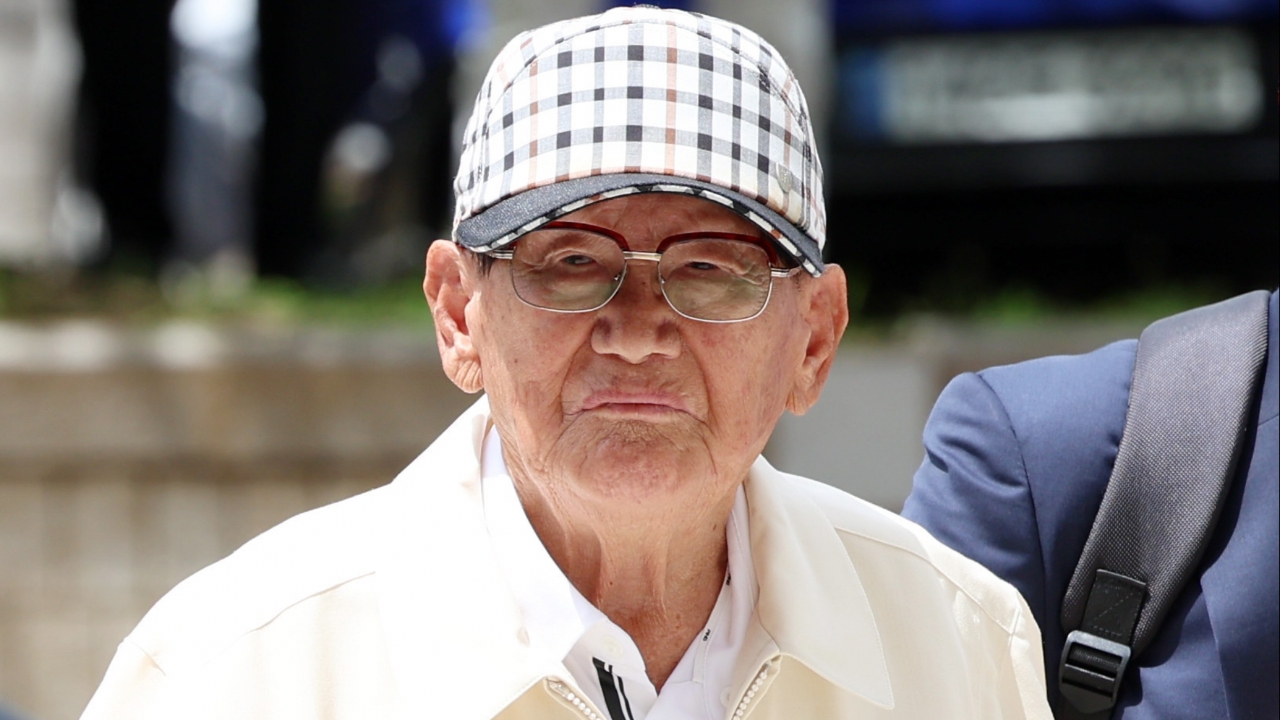
South Korea has ordered the arrest of Lee Man-hee, the 95-year-old founder of the Shincheonji sect, on charges of violating political party laws. He is accused of orchestrating the mobilization of tens of thousands of followers to join the People Power Party to interfere in the candidate selection process, aiming to benefit the conservative political faction and former President Yoon Suk-yeol.
The Seoul Central District Court approved an arrest warrant for Lee Man-hee, 95, founder and leader of the Shincheonji sect, on charges of election interference and violating political party laws, which prohibit religious organizations from involving themselves in politics. The court justified the warrant late at night due to a high risk that the suspect might destroy evidence.
On Wednesday afternoon (24 Jun), before the court issued its order, Lee Man-hee, who appeared frail, using a cane and supported by church officials, attended a hearing on the arrest warrant request. He refused to answer any questions from the media. On Thursday morning, the Shincheonji Church issued a statement expressing deep regret over the arrest, noting that their leader has cooperated fully with investigations and expressing concern over Lee's health and advanced age.
Investigators stated that Lee Man-hee is suspected of directing, through the church's branch network, pressure and mobilization of more than 50,000 followers to join the conservative People Power Party (PPP) between 2021 and 2024.
This move aimed to interfere with and influence the party's internal primary elections, including presidential and parliamentary candidate selections. The main goal was to support former President Yoon Suk-yeol in exchange for Shincheonji receiving benefits and protection from the government, including approval of permits to expand church buildings and facilities.
This arrest of Shincheonji's leader is part of a broader investigation since January led by prosecutors and a special police team under the current administration of President Lee Jae-myung. The focus is on rooting out improper relationships between religious groups and politicians, including cases involving the Unification Church.
A few months earlier, Hak Ja Han, the supreme leader of the Unification Church and widow of founder Sun Myung Moon, was arrested and charged with ordering church officials to bribe the wife of Yoon Suk-yeol and conservative politicians to secure business favors. In April, an appellate court sentenced Kim Kun-hee, Yoon's wife, to four years in prison on multiple charges, including accepting luxury gifts from officials of that sect.
Former President Yoon Suk-yeol was impeached in April 2025 after declaring a short-term martial law in December 2024 and was arrested in July 2025. He is currently serving a life sentence for rebellion and an additional 30-year sentence for ordering drone flights over North Korean airspace to escalate tensions and justify martial law. He is presently appealing the verdict.
Shincheonji was founded in 1984 by Lee Man-hee; its name means "New Heaven and New Earth." The sect claims about 200,000 followers. Lee claims to be the messenger of Jesus or the "Pastor of the Covenant." Mainstream Christian groups often label it a cult with brainwashing tactics. Shincheonji gained global attention in 2020 as a COVID-19 outbreak center in South Korea, with over half of infections linked to its followers. However, Lee was cleared of public health violations in 2021.
The Unification Church was founded in 1954 by the late Sun Myung Moon, who claimed to be the Messiah. It is currently led by his widow, Hak Ja Han. The sect has a global network with millions of followers and vast business interests. It is widely known for mass wedding ceremonies uniting thousands of couples, mostly young people from different countries matched by the church.